The revenue leak is not just after hours
After-hours calls are visible because no one is at the desk. Overcapacity is harder to see because it happens while the team is technically open: staff are on another call, handling a customer in person, chasing documents, resolving a support issue, or trying to call back yesterday's list.
In both cases the buyer experiences the same thing: no useful answer now. If the call was about booking, pricing basics, support, a quote, an urgent issue, a callback, a reschedule, or a current-customer concern, the delay can become an opportunity-cost problem.
- After-hours calls that become voicemail
- Daytime overflow calls while staff are busy
- Missed callbacks that are never returned while intent is active
More details
- Support or scheduling questions that block a booking
- Quote, estimate, demo, and appointment records that wait too long
Use 30%+ as a stress test, not a universal claim
The right way to use the 30%+ number is as an opportunity-cost stress test. It asks what happens if roughly a third of revenue-relevant demand is missed, delayed, abandoned, or never followed up while buyer intent is active.
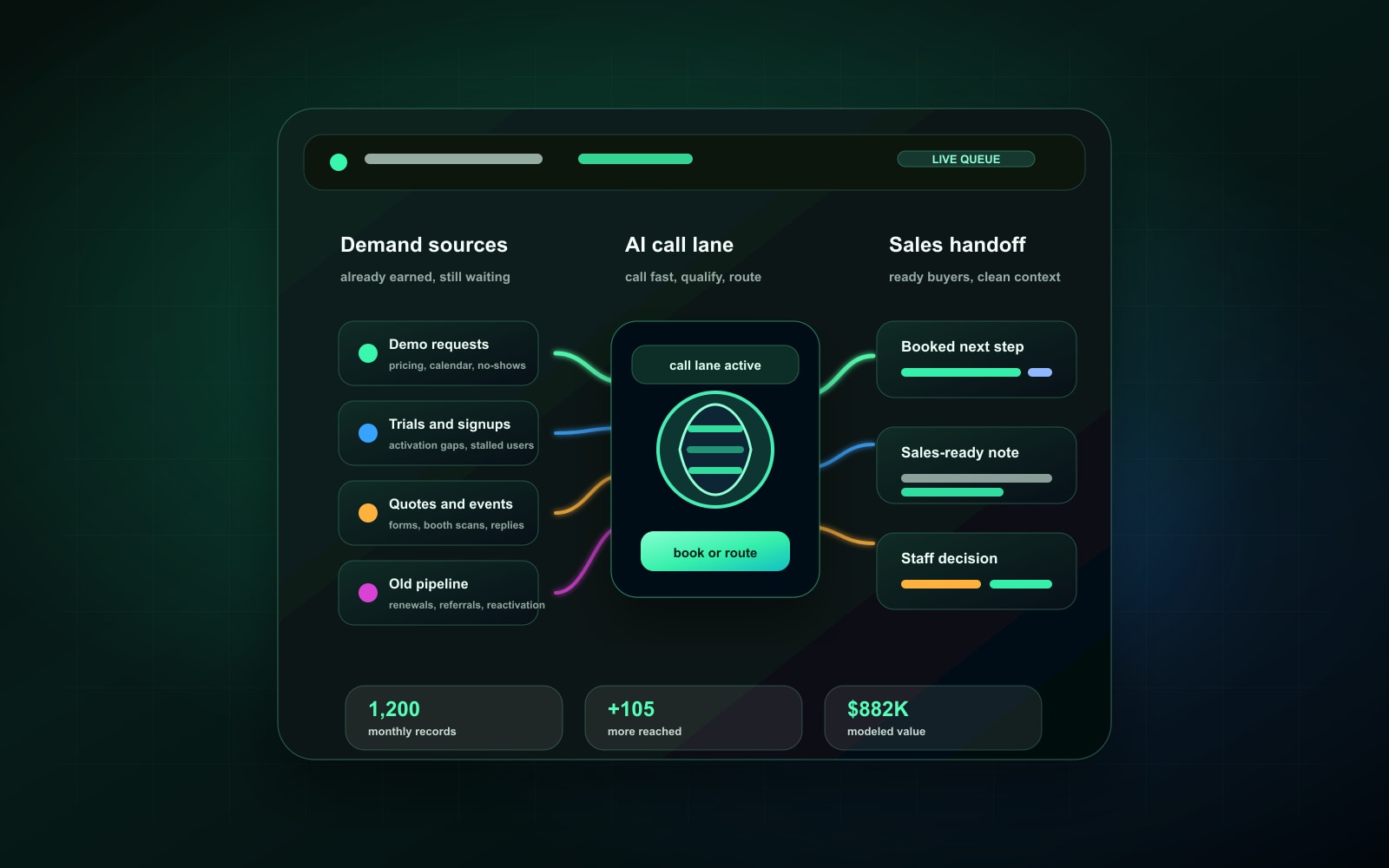
For planning, 900 monthly calls and follow-up records x 42 percent revenue-relevant intent x 30 percent opportunity-cost gap x $420 weighted value equals about 113 protected next steps and $47,628 in monthly modeled opportunity. The business should replace those inputs with real call logs and revenue data before making a forecast.
- Do not call it guaranteed lost revenue.
- Call it an opportunity-cost model until real call logs prove the number.
- Segment after-hours, overflow, missed calls, callbacks, support, quote, appointment, and follow-up demand separately.
- Measure booked, routed, recovered, retained, or staff-ready outcomes after launch.
AI coverage should protect the first useful answer
Inbound AI and approved outbound follow up solve different pieces of the same problem. Inbound AI answers the call when the team is unavailable. Outbound AI follows up on approved records that still need a response.
The first useful answer is not a script dump. It captures intent, answers approved basics, books what is ready, records opt-outs, and routes staff-only questions with context.
- Book routine appointments, estimates, demos, tours, consults, or callbacks when the path is approved.
- Answer approved basics such as hours, location, routing, scheduling windows, document needs, or next-step instructions.
- Collect missing context before staff calls back.
- Escalate urgent, sensitive, regulated, pricing, clinical, legal, coverage, safety, or judgment-heavy questions.
The highest-value lanes to inspect first
Start where the gap is easiest to prove. Pull call logs by hour, source, answer status, voicemail, callback timing, booking result, and staff capacity. Then pick one lane where better coverage could plausibly protect bookings or retention.
For local services, that may be after-hours emergency and estimate calls. For healthcare, it may be appointment requests, referral callbacks, cancellations, and refill routing. For home care or property management, it may be current-client, family, resident, owner, vendor, or urgent concern calls. For SaaS or B2B services, it may be demo, trial, quote, and event follow up.
- After-hours booking and urgent-call coverage
- Daytime overflow and missed-call recovery
- Quote, estimate, demo, and event follow-up queues
More details
- Current-customer support and retention-sensitive callbacks
- No-show rebooking, appointment changes, waitlist fills, and schedule recovery
Make the source proof visible before launch
After-hours and overcapacity coverage works best when the business can show why the AI employee should answer, call back, book, or route the record. The proof should be visible before volume expands so staff can trust the first lane and buyers do not hear a generic script.
Use the same Source, Gate, Value, and Owner receipt on every lane: the demand source that created the call or callback, the rules that decide what AI may do, the protected next step being measured, and the human owner for exceptions.
- Source: live call, voicemail, missed call, form, quote request, demo request, appointment change, support question, event reply, resident update, or stale callback.
- Gate: approved answers, opt-out path, permanent suppression check, staff-only topics, contact window, sender limit, and escalation rule.
- Value: booked appointment, routed answer, recovered callback, quote review, retained customer, protected follow-up record, or staff-ready handoff.
- Owner: the operator, scheduler, producer, seller, manager, clinician, licensed staff member, or service lead who owns judgment-heavy decisions.
What to measure in the first 30 days
The first month should produce a cleaner operating picture even before the business has a perfect attribution model. The goal is to prove whether AI coverage protects useful next steps and reduces loose ends.
Track answered calls, missed-call recovery, after-hours share, overflow share, booked next steps, routed staff handoffs, opt-outs, abandoned calls, callback speed, support resolution path, staff-only exception rate, and actual value after staff completes the human-owned work.
- Calls answered while staff were unavailable
- Voicemails avoided and missed calls recovered
- Booked appointments, estimates, demos, tours, consults, quote reviews, or callbacks
More details
- Staff-ready handoffs with source, context, urgency, owner, and next step
- Opt-outs, low-fit filters, and sensitive questions routed to people