Speed matters because intent has a short shelf life
When someone calls, submits a demo request, asks for a quote, registers for an event, requests an estimate, no-shows, or starts a trial, the business has a narrow window where the buyer still remembers the problem and expects a useful next step.
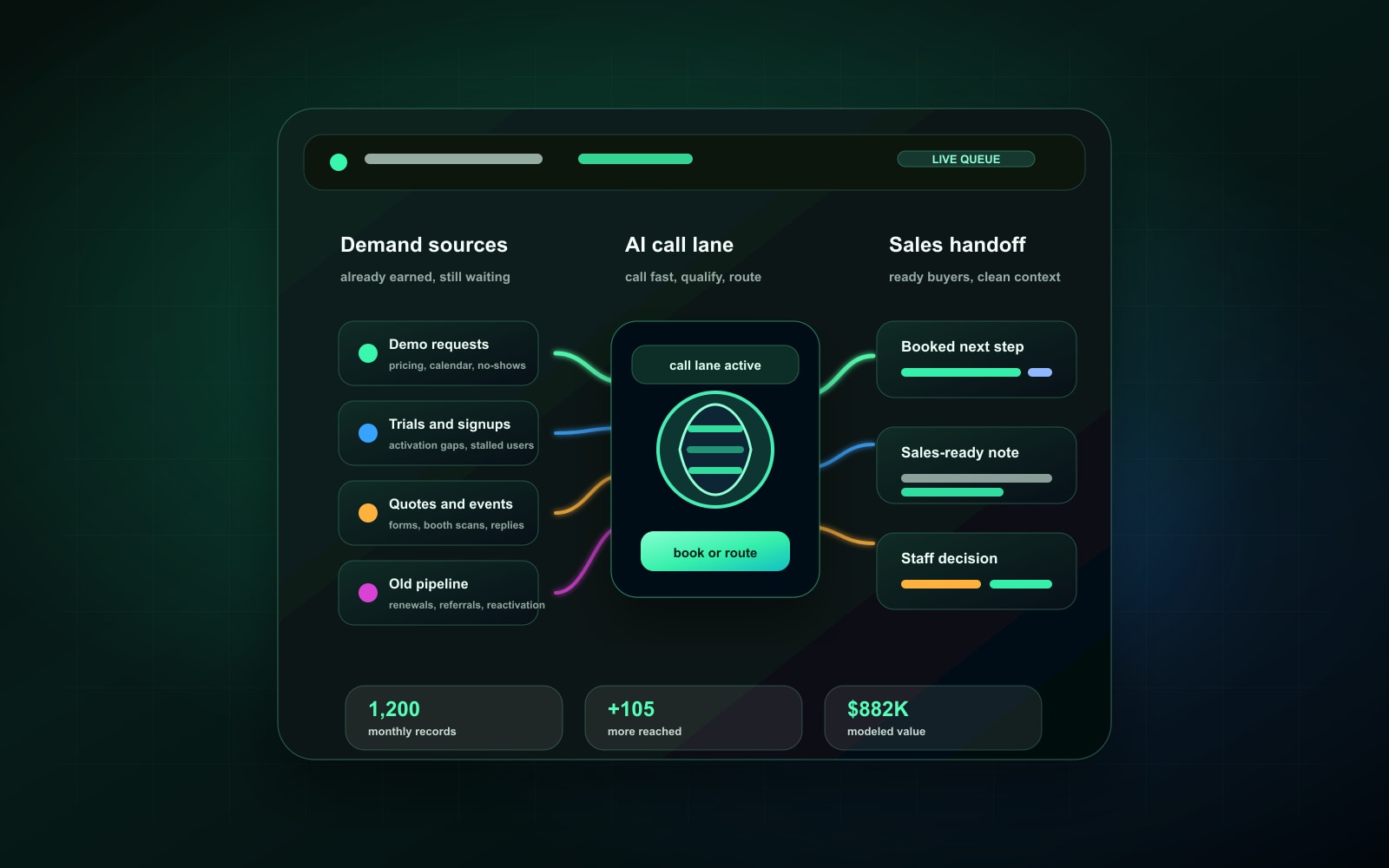
That is why speed to lead should be treated as a conversion system, not a dashboard stat. The point is not to be the fastest interruption. The point is to reach the buyer while intent is still specific enough to capture, qualify, book, route, or hand off.
- Inbound AI answers live calls before they become voicemail.
- Outbound AI follows up on approved buyer signals before the list cools.
- Staff keeps pricing, approvals, advice, negotiation, regulated decisions, and closing.
- The first metric is protected next steps, not raw attempts.
A fast response still has to feel earned
The highest-converting follow up starts with the buyer's own signal. A demo request, quote form, referral, event registration, missed call, appointment change, trial signup, or prior conversation gives the caller a reason to accept the response.
The call should make that reason clear, collect only the facts needed for the next step, and stop cleanly when the buyer opts out, the source is unclear, or the question belongs to staff.
- Name the source: call, form, demo, quote, event, referral, trial, estimate, renewal, or prior callback.
- Move one step: book, rebook, qualify, collect missing context, or summarize for staff.
- Avoid overreaching: no promises, pressure, advice, pricing exceptions, legal answers, clinical answers, or licensed decisions.
- Record the ending: booked, routed, opt out, wrong fit, staff-only, or no answer.
Make the speed proof visible before the first lane scales
Speed-to-lead AI should not launch from a vague promise to respond faster. It should show the source record, the allowed response path, the protected next step, and the staff owner before more volume is added.
Use the same Source, Gate, Value, and Owner receipt that supports the broader call plan. That keeps the speed claim tied to a real buyer action and a human-owned boundary instead of turning fast follow up into generic outreach.
- Source: demo request, quote form, missed call, event reply, trial signal, referral, appointment request, estimate request, no-show, pricing click, or prior callback.
- Gate: opt-out status, permanent suppression, source age, allowed opener, approved answer list, contact window, sender limit, and staff-only stop line.
- Value: booked meeting, quote review, estimate, consult, appointment, rebooked no-show, recovered callback, or staff-ready next step.
- Owner: the seller, producer, scheduler, estimator, clinician, manager, agent, or operator who keeps pricing, advice, approval, regulated, negotiation, and closing decisions.
Use conversion math that operators can trust
The practical model starts with monthly buyer signals, filters for still-qualified intent, estimates a lift from faster response and cleaner handoffs, then assigns a conservative value to the protected next step.
For planning, 1,000 monthly buyer signals x 36 percent still-qualified intent x 22 percent lift x $550 weighted next-step value equals about 79 protected next steps and $43,560 in monthly modeled value. That is not guaranteed revenue. It is a way to decide whether one speed-to-lead lane deserves a test.
After launch, replace the model with real source data: response time, answer rate, connect rate, qualification rate, booked-next-step rate, show rate, opt-outs, staff-review rate, close rate, and actual value.
Where speed-to-lead AI works best
Speed-to-lead AI is strongest when the next step is known and the human bottleneck is response capacity. That can be an inbound call that needs scheduling, a missed call that needs recovery, or an approved outbound follow-up list with clear source context.
It is weaker when the business cannot explain why the buyer should be contacted, does not have an opt-out path, or expects AI to make judgment-heavy decisions that staff should own.
- Demo requests, pricing clicks, trials, and no-show meetings
- Quote forms, estimate requests, policy reviews, and proposal callbacks
- Event registrants, attendees, no-shows, booth scans, and sponsor inquiries
More details
- Appointment requests, referral callbacks, waitlist openings, and scheduling changes
- Home-service missed calls, project photos, and stale estimate callbacks
- Real estate portal leads, open-house visitors, valuation forms, and showing requests
Build the first lane before buying more demand
Many teams try to solve slow conversion by buying more traffic. The better first move is often protecting the demand they already created. If a business pays for calls, forms, events, ads, referrals, or content, response speed becomes part of the cost of acquisition.
Start with one lane. Define the buyer source, allowed answers, qualification fields, opt-out handling, suppression gate, staff owner, handoff destination, and the metric that proves the call helped.
- Choose the source with the clearest buyer intent.
- Write the opener from the buyer's action, not a generic pitch.
- Keep the first form short enough to complete while the buyer is still engaged.
- Measure booked next steps and staff-ready handoffs before expanding volume.