AI For Emergency Dentist Calls

Answer urgent calls fast

140 calls per month modeled
+17 more conversions per month
$84,672 annual upside modeled

iando.ai answers tooth-pain, swelling, broken-tooth, after-hours, and same-day dental calls 24/7 so urgent callers hear a calm first response, get routed by your rules, and leave staff with useful context.

Built for dental offices where the first answer needs to lower anxiety, capture urgency, avoid clinical advice, and create a believable appointment, escalation, or callback path.

Built around the jobs your phone has to do: answer, schedule, route, handle approved Q&A, and recover missed-call revenue.

  • 24/7 first answer for severe pain, swelling, broken teeth, and urgent dental calls
  • Caller status, symptoms described by the patient, timing, photos, and callback needs captured
  • Same-day, after-hours, existing-patient, and new-patient paths separated
  • Practice-approved language only; no diagnosis, treatment advice, or unsafe promises
Revenue Lift 24/7
Monthly revenue upside

Edit call volume, buyer intent, 25% lift, and average emergency visit value.

$7,056/mo
+17 recovered urgent dental visits/mo
90-day guarantee: book 20% more business or your money back.
Run your numbers
140 calls/mo, 48% intent, 25% lift 24/7 coverage captures the calls that happen after hours, during peaks, and while staff are busy.
$420 average emergency visit value Average revenue per converted booking, job, consult, or appointment.
$84,672/yr Annualized upside from recovered appointment conversions.

Planning model only. Replace with call logs, same-day capacity, new-patient share, emergency exam fee, procedure mix, callback speed, and actual collected first-visit value.

Industry ROI

The business case for emergency dentist call teams

Start with the calls the business already earned, then estimate which ones can become appointments, jobs, consults, or useful follow-ups.

Emergency dental call recovery
The business case starts with urgent callers who need reassurance and a clear next step before they call another office.

For emergency dentist calls, ROI is recovered same-day visits, new-patient intake, after-hours demand, treatment-plan follow-up, and front-desk time protected by cleaner call summaries.

Missed calls x bookable intent x average appointment value x recovery rate
  • Monthly severe-pain, swelling, broken-tooth, and after-hours dental calls
  • Same-day visit or urgent callback share of those calls
  • Average emergency exam, treatment, or first-visit value
  • A conservative 25% lift from immediate answering and cleaner routing
What to recover first
Prioritize the calls with direct revenue or schedule impact.
  • Severe-pain, swelling, broken-tooth, and after-hours calls answered immediately
  • Same-day visit, existing-patient, new-patient, and callback paths separated
  • Clinical advice avoided while staff get cleaner urgency context
  • Recovered urgent visits modeled against real call logs and first-visit value
Where Revenue Leaks

What missed calls actually look like for emergency dentist call teams

These are the moments where demand slips away because the team is already busy serving customers, patients, or active jobs.

Pain and swelling callers are anxious

A caller describing severe tooth pain, facial swelling, a broken tooth, or a child in discomfort wants a calm next step before office hours or schedule availability even come up.

After-hours voicemail loses urgent demand

Emergency dental searches often happen at night, on weekends, and between appointment blocks. If no one answers, the caller keeps looking for an office that sounds ready.

Clinical guardrails matter

Urgent dental calls can involve infection concern, trauma, bleeding, medication questions, pregnancy, medical history, or emergency-room questions. The answer must route, not diagnose.

Proof And Context

What public data says about this buying behavior

Every stat references a public source below, so the revenue argument stays grounded instead of padded with invented benchmarks.

Daily
emergency time is often reserved in dental schedules 1

MouthHealthy notes that most dentists reserve time in daily schedules for emergency patients, making fast call capture commercially and operationally important.

Guardrails
matter for dental pain and swelling calls 23

Dental pain, swelling, fever concern, trauma, and medication questions should route to approved clinical judgment instead of AI diagnosis or treatment advice.

$420
planning value for emergency dental first visits 4

Use local collections data to replace this conservative model value across emergency exams, imaging, fillings, extractions, crown repair, root-canal starts, and first appointments.

Why This Industry Is Different

Emergency Dentist Call Teams need phone coverage built around their actual calls

The phone experience should match how the business earns trust, books revenue, and routes exceptions.

The first answer lowers panic

A fast answer can gather the reason for the call, reassure the caller that the practice has a next-step process, and preserve urgency for staff without pretending to make a clinical decision.

Same-day demand is perishable

Emergency dental callers usually need help now or soon. The office that captures contact details, timing, patient status, and urgency first has a better chance of earning the visit.

Better summaries protect staff time

Front-desk and clinical teams should not have to restart every urgent call from zero. The callback should begin with what the caller already reported and what path the practice allows.

How It Works

How iando.ai handles these calls

The best first layer is fast answer, clear qualification, then booking or escalation based on your operating rules.

01

Answer and classify the dental concern

iando.ai identifies tooth pain, swelling, broken or knocked-out tooth, crown or filling issue, bleeding, post-op concern, pediatric concern, new-patient request, or existing-patient callback.

02

Capture the intake details staff need

It gathers caller role, patient status, timing, location, described symptoms, photos if the practice requests them, medication-allergy notes if volunteered, and whether the caller is already a patient.

03

Route the next step by practice rules

Same-day, after-hours, emergency-room, doctor callback, schedule request, and next-business-day paths follow approved language without diagnosis, treatment advice, or fake ETA certainty.

Calls It Handles

Calls iando.ai can answer, route, or recover

These conversations are the highest-leverage starting point because they connect directly to revenue, schedule protection, or staff capacity.

Severe tooth-pain calls

Adults or parents calling about intense pain, sensitivity, broken restorations, pressure, or inability to sleep.

Outcome: Capture urgency and route into the approved same-day or callback path.

Swelling and infection-concern calls

Callers describing facial swelling, gum swelling, fever concern, bad taste, drainage, or worsening symptoms in their own words.

Outcome: Escalate according to practice rules without giving diagnosis or medication advice.

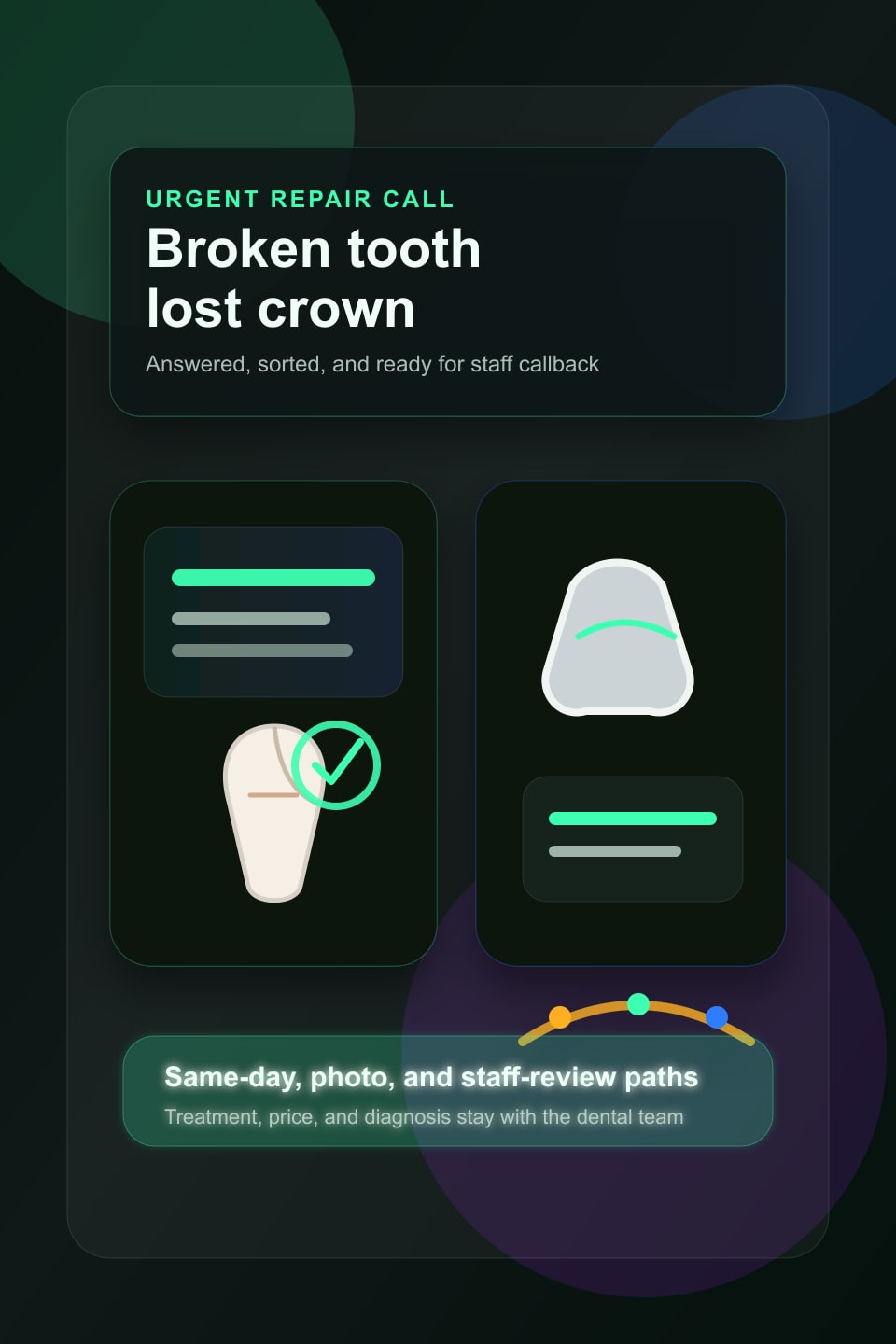
Broken tooth, crown, or filling calls

New or existing patients reporting a cracked tooth, lost crown, broken filling, trauma, or cosmetic emergency before work or an event.

Outcome: Collect timing, photos, pain level, and visit intent for a cleaner appointment path.

After-hours new-patient calls

Search-driven callers who are not established patients but need to know if the office can help and what happens next.

Outcome: Keep the lead from going cold while preserving office-approved emergency boundaries.

Outcomes

What operators actually care about

More same-day visit opportunities captured

Urgent callers get an immediate answer, a structured intake path, and a practice-approved next step before they call the next emergency dentist result.

Cleaner escalation for sensitive calls

Swelling, trauma, bleeding, fever concern, medication questions, and post-op concerns are routed by rule instead of improvised by voicemail.

Less front-desk overload

Staff receive a useful summary with caller details, patient status, timing, and described issue instead of a bare missed number.

Recovered Value

Where the payoff shows up operationally

  • Severe-pain, swelling, broken-tooth, and after-hours calls answered immediately
  • Same-day visit, existing-patient, new-patient, and callback paths separated
  • Clinical advice avoided while staff get cleaner urgency context
  • Recovered urgent visits modeled against real call logs and first-visit value
Before And After

How the operation changes when the phone stops leaking revenue

Before

A swelling or severe-pain call hits voicemail while the caller keeps searching.

After

The call is answered, documented, and routed into same-day, callback, or emergency instructions.

Before

Staff call back without knowing patient status, timing, symptoms, or whether photos exist.

After

The summary gives staff the context needed to respond without starting over.

Before

After-hours messages make urgent dental demand feel generic.

After

The caller hears a dental-specific intake path that stays inside approved guardrails.

Before

New-patient emergency calls mix with routine scheduling traffic.

After

Urgent demand is classified separately from hygiene, billing, and routine appointment calls.

Operator Questions

Questions before putting AI on the phone

Dental emergencies require clinical judgment

Correct. The AI should not diagnose, recommend medication, or decide treatment. It should capture the caller's words and route according to the practice's approved rules.

We need to protect doctor time after hours

The call path can separate existing patients, new-patient inquiries, swelling language, trauma, post-op concerns, and non-urgent scheduling so the right callbacks rise first.

Some patients need emergency-room language

That language should be practice-approved. iando.ai can deliver the approved instruction for life-threatening or out-of-scope situations while documenting the call.

Recover Missed Revenue

Turn more calls into booked revenue for emergency dentist call teams.

iando.ai is built for businesses that depend on the phone and lose money when callers do not get a fast, useful answer. Book a demo and map the call plan to your call volume, hours, and booking logic.

FAQ

Frequently asked questions

Can AI answer emergency dentist calls safely?

Yes, when it is limited to approved intake and routing. It should not diagnose, recommend medication, or tell a caller what treatment they need.

What happens with swelling or severe pain?

The call path captures what the caller reports, flags the concern according to practice rules, and routes to the approved same-day, after-hours, callback, or emergency instruction path.

Can it handle new patients after hours?

Yes. It can capture contact details, timing, described concern, insurance or availability basics if approved, and the next callback or booking step.

Why make an emergency dentist page separate from a general dental page?

Because severe-pain and swelling callers search differently. They care about speed, reassurance, same-day availability, and whether the office sounds prepared.

Supporting Guides

Deeper articles for emergency dentist call teams

Each guide supports the ICP landing page with practical, search-focused depth around staffing, routing, conversion, and operational efficiency.

Severe-pain calls are won by the first calm answer

Emergency dental callers need a calm first answer, not a generic voicemail. The right call path captures urgency, avoids clinical advice, and gives staff a cleaner next step.

Read article

Worried-parent calls need fast routing, not casual advice

Pediatric urgent care callers need fast, calm routing. The ROI is recovered same-shift visits, cleaner intake notes, and safer boundaries for parent questions that should never be diagnosed by a phone assistant.

Read article
Sources

Research behind this page

These references support the phone-demand, local-search, and response-speed claims above.

1. Dental Emergencies

MouthHealthy / American Dental Association • Accessed 2026-04-28

ADA patient guidance explaining what to do for dental emergencies, including toothaches, cracked teeth, knocked-out teeth, swelling, and the importance of contacting a dentist or emergency room promptly.

Open source
2. Antibiotics for Dental Pain and Swelling Guideline

American Dental Association • Accessed 2026-04-28

ADA evidence-based guideline page for urgent management of pulpal- and periapical-related dental pain and intraoral swelling, emphasizing professional evaluation and guideline-based treatment decisions.

Open source
3. Odontogenic Orofacial Space Infections

NCBI Bookshelf / StatPearls • 2023 • Accessed 2026-04-28

Clinical reference describing odontogenic infections, possible spread into facial spaces, and the importance of dental or medical evaluation for infection-related symptoms.

Open source
4. Dental Exam and Procedure Costs

CareCredit • Accessed 2026-04-28

CareCredit dental procedure cost guide covering common exam, filling, extraction, crown, root canal, and other dental procedure cost ranges that can inform conservative first-visit value modeling.

Open source
5. Emergency Patient Treatment

American Dental Association • Accessed 2026-04-28

ADA practice-management guidance stating that dentists must be available for patients of record when emergencies occur and that staff should be trained in basic triage and after-hours emergency handling.

Open source
6. Phone Calls from Prospective Patients

American Dental Association • 2026 • Accessed 2026-03-31

ADA patient-intake guidance for dental practices covering answer speed, phone scripts, emergency handling, and first-appointment call flows.

Open source
7. 5 Strategies to Fix Your Call Answer Rate and Stop Losing Revenue

Invoca • 2025-08-18 • Accessed 2026-03-31

Invoca analysis showing live answer-rate benchmarks across industries and calling behavior for high-stakes purchases.

Open source
8. Consumer Search Behavior: Where Are Your Customers?

BrightLocal • 2025 • Accessed 2026-03-31

Survey of 1,000 US consumers about general and local search behavior, maps usage, and business information expectations.

Open source