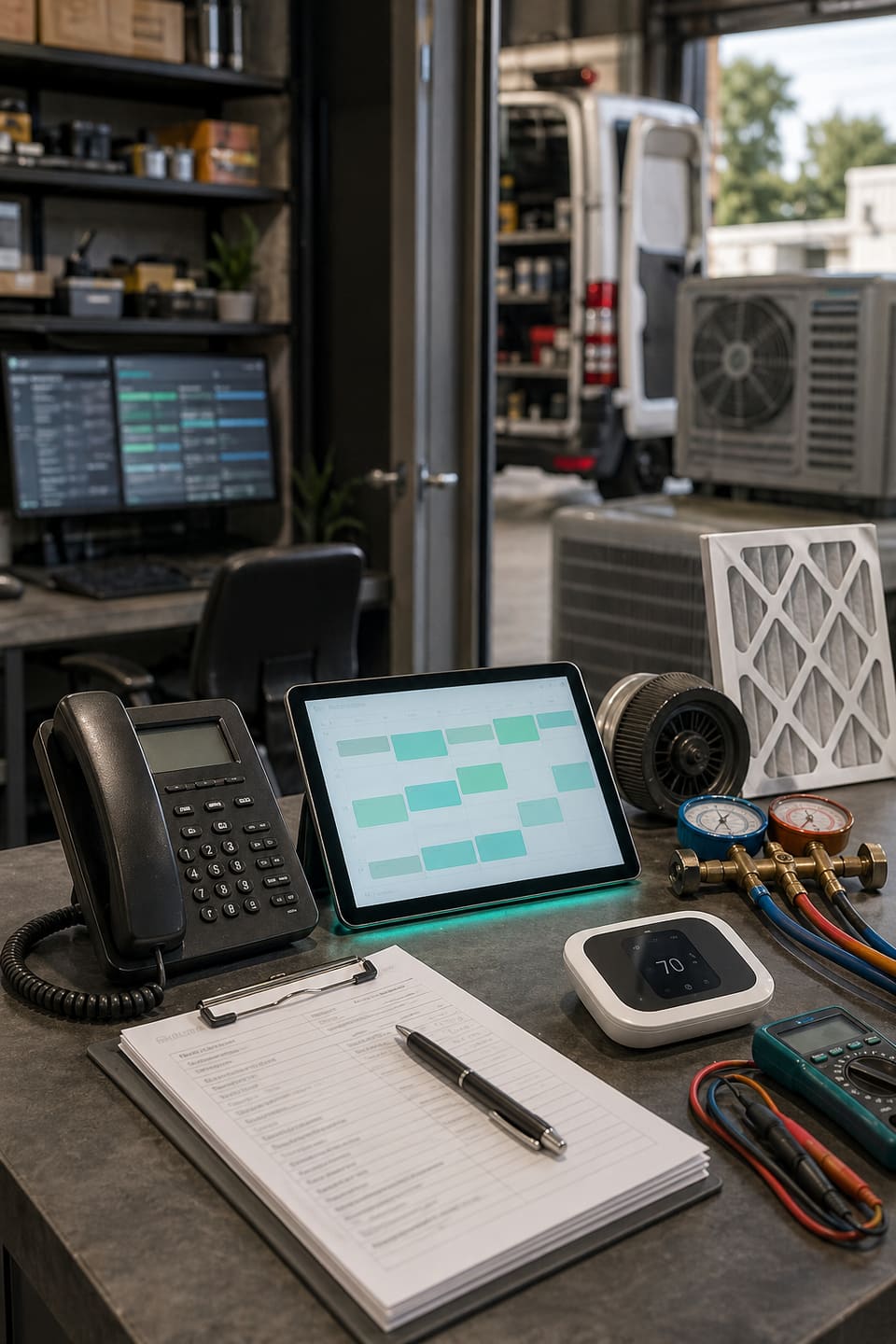
AI Answering Service For HVAC

Capture no-heat, no-cool, and estimate calls before they call the next contractor

420 calls per month modeled
+36 more conversions per month
$278,460 annual upside modeled

iando.ai answers inbound HVAC calls when techs are on jobs, the office is overwhelmed, or it is after hours. It handles emergency intake, scheduling, estimate requests, service-area questions, and call routing so high-intent homeowners do not hit voicemail.

Built for contractors competing on speed during peak season: no-heat mornings, no-AC afternoons, maintenance-plan scheduling, replacement estimates, and warranty questions.

Built around the jobs your phone has to do: answer, schedule, route, handle approved Q&A, and recover missed-call revenue.

  • After-hours and peak-season call coverage
  • Emergency intake for no-heat/no-cool scenarios
  • Scheduling + rescheduling without office interruption
  • Estimate-request capture and clean callback summaries
Revenue Lift 24/7
Monthly revenue upside

Edit call volume, buyer intent, 25% lift, and average job value.

$23,205/mo
+36 service + install jobs/mo
90-day guarantee: book 20% more business or your money back.
Run your numbers
420 calls/mo, 34% intent, 25% lift 24/7 coverage captures the calls that happen after hours, during peaks, and while staff are busy.
$650 average job value Average revenue per converted booking, job, consult, or appointment.
$278,460/yr Annualized upside from recovered appointment conversions.

Planning model only. Replace with your call logs, emergency mix, booked-call rate, and average invoice by job type (service vs replacement).

Industry ROI

The business case for hvac contractors

Start with the calls the business already earned, then estimate which ones can become appointments, jobs, consults, or useful follow-ups.

Emergency + estimate capture
HVAC ROI is won in the first two minutes: answer fast, qualify the job, and route it correctly.

For HVAC contractors, the phone is where comfort emergencies and high-ticket replacements turn into booked work. Miss a call and the homeowner keeps dialing until someone answers.

Missed calls x bookable intent x average appointment value x recovery rate
  • Missed calls during peak-season overflow and after hours
  • Emergency share (no heat / no cool / safety concerns)
  • Average invoice value for service calls and replacements
  • Recovered booking rate from immediate AI intake and routing
What to recover first
Prioritize the calls with direct revenue or schedule impact.
  • Capture more no-heat/no-cool calls before the homeowner books the next contractor.
  • Recover replacement-estimate requests that would otherwise hit voicemail.
  • Reduce repeat calls by answering common questions immediately.
  • Give dispatch structured context so follow-up turns into scheduled work.
Where Revenue Leaks

What missed calls actually look like for hvac contractors

These are the moments where demand slips away because the team is already busy serving customers, patients, or active jobs.

Peak-season calls arrive when nobody can answer

When every tech is on a job and the office is buried, the phone becomes a queue. Homeowners with no heat or no AC keep calling until someone answers.

Emergency calls and estimate calls get mixed together

A no-cool call, a maintenance-plan reschedule, and a replacement estimate should not land in the same generic voicemail path. The first win is classification and routing.

After-hours demand is real demand

HVAC problems do not wait for office hours. If the caller cannot get a next step, they book whoever answers first.

Proof And Context

What public data says about this buying behavior

Every stat references a public source below, so the revenue argument stays grounded instead of padded with invented benchmarks.

88%
of U.S. homes have air conditioning 1

For HVAC contractors, cooling demand is mainstream, seasonal, and often urgent when comfort fails.

52%
of household energy consumption went to space heating + air conditioning (2020) 2

Heating and cooling are not niche line items; they dominate home energy use and drive steady service and replacement demand.

61%
of business calls are answered by a live person across industries 3

A broad benchmark for what buyers experience when they call businesses today.

Why This Industry Is Different

HVAC Contractors need phone coverage built around their actual calls

The phone experience should match how the business earns trust, books revenue, and routes exceptions.

Speed is a competitive advantage in HVAC

In stressful comfort scenarios, response time is the product. Answering immediately keeps intent warm and prevents shopping.

A clean intake protects dispatch and customer experience

Gather the job type, urgency, location, system symptoms, and contact details up front so callbacks turn into booked work, not back-and-forth.

Local SEO only pays off if calls convert

HVAC contractors spend heavily on local search. The conversion point is still the phone, especially for emergencies and replacement quotes.

How It Works

How iando.ai handles these calls

The best first layer is fast answer, clear qualification, then booking or escalation based on your operating rules.

01

Answer and classify the call immediately

iando.ai identifies whether the caller needs emergency service (no heat/no cool), routine service, a replacement estimate, or a billing/warranty answer.

02

Collect job details that dispatch can use

It captures symptoms, equipment type, location/service area, timing, and any escalation signals you define so the handoff is actionable.

03

Schedule, route, or create a clean callback

Bookable calls move toward the calendar. Urgent calls route to the right on-call path. Everything else produces a structured summary for fast follow-up.

Calls It Handles

Calls iando.ai can answer, route, or recover

These conversations are the highest-leverage starting point because they connect directly to revenue, schedule protection, or staff capacity.

No-heat and no-cool service calls

Urgent comfort problems, system not turning on, weak airflow, frozen coils, or repeat shutdowns that demand a fast next step.

Outcome: Classify urgency and move the caller into the right dispatch or on-call call path.

Replacement and upgrade estimates

Furnace/AC/heat-pump replacement inquiries, sizing questions, and quote requests driven by seasonal demand and rising energy costs.

Outcome: Capture property context and schedule an estimate or callback with the details your team needs.

Maintenance plan and seasonal tune-up scheduling

Filter questions, tune-up bookings, membership plans, and reschedules that spike before hot and cold seasons.

Outcome: Keep routine scheduling moving without clogging dispatch lines.

Warranty, financing, and service-area questions

Coverage, basic policies, hours, service radius, and next steps when the caller is comparing contractors.

Outcome: Answer common questions and keep the caller on a clear booking path.

Outcomes

What operators actually care about

Book more emergency work without staffing the phone 24/7

Immediate intake keeps callers from bouncing, even when the office is closed or overwhelmed.

Turn estimate calls into scheduled appointments

Replacement intent is high-ticket. Capturing details and scheduling the next step fast protects that revenue.

Reduce office interruptions during peak season

Routine calls stop colliding with dispatch and invoicing while the phone still stays covered.

Recovered Value

Where the payoff shows up operationally

  • Capture more no-heat/no-cool calls before the homeowner books the next contractor.
  • Recover replacement-estimate requests that would otherwise hit voicemail.
  • Reduce repeat calls by answering common questions immediately.
  • Give dispatch structured context so follow-up turns into scheduled work.
Before And After

How the operation changes when the phone stops leaking revenue

Before

No-heat/no-cool calls hit voicemail during peak season and after hours.

After

Every caller gets immediate intake and a clear next step.

Before

Estimate requests arrive with little detail, creating callback ping-pong.

After

Callbacks include symptoms, location, timing, and equipment context.

Before

Routine scheduling interrupts dispatch and tech coordination.

After

Common bookings and reschedules are handled without office interruption.

Before

Local SEO spend leaks when the phone is not covered.

After

High-intent demand gets a scheduling or recovery path 24/7.

Operator Questions

Questions before putting AI on the phone

Emergency calls need a human, not a bot

Correct: escalation should stay in place. The win is answering immediately, collecting critical details, and routing according to your on-call rules instead of dumping callers into voicemail.

Our business is seasonal and chaotic

That is why it works. The best use case is peak-season overflow and after-hours coverage when your team physically cannot answer every call.

We do not want to waste time on low-intent price shoppers

Then qualify fast. Capture service area, timing, equipment basics, and the reason for the call, and route only the right work to humans.

Recover Missed Revenue

Turn more calls into booked revenue for hvac contractors.

iando.ai is built for businesses that depend on the phone and lose money when callers do not get a fast, useful answer. Book a demo and map the call plan to your call volume, hours, and booking logic.

FAQ

Frequently asked questions

Can it answer after-hours HVAC emergency calls?

It can answer immediately, identify urgency signals, collect critical details, and route the call according to your on-call rules. True emergencies should still escalate to humans based on your policy.

Can it schedule HVAC service appointments?

Yes. Scheduling and rescheduling are core call paths. The exact depth depends on your calendar and dispatch rules.

Can it help with replacement estimates?

Yes. It can capture context (system type, home details, timing, symptoms) and schedule an estimate or callback so your sales process starts with better information.

Will callers accept an AI answering flow?

They will accept a fast, calm, useful experience that gets them a next step. The goal is not novelty. It is reducing friction when the caller has a real problem.

Is this only for large HVAC companies?

No. Smaller contractors often see the biggest impact because they cannot staff phones perfectly but still compete on responsiveness.

Supporting Guides

Deeper articles for hvac contractors

Each guide supports the ICP landing page with practical, search-focused depth around staffing, routing, conversion, and operational efficiency.

Every urgent plumbing caller needs a next step before they call someone else

For plumbers, a missed call is often a homeowner with water on the floor, no hot water, a sewer backup, or a same-day repair need. The revenue case starts with speed, routing, and job-value math.

Read article

Peak season is not the time to send callers to voicemail

In HVAC, missed calls are rarely casual browsing. They are no-heat/no-cool urgency, same-day scheduling, or replacement-estimate intent that will keep dialing until someone answers.

Read article

Size the revenue leak before another electrical call hits voicemail

For electricians, missed calls are not just admin leakage. They can be urgent service requests, safety concerns, panel upgrades, EV charger installs, generator estimates, and property-manager work that goes to whoever answers first.

Read article
Sources

Research behind this page

These references support the phone-demand, local-search, and response-speed claims above.

1. Air Conditioning

U.S. Department of Energy • Accessed 2026-04-25

DOE Energy Saver overview noting that air conditioning is widespread in U.S. homes and summarizing household energy/cost impacts and maintenance considerations.

Open source
2. Use of energy in homes

U.S. Energy Information Administration (EIA) • Accessed 2026-04-25

EIA Energy Explained page summarizing household energy end uses, including that space heating and air conditioning together accounted for 52% of U.S. household annual energy consumption in 2020.

Open source
3. 5 Strategies to Fix Your Call Answer Rate and Stop Losing Revenue

Invoca • 2025-08-18 • Accessed 2026-03-31

Invoca analysis showing live answer-rate benchmarks across industries and calling behavior for high-stakes purchases.

Open source
4. Air conditioning accounts for about 12% of U.S. home energy expenditures

U.S. Energy Information Administration (EIA) • Accessed 2026-04-25

EIA Today in Energy article (RECS 2015) reporting that air-conditioning equipment is used in most U.S. homes and that average air-conditioning spending represented about 12% of total home energy expenditures in 2015.

Open source
5. Clean Heating and Cooling

ENERGY STAR • Accessed 2026-04-25

ENERGY STAR guidance on efficient heating and cooling upgrades and contractor best practices, including proper system sizing (Manual J) and maintenance recommendations.

Open source
6. How Much Do HVAC Repairs Cost?

Forbes Home • Accessed 2026-04-25

Forbes Home cost guide covering common HVAC repair scenarios and price ranges for typical parts and labor.

Open source
7. Consumer Services Call Conversion Benchmarks Report 2025

Invoca • 2025 • Accessed 2026-03-31

Invoca benchmark report based on AI analysis of more than 60 million phone calls in consumer services.

Open source
8. Consumer Search Behavior: Where Are Your Customers?

BrightLocal • 2025 • Accessed 2026-03-31

Survey of 1,000 US consumers about general and local search behavior, maps usage, and business information expectations.

Open source