
Turn resident photos into owner-ready proof.
230
calls per month modeled
+33
more next steps per month
$126,063
annual modeled value
iando.ai answers property management photo proof calls 24/7, captures resident photos, videos, access, owner proof requests, vendor context, and staff-ready maintenance notes before the callback queue splinters.
Built for property managers where the first answer has to turn "I already sent pictures" into a calm, documented callback, vendor, owner update, or staff-review path.
Start with the buyer's reason for calling. iando captures intent, books what is ready, and hands staff the context that closes.
Edit call volume, qualified intent, 25% lift, and average protected maintenance, vendor, or owner-touch value.
Planning model only. Replace with portfolio call logs, photo request volume, repeat ticket rate, vendor trip fees, no-access rates, owner churn risk, renewal economics, and actual proof, access, maintenance, and approval rules.
iando answers fast, captures why they raised their hand, books or routes the next step, and gives staff the context to close.
The strongest photo proof path answers quickly, captures what the proof is meant to show, ties it to the property and unit, and routes sensitive decisions back to approved staff.
Start with the demand the business already earned, then replace each assumption with phone logs and completed outcomes. The model follows one direct path: total demand, calls not answered live, and recaptured next steps.
Gross modeled value from proof-backed maintenance next steps. The model excludes uncollected revenue and outcomes the team cannot fulfill.
Model: monthly inbound calls × calls not answered live (%) × unanswered calls recovered (%) × average protected maintenance, vendor, or owner-touch value.
Pricing is scoped after lane review using coverage, expected volume, workflow depth, integrations, and staff handoff. The value model excludes setup, labor, cancellations, refunds, and uncollected revenue.
Demand slips away while the team is already serving customers, patients, or active jobs.
A resident can send a picture of a leak, odor clue, fixture problem, lock, appliance, or damaged area, but staff still need the unit, room, timing, active condition, access, repeat history, and what changed since the last update.
An owner asking for photos usually wants more than an attachment. They want a clear status note: what was reported, what proof exists, which next step was started, and what still needs staff judgment.
A photo can tempt someone to diagnose mold, electrical risk, water source, habitability, tenant damage, reimbursement, or vendor responsibility. The first answer should capture facts and send decisions to staff, not decide the issue from an image.
Every statistic links to a public source, keeping the revenue case grounded.
230 monthly proof, owner, vendor, repeat-ticket, and access calls x 58% documented-proof or staff-review intent x 25% lift creates about 33 cleaner next steps before portfolio-specific data is applied.
Property-management call paths should capture what photos, videos, or documents are meant to show, then send cause, safety, reimbursement, responsibility, and approval decisions through staff.
Maintenance responsiveness connects resident service with retention, which makes after-hours and overflow call handling commercially meaningful.
Call handling should capture resident impact, vendor requirements, and owner deadline pressure in one structured record.
Phone still matters in resident communication, especially when a maintenance issue, leasing question, or account problem needs a fast answer.
Call handling should match how the business earns trust, books revenue, and hands off exceptions.
Buildium describes maintenance requests where residents, owners, or employees can submit work orders and attach videos, documents, and images. The phone path should capture the same proof context when the conversation starts with a call.
Buildium's 2026 trends research connects maintenance responsiveness with renter retention and owner confidence, making proof capture part of the service experience.
AppFolio's maintenance guidance emphasizes visibility across residents, vendors, and owners. Proof calls need all three contexts, not just a forwarded image.
Buildium renter research shows phone calls remain a meaningful resident communication channel, especially when a maintenance issue feels urgent, confusing, or unresolved.
The best first layer is fast answer, clear qualification, then booking or escalation based on your operating rules.
iando.ai captures property, unit, room, issue type, what the photo or video is meant to show, when it was taken, whether the issue changed, and whether there is a prior ticket, owner thread, or vendor note.
It records resident impact, active water, odor, access windows, pets, parking, gates, photos, videos, documents, prior vendor notes, and what update the caller expects next.
Routine proof moves toward the resident callback, owner update, vendor note, no-access prevention, or maintenance path. Safety-sensitive, legal, habitability, reimbursement, damage dispute, exact promise, and cost approval issues go to staff with a documented summary.
These conversations are the highest-leverage starting point because they connect directly to revenue, schedule protection, or staff capacity.
Residents calling after sending photos of leaks, fixtures, doors, appliances, odors, stains, access issues, or repeat maintenance problems.
Outcome: Capture what the proof shows, where it was taken, when it changed, who is affected, and what next update is needed.
Owners asking for photos, documents, vendor context, resident impact, or confirmation before they approve a next step.
Outcome: Preserve proof status, missing facts, approval pressure, knowns, unknowns, and the next staff or vendor path.
Vendors asking for better images, access details, location, measurements, shutoff context, prior ticket history, or arrival readiness.
Outcome: Create a vendor-ready note without approving costs or diagnosing the repair.
Residents, vendors, or owners calling after a visit stalls because the door, gate, lockbox, pet note, parking detail, or image angle was not usable.
Outcome: Capture the proof gap, access blocker, caller expectation, and staff-only decision before another return trip is scheduled.
Calls where the photo is connected to tenant damage claims, owner questions, deposits, insurance, reimbursement, or blame.
Outcome: Document the call and send decisions that need staff authority instead of improvising commitments.
Staff see what proof exists, what it is supposed to show, where it was taken, when it changed, and what context is still missing.
Owner-facing language starts with reported facts, proof status, assigned next step, and unknowns that still need staff or vendor review.
Vendors get issue location, access, photos, resident availability, repeat ticket context, and missing details before calling back.
Resident-facing summaries show what was received, what is still missing, and which approved callback, access, or staff-review path comes next.
A resident leaves a voicemail saying they already sent pictures.
AfterThe call is answered and summarized with proof status, room, issue type, active condition, resident impact, access, and expected next update.
An owner asks for photos before anyone has a usable status note.
AfterThe update starts with what was reported, what proof exists, what has been started, and what is still unknown.
A vendor asks for another image and access details in a separate text thread.
AfterThe first vendor note includes proof context, access windows, unit details, image gaps, and missing information.
Staff accidentally interpret a photo as a diagnosis or damage decision.
AfterApproved guardrails keep the call focused on intake, documentation, and escalation.
Correct. The AI should not diagnose from the image. It should capture what the caller says the proof shows and send the decision through your approved process.
Keep that rule. iando.ai can document the photo, caller context, access, and owner pressure, then send responsibility, deposit, insurance, and reimbursement questions to staff.
That remains true. The call path gives vendors a cleaner starting point so inspection decisions begin with location, proof, access, and resident impact.
Book a demo, talk to Adam, or start with one lane: the demo request, quote form, missed call, renewal, no-show, or follow-up list your team already earned but cannot reach fast enough.
Use these checks to decide whether this call lane is worth modeling, what staff keeps, and where the next step should route.
It should capture what the proof is meant to show, issue location, active condition, resident impact, access, prior ticket context, and the next approved step.
Cause, responsibility, reimbursement, deposits, insurance, legal, safety, and habitability questions should go to staff unless management has approved exact language.
It captures what the owner needs, what proof exists, what is missing, whether a vendor or resident update is pending, and what staff needs to review.
Each guide gives operators practical depth around staffing, call handling, conversion, and operational efficiency.
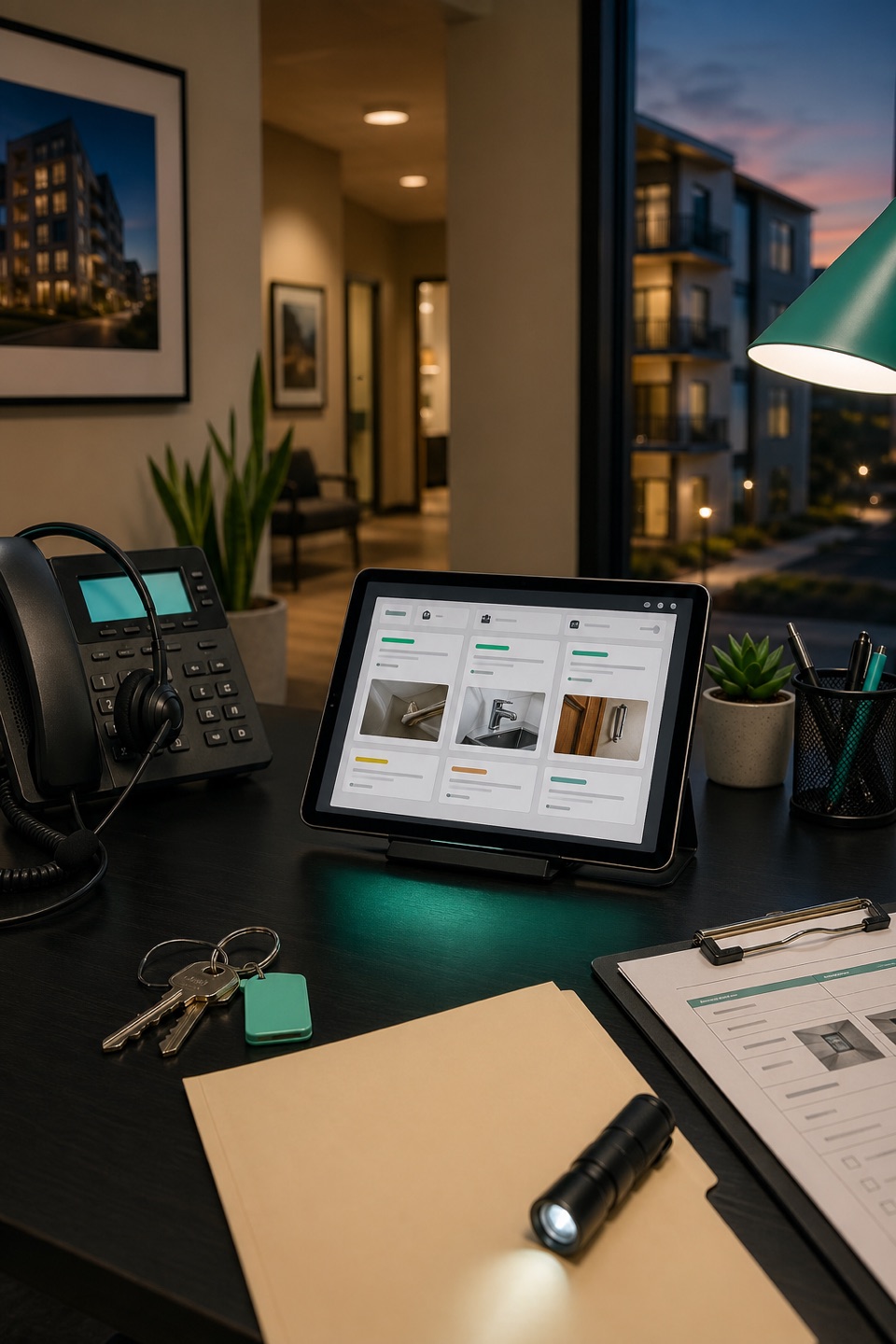
A resident photo only helps when the call captures what it shows, where it was taken, what changed, who is affected, what access is needed, and which staff-safe next step is approved.
Read resource
Owner update calls are not just status checks. They are moments where an answering service can capture maintenance facts, resident pressure, vendor context, and owner confidence before the relationship gets hotter.
Read resource
No-access and no-show calls are not routine updates. They are the second call after a stalled visit, when a resident is waiting, a vendor needs context, and an owner wants a credible next step.
Read resourceThese references support the phone demand, local search, and response speed claims above.
Buildium • Accessed 2026-05-14
Buildium maintenance request page describing work orders submitted by residents, owners, or employees with videos, documents, and images attached, plus status updates and communication around maintenance tasks.
Open sourceAppFolio • Accessed 2026-05-15
AppFolio maintenance operations guide describing real-time tracking, assignment, and completion of maintenance requests to improve communication between residents, vendors, and owners.
Open sourceBuildium • 2025-10-31 • Accessed 2026-05-15
Buildium research article reporting rising rental-owner demand for compliance help and renter-retention findings tied to maintenance investment and responsiveness to maintenance requests.
Open sourceAppFolio • Accessed 2026-05-14
AppFolio maintenance software page describing detailed descriptions, live status views, intake, follow-up, vendor coordination, feedback, and line-of-sight across maintenance operations.
Open sourceBuildium • 2025 • Accessed 2026-05-15
Buildium renter expectations report showing communication preferences, including 43% preferring phone calls as a contact method and 20% wanting more communication from their property manager or landlord.
Open sourceU.S. Department of Housing and Urban Development • Accessed 2026-05-14
HUD page describing the Multifamily Housing Complaint Line for resident complaints about poor maintenance, health and safety dangers, mismanagement, and related property-management issues.
Open sourceInstitute of Real Estate Management • 2024 • Accessed 2026-05-15
IREM policy document listing property-management firm functions such as client customer service plans, leasing plans, operating policies, emergency preparedness, adequate staffing, and maintenance planning.
Open sourceNational Apartment Association • Accessed 2026-05-15
NAA sample maintenance-emergency guidance illustrating apartment examples such as no heat or air conditioning, no hot or cold water, water leaks, sewer backup, gas smell, electrical failure, and one-toilet stoppages.
Open sourceU.S. Bureau of Labor Statistics • 2025-08-28 • Accessed 2026-05-15
BLS Occupational Outlook Handbook profile for property, real estate, and community association managers covering duties, customer-service expectations, emergency/off-duty work, 2024 employment, projected growth, and annual openings.
Open sourceInvoca • 2025-08-18 • Accessed 2026-05-16
Invoca analysis showing live answer-rate benchmarks across industries and calling behavior for high-stakes purchases.
Open sourceBrightLocal • 2025 • Accessed 2026-05-16
Survey of 1,000 US consumers about general and local search behavior, maps usage, and business information expectations.
Open source