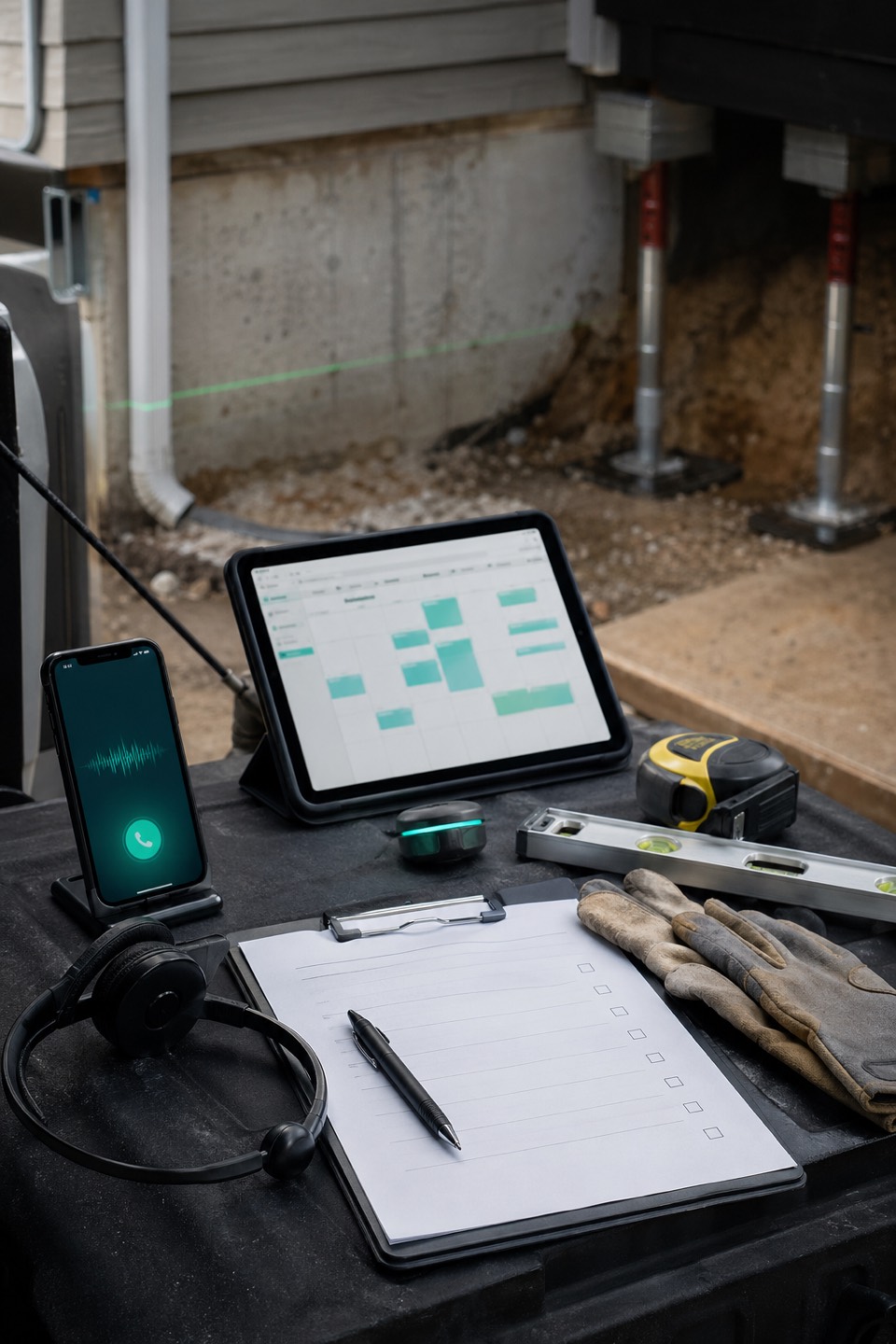
AI For Foundation Repair Companies
iando.ai answers inbound foundation repair calls 24/7, captures cracks, sticking doors, uneven floors, water intrusion, crawlspace, basement, slab, drainage, and inspection context, then routes qualified estimate requests with cleaner notes.
Built for foundation repair teams where inspectors, owners, and crews can be in crawlspaces, on job sites, or driving between estimates when the next high-ticket homeowner call comes in.
Built around the jobs your phone has to do: answer, schedule, route, handle approved Q&A, and recover missed-call revenue.
Edit call volume, buyer intent, 25% lift, and average foundation repair value.
Planning model only. Replace with the company's missed-call report, inspection booking rate, inspection-to-job close rate, slab versus crawlspace mix, average project value, drainage add-ons, financing mix, seasonality, and callback speed.
The business case for foundation repair companies
Start with the calls the business already earned, then estimate which ones can become appointments, jobs, consults, or useful follow-ups.
For foundation repair companies, ROI is not generic phone coverage. It is recovered inspection requests, better job qualification, faster follow-up on high-anxiety homeowners, and fewer vague voicemails during route time.
- Monthly foundation inspection, quote, and water-intrusion calls
- Buyer-intent share for homeowners ready to schedule an evaluation
- Average project value using a conservative foundation repair benchmark
- A conservative 25% lift from immediate answering and better intake
- Capture foundation inspection, crack, settlement, water-intrusion, crawlspace, slab, basement, and after-hours calls.
- Collect property type, foundation type, symptoms, access, drainage, photos, urgency, and preferred inspection windows before callback.
- Answer approved service-area, inspection, preparation, financing, and scheduling questions without inventing engineering or warranty promises.
- Route structural safety, active water, permits, engineer reports, warranty, complaints, commercial, and complex pricing questions to staff.
What missed calls actually look like for foundation repair companies
These are the moments where demand slips away because the team is already busy serving customers, patients, or active jobs.
Homeowners call when anxiety is high
A caller noticing stair-step cracks, doors that stick, sloping floors, basement water, a crawlspace concern, or a real-estate deadline is not casually browsing. If the call hits voicemail, they often book whoever gives a clear next step first.
Inspectors cannot answer from every job site
Foundation repair work puts the most knowledgeable people in crawlspaces, basements, driveways, and trucks. The owner or inspector who can qualify the work may not be able to answer cleanly.
Weak intake wastes inspection time
A useful callback needs foundation type, visible symptoms, crack location, water history, drainage details, access, property type, photos, urgency, financing interest, and whether a real-estate or insurance deadline is involved.
What public data says about this buying behavior
Every stat references a public source below, so the revenue argument stays grounded instead of padded with invented benchmarks.
Average repair value gives foundation repair companies a practical missed-call recovery baseline before close rate, inspection rate, job mix, financing, and local pricing are applied.
A small number of recovered inspection-ready calls can matter because many foundation repair projects are high-consideration, high-ticket home-service decisions.
Drainage and water-intrusion context should be captured because it can change scope, urgency, and whether the call needs inspection, waterproofing, or approved human review.
Market guidance describes demand drivers including aging building stock, environmental wear, natural disasters, structural deterioration, repair technology, and customer-service competition.
Skilled field time is constrained; foundation repair call plans should reduce avoidable phone loops while preserving inspection and repair capacity.
Foundation Repair Companies need phone coverage built around their actual calls
The phone experience should match how the business earns trust, books revenue, and routes exceptions.
Project value makes speed matter
Fixr's 2026 guide lists average foundation repair around $5,200, with many projects in the $2,200 to $8,200 range. Missing a small number of qualified inspection calls can create a meaningful revenue gap.
Water and drainage change the scope
Foundation callers often mix structural symptoms with gutters, grading, groundwater, basement seepage, or crawlspace moisture. Those details affect whether the next step is inspection, drainage review, waterproofing, or engineer referral.
Trust is won before the inspection
Foundation repair buyers are worried about safety, cost, permits, financing, warranty language, and whether they are being oversold. A calm first answer can shape whether they keep the appointment.
How iando.ai handles these calls
The best first layer is fast answer, clear qualification, then booking or escalation based on your operating rules.
Answer and identify the foundation concern
iando.ai picks up right away and sorts the caller into crack concern, settlement symptom, slab leveling, crawlspace or pier-and-beam issue, basement wall, water intrusion, drainage, real-estate inspection, warranty, or callback-worthy exception.
Capture inspection details before callback
It collects address, property type, foundation type if known, symptoms, timing, photos or notes, access, water history, drainage clues, urgency, real-estate deadline, financing interest, and preferred inspection windows.
Book, route, or escalate with context
Simple inspection requests can move toward scheduling. Active water, safety-sensitive movement, structural engineering, permit, commercial, warranty, or complex pricing questions route to staff with useful notes.
Calls iando.ai can answer, route, or recover
These conversations are the highest-leverage starting point because they connect directly to revenue, schedule protection, or staff capacity.
Foundation inspection requests
Cracks, sticking doors, uneven floors, gaps, settlement, slab movement, crawlspace concerns, basement walls, and preferred inspection timing.
Outcome: Move ready homeowners toward a booked inspection with better symptom and access context.
Water, drainage, and basement calls
Basement seepage, crawlspace moisture, gutters, downspouts, grading, pooling water, sump questions, recent storms, and drainage add-ons.
Outcome: Separate structural repair, waterproofing, drainage, and human-review paths before the callback.
Real-estate and deadline calls
Buyer inspection findings, seller disclosures, closing deadlines, engineer reports, repair documentation, transferable warranty questions, and estimate timing.
Outcome: Capture urgency and document needs so staff can prioritize high-decision calls.
Pricing, financing, warranty, and exception calls
Pier count questions, slab lifting, wall anchors, carbon fiber, soil reports, permits, payment options, warranties, complaints, or prior repair concerns.
Outcome: Answer approved basics and route project-specific or promise-sensitive questions to staff.
What operators actually care about
Recover inspection calls during field time
Calls still get answered while inspectors are under houses, crews are installing piers, coordinators are checking permits, or owners are driving between estimates.
Give inspectors better notes
Callbacks start with symptom, access, foundation type, water, drainage, photo, deadline, and project context instead of a name and a phone number.
Prioritize high-intent homeowners
Real-estate deadlines, active water, visible movement, financing interest, and quote-ready homeowners can be identified before the schedule fills with vague calls.
Where the payoff shows up operationally
- Capture foundation inspection, crack, settlement, water-intrusion, crawlspace, slab, basement, and after-hours calls.
- Collect property type, foundation type, symptoms, access, drainage, photos, urgency, and preferred inspection windows before callback.
- Answer approved service-area, inspection, preparation, financing, and scheduling questions without inventing engineering or warranty promises.
- Route structural safety, active water, permits, engineer reports, warranty, complaints, commercial, and complex pricing questions to staff.
- Turn homeowner anxiety into booked inspections, cleaner estimates, and faster follow-up.
How the operation changes when the phone stops leaking revenue
Inspection calls hit voicemail while owners and inspectors are on job sites.
AfterEvery caller gets an immediate answer and a clear inspection or callback path.
Callbacks start without symptoms, photos, foundation type, drainage, access, or deadlines.
AfterInspectors receive useful notes before deciding how to schedule and qualify the visit.
Water, drainage, warranty, and structural questions get mixed into one generic voicemail queue.
AfterSensitive or complex calls route to staff while routine inspection requests keep moving.
Homeowners compare contractors based on who answers first.
AfterYour company gives anxious callers a calm first response and a concrete next step.
Questions before putting AI on the phone
Foundation calls are too technical
Correct. The AI should qualify the concern and capture context. It should not diagnose structural movement, specify repairs, or promise outcomes that require an inspector, engineer, or company owner.
We do not want warranty or engineering promises
The call path should use approved language and route warranty, engineer-report, permit, structural-safety, soil, pier-count, and prior-repair questions to a human.
Our jobs vary too much for a simple calculator
That is why the ROI model is only a planning baseline. It should be replaced with your inspection close rate, average job size, market, lead source, seasonality, and callback speed.
Turn more calls into booked revenue for foundation repair companies.
iando.ai is built for businesses that depend on the phone and lose money when callers do not get a fast, useful answer. Book a demo and map the call plan to your call volume, hours, and booking logic.
Frequently asked questions
Can AI book foundation repair inspections?
Yes, when the company's service area, inspection calendar, and qualification rules allow it. At minimum, it can capture symptoms, photos, access, water history, and timing so staff can confirm quickly.
Can it diagnose foundation problems?
No. It should collect the caller's words, use approved language, and route diagnosis, repair method, pier count, engineering, permit, warranty, and safety questions to qualified staff.
What should route to a human?
Structural safety concerns, active water intrusion, commercial work, engineer reports, real-estate deadlines, permit questions, financing exceptions, warranty claims, complaints, prior repairs, and complex pricing.
Can it handle pricing questions?
It can explain approved ranges or inspection policies, but final pricing should depend on foundation type, movement, soil, access, repair method, drainage, permits, and inspector review.
Why build a dedicated foundation repair page instead of generic contractor copy?
Because foundation repair callers ask about cracks, settlement, water, drainage, crawlspaces, slabs, basements, inspections, engineering, warranties, financing, and real-estate deadlines. Generic contractor copy misses the buying process.
Deeper articles for foundation repair companies
Each guide supports the ICP landing page with practical, search-focused depth around staffing, routing, conversion, and operational efficiency.
Foundation repair call ROI
Foundation repair calls are often anxious, high-value, and time-sensitive. A missed call can be an inspection request, a real-estate deadline, a drainage add-on, or a homeowner who books the first contractor that answers.
Read articleMore phone-revenue pages
Research behind this page
These references support the phone-demand, local-search, and response-speed claims above.
Fixr • 2026-01-27 • Accessed 2026-04-27
Fixr 2026 cost guide reporting average foundation repair around $5,200, a common range of $2,200 to $8,200, and cost drivers including damage type, repair method, permits, excavation, labor, materials, and repair categories such as crack sealing, slab jacking, waterproofing, wall reinforcement, tiebacks, and underpinning.
Open sourceThis Old House • 2026 • Accessed 2026-04-27
This Old House 2026 pricing guide reporting an average foundation repair cost of $5,179, a common homeowner range of $2,224 to $8,134, and key cost drivers including location, provider, home size, materials, and project scope.
Open sourceNerdWallet • 2026-02-25 • Accessed 2026-04-27
NerdWallet 2026 guide explaining foundation repair cost ranges, full foundation replacement scenarios, the value of acting early, and the role of residential structural engineers for unbiased evaluation.
Open sourceU.S. Environmental Protection Agency • Accessed 2026-04-27
EPA moisture-control guidance for building professionals covering site drainage, foundations, walls, roof and ceiling assemblies, plumbing systems, HVAC systems, and why moisture movement into and within buildings should be controlled.
Open sourceFuture Market Report • 2026 • Accessed 2026-04-27
Market overview describing foundation repair services demand drivers such as aging building stock, natural disasters, structural deterioration, service competition, customer service expectations, and repair techniques including underpinning, mudjacking, slabjacking, piering, grouting, and wall anchoring.
Open sourceU.S. Bureau of Labor Statistics • 2025-08-28 • Accessed 2026-04-27
BLS Occupational Outlook Handbook profile reporting construction laborers and helpers' jobsite work, outdoor and confined-space conditions, 2024 employment, projected 7% employment growth from 2024 to 2034, and about 149,400 projected annual openings.
Open sourceInternational Code Council • Accessed 2026-04-27
ICC technical note explaining rain and groundwater management concepts, foundation drainage, dampproofing, waterproofing, and that the International Residential Code establishes minimum moisture-control measures for foundations, walls, and roofs.
Open sourceInvoca • 2025-08-18 • Accessed 2026-03-31
Invoca analysis showing live answer-rate benchmarks across industries and calling behavior for high-stakes purchases.
Open sourceBrightLocal • 2025 • Accessed 2026-03-31
Survey of 1,000 US consumers about general and local search behavior, maps usage, and business information expectations.
Open source