
Learn
Set the operating rules.
Services, coverage, hours, booking, routing, approved answers, and escalation paths are defined first.
I&O answers first-loss calls, captures property and hazard context, and creates dispatch-ready records.
See restoration missed-call ROIAnswer live demand. Follow up approved opportunities. One human-sounding system works both ways.
I&O answers property owners, captures approved water damage restoration companies context, and books or routes the next step.
I&O follows up approved property owners, preserves source and contact rules, and books the next conversation.
Illustrative planning model. Replace the assumptions with your own call volume and booking value.
Model: monthly inbound calls × calls not answered live (%) × unanswered calls recovered (%) × average restoration job value. Replace every assumption with your phone logs and collected outcomes.
Meet Adam, your around-the-clock call handling employee that feels human.
I&O learns the operation once, then answers, books, follows up, and routes every approved conversation within your rules.
Services, coverage, hours, booking, routing, approved answers, and escalation paths are defined first.
Human-sounding AI answers property owners without sending valuable demand to voicemail.
Each handled conversation becomes recovered mitigation jobs or a complete staff-ready handoff.
Answered demand, booked outcomes, routed conversations, and modeled value stay visible as performance improves.
Start with missed demand or approved follow-up, then expand after booked outcomes and recovered value are proven.
Use these checks to decide whether this call lane is worth modeling, what staff keeps, and where the next step should route.
It answers burst-pipe, basement-flood, ceiling-leak, sewage, storm-water, mold-risk, insurance, access, and after-hours calls; captures source of water, affected rooms, photos, access, insurance, plumber status, urgency, and callback window; and routes staff-owned mitigation, safety, coverage, scope, pricing, and dispatch decisions to the restoration team.
It can answer immediately, collect property and loss details, identify urgency, capture photos or access notes when useful, and send the call through your dispatch rules.
Coverage decisions and policy-specific advice should go to staff.
It covers missed calls, overflow, after-hours intake, approved Q&A, and summaries so your team can focus on mitigation decisions, dispatch, documentation, and job quality.
Demand slips away while the team is already serving customers, patients, or active jobs.
A homeowner with standing water, a property manager with a ceiling leak, or a business with a sewage backup usually keeps calling until someone gives a clear next step.
Loss source, water category concerns, affected rooms, electricity status, property type, access, photos, insurance carrier, and timing determine whether the next step is emergency dispatch, staff callback, or careful triage.
Water losses do not respect office hours. Voicemail during nights, weekends, storms, freezes, and heavy rain can turn high-intent calls into competitor jobs.
Every statistic links to a public source, keeping the revenue case grounded.
Water, fire, smoke, mold, and storm restoration companies compete in a large local-services market where urgent call capture can decide who wins the job.
IBISWorld's industry page reports a fragmented market, so homeowners and property managers often have many local alternatives after a water loss.
Average job value can justify better missed-call coverage, especially when the caller needs emergency extraction, drying, mitigation, or repair coordination.
Project value changes with water source, affected square footage, materials, drying time, mold risk, and insurance context, making qualified intake commercially important.
Triple-I reports water damage and freezing as a major homeowners claim category, which helps explain why callers often need insurance-aware next steps.
EPA says mold can grow on materials such as wood, drywall, carpet, and furniture if they remain wet for more than 24 hours, so fast call handling matters.
FEMA's flood-insurance outreach reinforces why flood, storm, and water-intrusion callers need a fast, careful response and accurate coverage expectations.
Water restoration calls need structured intake because professional drying and mitigation depend on inspections, precautions, documentation, and building-material context.
Call handling should match how the business earns trust, books revenue, and hands off exceptions.
IBISWorld reports a $7.2 billion U.S. damage restoration services market in 2025. Many calls come from homeowners and property managers comparing local providers under time pressure.
EPA warns mold can grow on wet wood, drywall, carpet, and furniture when they stay wet for more than 24 hours. The first call should not become a voicemail with no context.
Triple-I reports water damage and freezing as a major homeowners claim category, while FEMA says flood damage is not typically covered by homeowners insurance. Intake needs to capture details without overpromising coverage.
The best first layer is fast answer, clear qualification, then booking or escalation based on your operating rules.
I&O picks up right away and separates burst pipes, appliance leaks, roof leaks, flooded basements, storm water, sewage backups, mold concerns, commercial losses, and general estimate questions.
It captures caller details, property address, source of water, affected rooms, standing water, visible mold, electricity concerns, photos, access notes, insurance carrier, claim status, and urgency.
Emergency jobs move toward dispatch. Insurance, mold, sewage, commercial, reconstruction, exact pricing, and staff-only questions move forward with the context your team needs.
These conversations are the highest-leverage starting point because they connect directly to revenue, schedule protection, or staff capacity.
Water heater failures, supply-line breaks, dishwasher leaks, washing machine overflows, toilet leaks, and active water intrusion.
Outcome: Capture the emergency and send it forward with location, source, shutoff status, standing-water details, and access notes.
Heavy rain, sump pump failure, seepage, storm water, roof leaks, ceiling leaks, and floodwater concerns.
Outcome: Separate covered-service, flood, roof, plumbing, and urgent mitigation paths without giving insurance promises.
Sewage backups, contaminated water, visible mold, long wet times, odor, damp drywall, and unsafe cleanup questions.
Outcome: Send risk-sensitive calls carefully and keep answers inside approved safety and staff-review rules.
Apartments, offices, retail, restaurants, schools, healthcare sites, HOAs, and managed rentals that need access, documentation, and fast coordination.
Outcome: Capture decision-maker, site, access, insurance, tenant, and urgency details before dispatch or callback.
Fast answering keeps burst-pipe, flooded-basement, sewage, leak, and mold-risk callers from moving to the next local restoration company.
Callbacks include loss source, affected areas, standing water, safety flags, insurance details, photos, access, and timing instead of only a phone number.
Approved Q&A and structured intake reduce interruptions while callers still get a professional answer and a clear next step.
Emergency water loss calls hit voicemail while crews are on jobs.
AfterEvery caller gets an immediate answer and a clear dispatch or callback path.
Staff call back without knowing source, affected rooms, insurance status, or urgency.
AfterCallbacks include the details needed to qualify, hand off, and respond faster.
Burst pipes, floods, sewage, mold concerns, and estimate calls all mix together.
AfterLoss types are identified early and sent through approved rules.
After-hours callers keep searching until someone answers.
AfterUrgent demand gets covered 24/7 without staffing every call manually.
The AI should not promise coverage. It can collect carrier and claim details, explain your approved process, and send policy-specific or adjuster-specific questions to staff.
Correct. The first answer should capture symptoms, timing, source, and safety concerns, then send category, mold, and remediation decisions to qualified staff.
This adds consistency and detail capture. Callers get an immediate answer, and your on-call team receives a cleaner summary before deciding how to respond.
Start with the buyer's reason for calling. iando captures intent, books what is ready, and hands staff the context that closes.
Edit call volume, qualified intent, 25% lift, and average restoration job value.
Planning model only. Replace with real missed-call volume, emergency-call mix, average mitigation invoice, reconstruction attachment, insurance program rules, technician capacity, and service-area coverage.
iando answers fast, captures why they raised their hand, books or routes the next step, and gives staff the context to close.
Each guide gives operators practical depth around staffing, call handling, conversion, and operational efficiency.
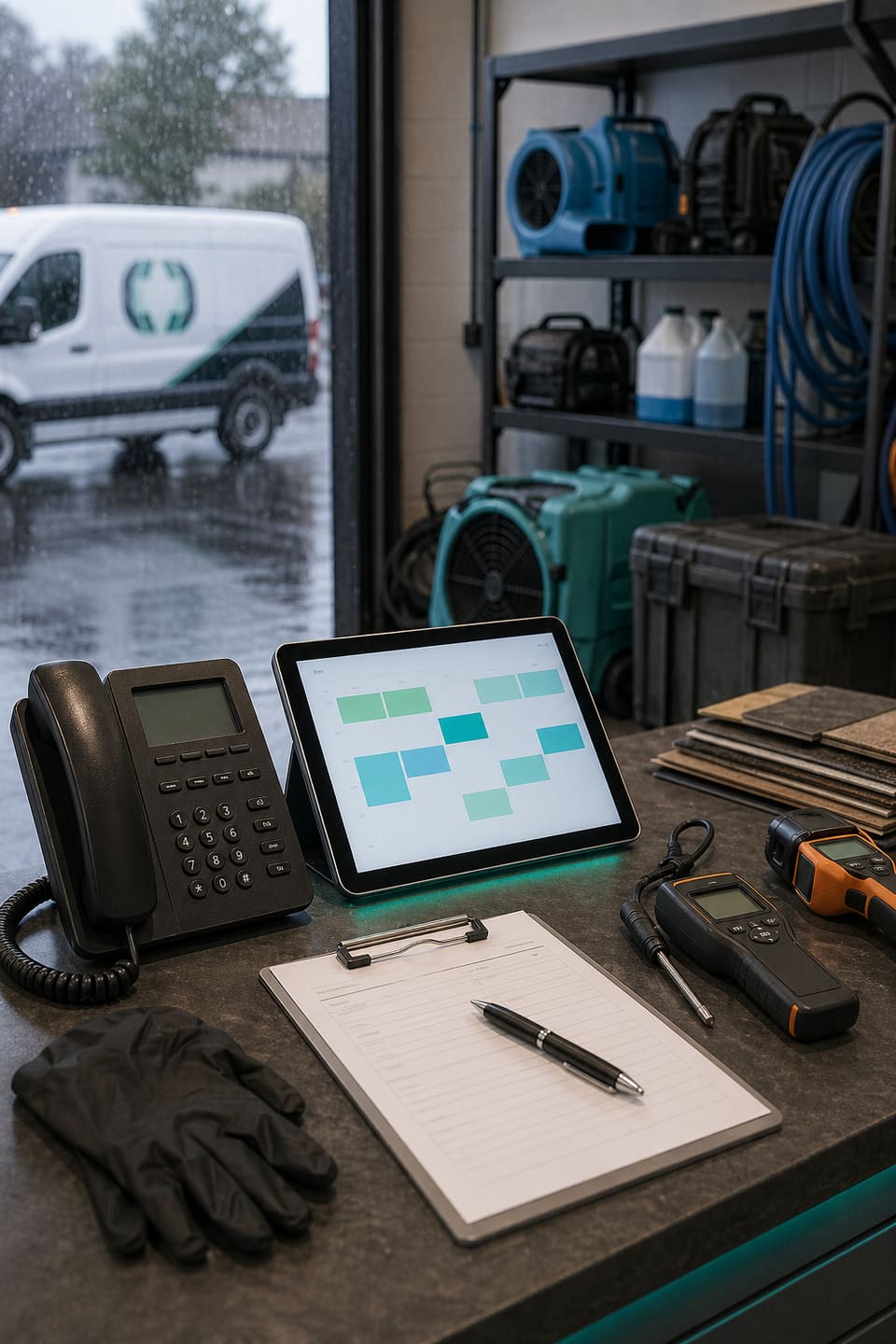
Dallas water damage searches become phone calls because timing matters. This sourced shortlist helps property owners compare public options while showing restoration operators how first-answer speed protects mitigation jobs.
Read resource
Miami water loss demand is urgent, local, and phone-led. This sourced shortlist helps property owners compare public restoration options while showing operators why first-answer speed protects mitigation revenue.
Read resource
Fort Lauderdale water damage searches are urgent because timing changes the loss. This sourced shortlist helps property owners compare public options while showing restoration teams why first-answer speed wins.
Read resourceThese references support the phone demand, local search, and response speed claims above.
IBISWorld • 2025-04 • Accessed 2026-04-26
IBISWorld market-size page reporting a $7.2 billion U.S. damage restoration services market in 2025, with 1.9% market-size growth in 2025.
Open sourceIBISWorld • 2025 • Accessed 2026-04-26
IBISWorld industry report page reporting 60,020 U.S. damage restoration service businesses in 2025 and no company with more than 5% market share.
Open sourceAngi • 2026-03-17 • Accessed 2026-05-11
Angi 2026 cost guide reporting average water damage restoration cost of $3,863, a normal range of $1,383-$6,381, and possible costs from $450 to $16,000 depending on source and extent.
Open sourceHomeGuide • Accessed 2026-05-07
HomeGuide 2026 water damage restoration cost guide covering national cost ranges and factors such as water category, affected square footage, materials, drying time, mold, and insurance coverage.
Open sourceInsurance Information Institute • Accessed 2026-05-07
Triple-I homeowners insurance statistics reporting 2023 homeowners claims frequency and severity, including water damage and freezing as the second-largest claim category by frequency.
Open sourceU.S. Environmental Protection Agency • Accessed 2026-05-11
EPA flood cleanup guidance noting that mold can grow on wood, drywall, carpet, and furniture if they remain wet for more than 24 hours, and that qualified professionals may have water damage restoration or mold-removal certification.
Open sourceFEMA • 2025-08-19 • Accessed 2026-04-26
FEMA NFIP release noting that one inch of floodwater can cause up to $25,000 in damage to a house and encouraging property owners to understand flood-insurance coverage.
Open sourceFEMA • Accessed 2026-04-26
FEMA FAQ stating that flood damage is not typically covered by a homeowners insurance policy.
Open sourceANSI Webstore • 2021 • Accessed 2026-05-11
ANSI listing for the IICRC S500 standard describing procedures and precautions for professional water damage restoration in residential, commercial, and institutional buildings.
Open sourceCDC • 2024-02-06 • Accessed 2026-05-11
CDC flood reentry guidance telling homeowners to dry out flooded homes as soon as possible, use pumps, fans, and dehumidifiers safely, and have flooded HVAC systems checked by professionals experienced in mold cleanup.
Open sourceCDC • 2024-03-28 • Accessed 2026-05-07
CDC mold cleanup guide from CDC, EPA, FEMA, HUD, and NIH emphasizing PPE, generator safety, complete cleanup before reoccupying, and mold growth where moisture remains.
Open sourceInvoca • 2025-08-18 • Accessed 2026-05-16
Invoca analysis showing live answer-rate benchmarks across industries and calling behavior for high-stakes purchases.
Open sourceBrightLocal • 2025 • Accessed 2026-05-16
Survey of 1,000 US consumers about general and local search behavior, maps usage, and business information expectations.
Open source