
Learn
Set the operating rules.
Services, coverage, hours, booking, routing, approved answers, and escalation paths are defined first.
I&O answers stuck-open and broken-spring calls, captures access context, and books technician-ready work.
See garage-door repair ROIAnswer live demand. Follow up approved opportunities. One human-sounding system works both ways.
I&O answers homeowners, captures approved garage door repair companies context, and books or routes the next step.
I&O follows up approved homeowners, preserves source and contact rules, and books the next conversation.
Illustrative planning model. Replace the assumptions with your own call volume and booking value.
Model: monthly inbound calls × calls not answered live (%) × unanswered calls recovered (%) × average job value. Replace every assumption with your phone logs and collected outcomes.
Meet Adam, your around-the-clock call handling employee that feels human.
I&O learns the operation once, then answers, books, follows up, and routes every approved conversation within your rules.
Services, coverage, hours, booking, routing, approved answers, and escalation paths are defined first.
Human-sounding AI answers homeowners without sending valuable demand to voicemail.
Each handled conversation becomes dispatch-ready garage door jobs or a complete staff-ready handoff.
Answered demand, booked outcomes, routed conversations, and modeled value stay visible as performance improves.
Start with missed demand or approved follow-up, then expand after booked outcomes and recovered value are proven.
Use these checks to decide whether this call lane is worth modeling, what staff keeps, and where the next step should route.
It can capture the issue, location, urgency, preferred time, service-area fit, contact details, and access notes, then move qualified calls toward booking or staff review.
It should not give repair instructions or tell callers to handle high-tension parts.
Exact repair quotes, commercial pricing, warranty issues, and replacement bids should route to staff.
It covers missed calls, overflow, approved Q&A, booking intake, and summaries so dispatch can focus on truck routing, pricing decisions, parts, and safety-sensitive exceptions.
Demand slips away while the team is already serving customers, patients, or active jobs.
A caller with a stuck garage door, broken spring, off-track door, trapped car, or open door that will not close is often looking for the fastest credible next step.
The same team dispatching trucks, pricing jobs, ordering parts, answering warranty questions, and coordinating installs also has to catch new repair demand.
Spring, cable, off-track, opener, and entrapment issues should not receive improvised repair advice. The call path should collect facts and route according to company policy.
Every statistic links to a public source, keeping the revenue case grounded.
Many repair calls carry enough value that recovering only a small share of missed demand can matter for a local garage door company.
Repair value depends on labor, hardware, urgency, spring work, opener issues, and service-area fit, so the call must capture the right facts early.
Replacement and upgrade calls can be high-consideration opportunities, not only simple repair tickets.
Garage door calls can involve safety-sensitive equipment, so AI should collect facts and escalate risky issues rather than giving repair advice.
Call handling should match how the business earns trust, books revenue, and hands off exceptions.
Angi reports an average garage door repair cost of $263, while Housecall Pro's 2026 pricing guide places many repairs in a $150-$600 range before larger opener, spring, commercial, or replacement work.
BBB warns that emergency garage door repair scams target urgent homeowners through search. A fast, clear, branded first answer helps legitimate companies sound organized before the truck roll.
Overhead Door's coverage of the 2024 Cost vs. Value report notes garage door replacement led national project ROI rankings. Some calls are not quick fixes; they are estimate and upgrade opportunities.
The best first layer is fast answer, clear qualification, then booking or escalation based on your operating rules.
I&O confirms whether the caller needs repair, spring service, opener help, replacement, maintenance, warranty support, or commercial service, then captures location and urgency.
It answers allowed questions about service area, hours, trip fees, booking windows, common symptoms, photos, access, and what information the homeowner should have ready.
Qualified repair calls move toward the schedule. Safety-sensitive spring, cable, off-track, entrapment, commercial, warranty, and exact-price questions route to staff with a useful summary.
These conversations are the highest-leverage starting point because they connect directly to revenue, schedule protection, or staff capacity.
Garage door will not lift, heavy door, visible spring gap, snapped cable, crooked door, loud pop, or car trapped inside.
Outcome: Capture urgency and route using the company's safety and dispatch rules.
Remote failures, keypad issues, opener noise, door reverses, safety sensor alignment, battery backup, or smart opener questions.
Outcome: Gather symptoms, model context when available, and move the caller toward repair or staff review.
Door is stuck open, will not close, panels are damaged, tracks are bent, or the home is exposed after a vehicle impact or storm.
Outcome: Identify security and safety urgency so dispatch can prioritize correctly.
Homeowners asking about new doors, insulated doors, curb appeal, noisy hardware, damaged panels, commercial doors, or quote timing.
Outcome: Capture project intent, address, photos or notes, timing, and a clear estimate next step.
Repair callers get an immediate answer during installs, lunch, after hours, weekends, and heavy weather instead of landing on voicemail.
Staff get door type, symptom, urgency, location, access notes, photos or requested details, and the caller's next step before they call back.
The AI stays inside approved answers and routes spring, cable, off-track, entrapment, exact-price, warranty, and commercial exceptions to staff.
Broken-spring calls hit voicemail while staff coordinate truck rolls.
AfterCallers get an immediate answer and a clear repair next step.
Homeowners describe symptoms from scratch on every callback.
AfterDispatch receives symptom, access, urgency, and location context before follow-up.
Safety-sensitive issues mix with routine estimate questions.
AfterSpring, cable, off-track, and entrapment language routes by company policy.
Replacement and upgrade inquiries wait behind active repair calls.
AfterEstimate requests are captured with project details and timing.
It should not. The call path should capture the customer's words, use approved safety language, and route risky spring, cable, opener, and off-track issues to trained staff.
Exactly. The AI can collect symptoms, door type, urgency, address, access notes, and photos or requested details, then avoid exact quotes unless the company has approved fixed pricing.
That is the point. I&O should answer with your call path, service area, approved language, and next step so urgent homeowners do not feel like they reached a generic call center.
Start with the buyer's reason for calling. iando captures intent, books what is ready, and hands staff the context that closes.
Edit call volume, qualified intent, 25% lift, and average job value.
Planning model only. Replace these assumptions with real call logs, missed-call rate, booked-job rate, service-area fit, emergency mix, average invoice, and technician capacity.
iando answers fast, captures why they raised their hand, books or routes the next step, and gives staff the context to close.
Each guide gives operators practical depth around staffing, call handling, conversion, and operational efficiency.
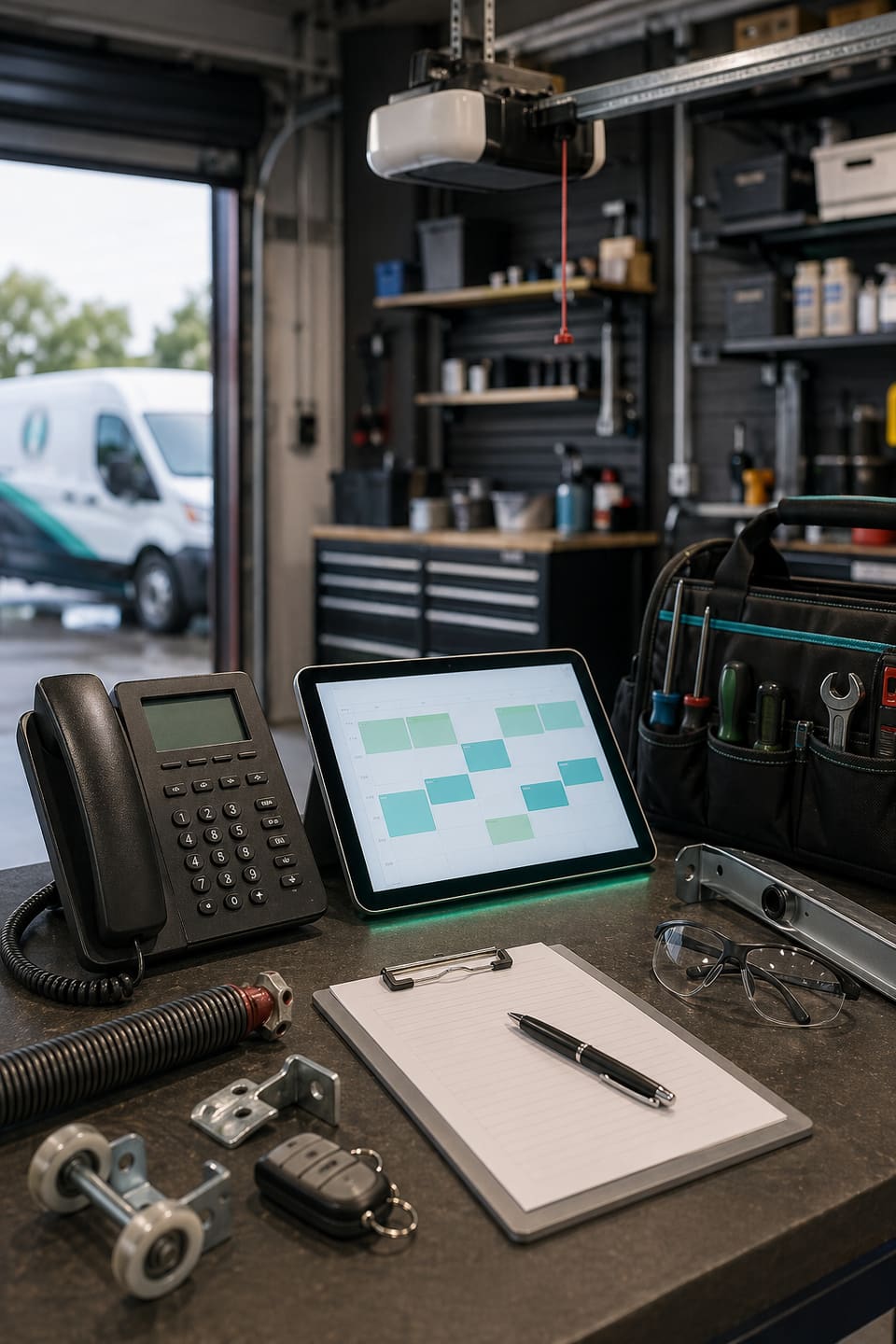
Garage door repair calls are often urgent, local, and ready to book. The missed-call revenue case starts with fast answering, safe handoffs, and better job context for dispatch.
Read resource
A broken-spring garage door call is urgent, local, and safety-sensitive. The first answer should capture the no-open problem, avoid repair advice, and move the job toward dispatch.
Read resource
Moving-company calls are often time-bound and quote-ready. The missed-call revenue case starts with fast answering, clear intake, trust-building Q&A, and better callback details for estimators.
Read resourceThese references support the phone demand, local search, and response speed claims above.
Angi • 2026 • Accessed 2026-05-07
Angi cost guide reporting a $265 average garage door repair cost, a $155-$379 normal range, labor and service-call fee context, spring replacement cost ranges, and guidance to hire trained garage door repair technicians.
Open sourceHousecall Pro • 2026 • Accessed 2026-05-07
Housecall Pro garage door pricing guide covering 2026 repair, torsion spring, opener replacement, residential installation, commercial installation, labor, inventory, margin, commercial access, and emergency-pricing considerations.
Open sourceOverhead Door • 2024 • Accessed 2026-05-07
Overhead Door summary of Remodeling Magazine and Zonda's 2024 Cost vs. Value Report, noting garage door replacement led the national project ROI list with a 194% average ROI.
Open sourceU.S. Consumer Product Safety Commission • Accessed 2026-05-07
CPSC voluntary standards page explaining federal garage door operator safety requirements, UL 325 entrapment-protection context, and incident history involving automatic garage doors and openers.
Open sourceDoor & Access Systems Manufacturers Association (DASMA) • Accessed 2026-05-07
DASMA safety guidance describing garage doors as large moving systems used daily, recommending trained technician service for dangerous spring systems, cables, struggling doors, and annual inspection.
Open sourceBetter Business Bureau • 2023-10-06 • Accessed 2026-05-07
BBB scam alert warning that emergency garage door repair scams are common, often target urgent homeowners through search ads, and may use vague names, fake addresses, low service fees, high pressure, and upfront payment demands.
Open sourceFederal Trade Commission • Accessed 2026-05-12
FTC consumer advice describing home improvement scam warning signs, including pressure for immediate decisions, upfront payment requests, cash-only demands, and the need for licensed, insured contractors and written estimates.
Open sourceInvoca • 2025-08-18 • Accessed 2026-05-16
Invoca analysis showing live answer-rate benchmarks across industries and calling behavior for high-stakes purchases.
Open sourceBrightLocal • 2025 • Accessed 2026-05-16
Survey of 1,000 US consumers about general and local search behavior, maps usage, and business information expectations.
Open source