
Learn
Set the operating rules.
Services, coverage, hours, booking, routing, approved answers, and escalation paths are defined first.
I&O answers urgent and project calls, captures site context, and books estimator-ready opportunities.
See tree service ROIAnswer live demand. Follow up approved opportunities. One human-sounding system works both ways.
I&O answers property owners, captures approved tree service companies context, and books or routes the next step.
I&O follows up approved property owners, preserves source and contact rules, and books the next conversation.
Illustrative planning model. Replace the assumptions with your own call volume and booking value.
Model: monthly inbound calls × calls not answered live (%) × unanswered calls recovered (%) × average tree job value. Replace every assumption with your phone logs and collected outcomes.
Meet Adam, your around-the-clock call handling employee that feels human.
I&O learns the operation once, then answers, books, follows up, and routes every approved conversation within your rules.
Services, coverage, hours, booking, routing, approved answers, and escalation paths are defined first.
Human-sounding AI answers property owners without sending valuable demand to voicemail.
Each handled conversation becomes estimate-ready tree jobs or a complete staff-ready handoff.
Answered demand, booked outcomes, routed conversations, and modeled value stay visible as performance improves.
Start with missed demand or approved follow-up, then expand after booked outcomes and recovered value are proven.
Use these checks to decide whether this call lane is worth modeling, what staff keeps, and where the next step should route.
I&O handles tree service calls, captures useful context, and moves the approved next step forward while staff keep sensitive decisions.
Calls involving wires, blocked access, roof impact, unstable trees, or active hazards should use approved escalation language.
Exact removal, crane, permit, stump, insurance, and hazardous-work pricing should route to staff.
It covers missed calls, overflow, approved Q&A, booking intake, and summaries so staff can focus on estimates, crew planning, safety decisions, and customer follow-up.
Demand slips away while the team is already serving customers, patients, or active jobs.
Owners and coordinators are often on job sites, driving between estimates, answering crew questions, or dealing with equipment. A caller with a leaning tree or removal request may keep searching if nobody answers.
High winds, ice, and heavy rain create urgent calls about blocked driveways, limbs on roofs, trees near wires, and cleanup needs at night or on weekends.
Tree height, species if known, distance from structures, access, power lines, debris hauling, stump work, and photos all affect the next step. A missed call with no context wastes callback time.
Every statistic links to a public source, keeping the revenue case grounded.
Tree service is a large local-services category where fast estimate capture, storm response, and trust-building call handling can shape who wins the job.
Tree-care labor is field-based and equipment-heavy, so owner and crew attention is often away from the phone when estimate calls arrive.
Removal value varies by height, location, access, debris, equipment, permit, and hazard complexity, making qualified call intake commercially important.
Even ordinary removals can justify better missed-call coverage when the company recovers only a modest share of qualified estimate demand.
Seasonal spikes make overflow answering more valuable when pruning, trimming, storm cleanup, and removal demand bunch together.
Calls mentioning trees on wires, limbs near service drops, or equipment near lines need careful routing instead of casual advice.
Call handling should match how the business earns trust, books revenue, and hands off exceptions.
The caller usually has a specific tree, hazard, cleanup job, or property project in mind. Capturing the details early helps staff decide whether to book an estimate, request photos, or route urgently.
Calls that mention power lines, hanging limbs, storm damage, unstable trees, or structures need a calm next step and staff routing, not improvised advice.
Spring, summer, fall, and storm windows can all create call spikes. The phone can become the bottleneck exactly when crews are already booked out.
The best first layer is fast answer, clear qualification, then booking or escalation based on your operating rules.
I&O picks up immediately and confirms whether the caller needs removal, pruning, stump grinding, storm cleanup, plant-health help, a commercial quote, or urgent hazard routing.
It collects address, tree location, rough size, nearby structures, wires, access issues, debris needs, stump work, timing, photos or requested details, and the caller's preferred next step.
Bookable estimates move forward. Power-line concerns, structure risk, storm emergencies, insurance questions, and exact pricing requests route to staff with the caller's context attached.
These conversations are the highest-leverage starting point because they connect directly to revenue, schedule protection, or staff capacity.
Dead, leaning, oversized, storm-damaged, or unwanted trees near homes, fences, driveways, pools, utility lines, or tight access areas.
Outcome: Capture the lead and move the caller toward an estimate, photo request, or staff review.
Canopy reduction, clearance, deadwood, roof overhangs, seasonal trimming, disease concerns, and arborist consultation requests.
Outcome: Gather the property details and service need without interrupting field crews.
Branches on roofs, blocked access, hanging limbs, uprooted trees, split trunks, trees tangled with wires, and urgent cleanup questions.
Outcome: Identify urgency and route safety-sensitive calls according to company policy.
Stump grinding, wood hauling, chipping, crane needs, permits, cleanup, commercial properties, HOA requests, and insurance-document questions.
Outcome: Handle approved basics and route exact scope, pricing, and documentation needs.
Tree callers are often comparing a short list of local companies. Fast answering keeps your crew in the decision before another provider frames the job.
Staff can call back with tree location, rough size, hazard notes, access issues, stump needs, cleanup expectations, and timing already captured.
The AI stays inside approved answers and routes power-line, storm, crane, exact-price, insurance, and structural-risk exceptions to staff.
Removal calls hit voicemail while the owner is on a job site.
AfterCallers get an immediate answer and a clear estimate next step.
Staff call back with only a phone number and no property context.
AfterCallbacks include tree size, location, hazards, access, stump, and cleanup notes.
Storm and power-line concerns mix with routine pruning questions.
AfterSafety-sensitive language routes by company policy with context attached.
Pricing questions force staff to restart the entire call.
AfterApproved Q&A handles basics while exact quotes stay with trained people.
Correct. AI should not invent exact prices. It should capture the facts, explain the approved estimate path, request photos where appropriate, and route pricing decisions to staff.
That is why the call path needs clear guardrails. Calls involving wires, unstable limbs, blocked access, roof impact, or storm emergencies should route to trained staff or emergency instructions approved by the company.
The phone answer should use the company name, service area, estimate process, safety limits, and next step so homeowners hear a local tree company, not a generic call center.
Start with the buyer's reason for calling. iando captures intent, books what is ready, and hands staff the context that closes.
Edit call volume, qualified intent, 25% lift, and average tree job value.
Planning model only. Refine with the company's missed-call rate, estimate-to-book rate, storm-call share, pruning/removal mix, crane or equipment jobs, and crew capacity.
iando answers fast, captures why they raised their hand, books or routes the next step, and gives staff the context to close.
Each guide gives operators practical depth around staffing, call handling, conversion, and operational efficiency.

Tree-service calls are often urgent, visual, and high-intent. The missed-call revenue case starts with fast answering, clean property details, careful safety handoffs, and better estimate follow-up.
Read resource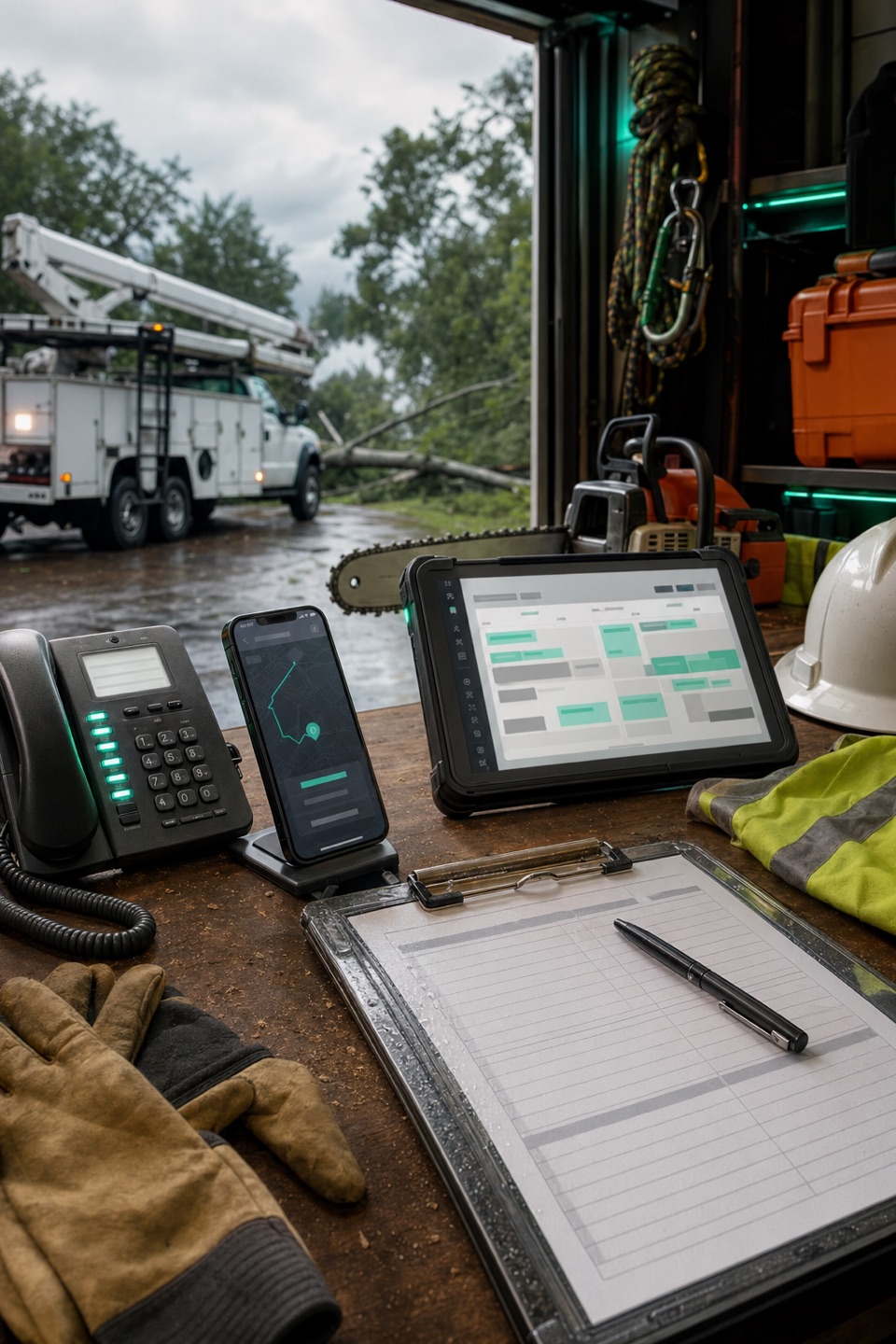
A blocked-driveway tree call is urgent, local, and safety-sensitive. The first answer should lower stress, capture access and hazard facts, avoid DIY cutting advice, and give a credible next step.
Read resource
Landscaping missed-call ROI is not just about phone volume. It is about recovered estimates, recurring maintenance accounts, seasonal cleanup demand, irrigation work, and better property details for callbacks.
Read resourceThese references support the phone demand, local search, and response speed claims above.
IBISWorld • 2025-07 • Accessed 2026-05-14
IBISWorld market-size page reporting a $39.5 billion 2025 U.S. tree-trimming services market and 3.4% 2025 market-size growth.
Open sourceU.S. Bureau of Labor Statistics • 2025-08-28 • Accessed 2026-05-14
BLS Occupational Outlook Handbook profile for grounds maintenance workers, noting swimming-pool maintenance duties, 1.3 million 2024 jobs, 4% projected growth, and seasonal spring, summer, and fall work patterns.
Open sourceAngi • 2026-03-04 • Accessed 2026-04-26
Angi tree-removal cost guide showing a normal $200-$2,000 range, an average around $750, and much higher costs for complex removals near structures or power lines.
Open sourceOccupational Safety and Health Administration • 2021-06-30 • Accessed 2026-04-26
OSHA guidance explaining that tree-care workers can be electrocuted when workers, equipment, or branches contact overhead or underground power lines.
Open sourceOccupational Safety and Health Administration • Accessed 2026-04-26
OSHA tree-care hazard page organizing resources around electrical, falling, struck-by, chipper, aerial-lift, PPE, and other tree-care work hazards.
Open sourceOccupational Safety and Health Administration • Accessed 2026-04-26
OSHA disaster-response activity sheet explaining that storm-damaged trees and limbs may block roads, fall onto structures, tangle in utility lines, or become future safety hazards.
Open sourceFederal Emergency Management Agency • 2026-03 • Accessed 2026-04-26
FEMA debris-removal guidance describing hazardous limb, branch, and tree removal when incident-damaged trees pose immediate threats to life, public health and safety, or significant property damage.
Open sourceTree Care Industry Association • Accessed 2026-04-26
TCIA industry site describing support for tree-care businesses across safety, workforce development, advocacy, training, and business strategy.
Open sourceInvoca • 2025-08-18 • Accessed 2026-05-16
Invoca analysis showing live answer-rate benchmarks across industries and calling behavior for high-stakes purchases.
Open sourceBrightLocal • 2025 • Accessed 2026-05-16
Survey of 1,000 US consumers about general and local search behavior, maps usage, and business information expectations.
Open source