
Learn
Set the operating rules.
Services, coverage, hours, booking, routing, approved answers, and escalation paths are defined first.
I&O answers new and existing customers, captures pest context, and protects route-ready appointments.
See pest control ROIRespond quickly, preserve customer context, and keep every approved follow-up moving without sacrificing the human experience.
I&O answers homeowners and account customers, captures approved pest control companies context, and books or routes the next step.
I&O follows up approved homeowners and account customers, preserves source and contact rules, and books the next conversation.
Illustrative planning model. Replace the assumptions with your own call volume and booking value.
Model: monthly inbound calls × calls not answered live (%) × unanswered calls recovered (%) × first-visit value. Replace every assumption with your phone logs and collected outcomes.
Meet Adam, your around-the-clock call handling employee that feels human.
I&O learns the operation once, then answers, books, follows up, and routes every approved conversation within your rules.
Services, coverage, hours, booking, routing, approved answers, and escalation paths are defined first.
Human-sounding AI answers homeowners and account customers without sending valuable demand to voicemail.
Each handled conversation becomes inspection-ready pest control bookings or a complete staff-ready handoff.
Answered demand, booked outcomes, routed conversations, and modeled value stay visible as performance improves.
Start with missed calls, service questions, or approved follow-up, then expand after retention impact is visible.
Use these checks to decide whether this call lane is worth modeling, what staff keeps, and where the next step should route.
It can collect contact details, property type, pest concern, location in the property, preferred timing, service area, and urgency, then move the caller toward an inspection or staff callback.
Product-specific pesticide use, safety judgment, treatment selection, and health-sensitive questions should route to trained staff.
It covers overflow, after-hours demand, repetitive questions, and missed-call recovery so the office can focus on dispatch, customers, and technicians.
Demand slips away while the team is already serving customers, patients, or active jobs.
A homeowner who saw termites, roaches, mice, bed bugs, wasps, or ants wants a clear next step now. If the office misses the call, the buyer often keeps searching until another company answers.
The office is often handling routes, technician questions, invoices, chemical records, callbacks, and cancellations when new inspection calls arrive.
A termite inspection, bed bug concern, commercial kitchen issue, mosquito plan, wildlife question, and routine quarterly service request need different intake details and routing.
Every statistic links to a public source, keeping the revenue case grounded.
BLS also notes that evening and weekend work is common, matching the hours when many pest callers need a fast answer.
Termite calls can carry high inspection, treatment, and property-risk urgency before a homeowner compares another provider.
Even ordinary pest calls can represent meaningful near-term revenue, while severe infestations and recurring plans can raise account value.
Call handling should match how the business earns trust, books revenue, and hands off exceptions.
Callers are inviting someone into a home, rental, restaurant, or office. A prompt, organized answer helps the company feel competent before the technician arrives.
BLS notes that evening and weekend work is common for pest control workers. Customer calls also happen outside office hours, especially when pests are discovered at night.
Pest type, room, property type, severity, pets, children, landlord or tenant status, recurrence, and service area can all change the booking path and technician preparation.
The best first layer is fast answer, clear qualification, then booking or escalation based on your operating rules.
I&O picks up immediately, captures contact details, property type, pest type, location in the property, urgency, photos or notes if needed, and preferred timing.
It answers company-approved questions about service area, inspection types, prep basics, recurring plans, hours, pricing ranges, and what happens before a technician visit.
Bookable inspection calls move toward the calendar. Safety-sensitive, commercial, pesticide, severe infestation, wildlife, or account-specific questions route to staff with a clean summary.
These conversations are the highest-leverage starting point because they connect directly to revenue, schedule protection, or staff capacity.
Homeowners asking about ants, roaches, spiders, fleas, ticks, wasps, mosquitoes, termites, mice, rats, or recurring indoor pests.
Outcome: Capture the concern and move the caller toward the right inspection or treatment visit.
Mud tubes, swarmers, damaged wood, real estate inspections, warranty questions, or annual renewal questions.
Outcome: Route high-value inspection demand quickly with property and urgency details attached.
High-anxiety calls where the company needs location, signs seen, travel or tenant context, pets, children, and whether the caller needs prep instructions.
Outcome: Give a calm first response and route according to the company's approved call path.
Restaurants, multifamily properties, offices, schools, warehouses, and landlords asking for urgent service, documentation, recurring plans, or compliance-sensitive help.
Outcome: Capture property details and route complex accounts without losing new business.
Local SEO, reviews, yard signs, referrals, property managers, and paid search create pest calls. I&O helps keep that demand from disappearing into voicemail.
Routine inspection, pricing-range, prep, and recurring-plan questions get handled while staff keep dispatch, billing, and technician support moving.
Commercial accounts, termite questions, bed bugs, pesticide concerns, and severe infestations reach staff with the caller's details already captured.
Inspection calls hit voicemail while dispatch is handling the morning route.
AfterCallers get an immediate answer, intake, and booking path.
Termite and bed bug callers leave vague messages with little context.
AfterStaff receive pest type, property details, urgency, and requested next step.
Routine service and prep questions interrupt the office all day.
AfterApproved answers are handled consistently before staff step in.
After-hours pest sightings wait until the company reopens.
AfterEvening and weekend callers can still move toward a booked inspection.
Some do. The call path keeps treatment decisions, pesticide guidance, structural conclusions, and commercial exceptions with staff while AI handles answer, intake, approved Q&A, booking, and routing.
Use approved price-range and inspection-policy language only. Exact treatment plans, termite bids, fumigation, wildlife, and commercial pricing should route to staff.
This covers the calls staff cannot catch immediately: route planning, technician dispatch, billing, lunch, weekends, seasonal surges, and after-hours pest sightings.
Start with the buyer's reason for calling. iando captures intent, books what is ready, and hands staff the context that closes.
Edit call volume, qualified intent, 25% lift, and first-visit value.
Planning model only. Replace with the company's call logs, inspection close rate, treatment mix, recurring-plan value, termite close rate, technician capacity, and service-area limits.
iando answers fast, captures why they raised their hand, books or routes the next step, and gives staff the context to close.
Each guide gives operators practical depth around staffing, call handling, conversion, and operational efficiency.
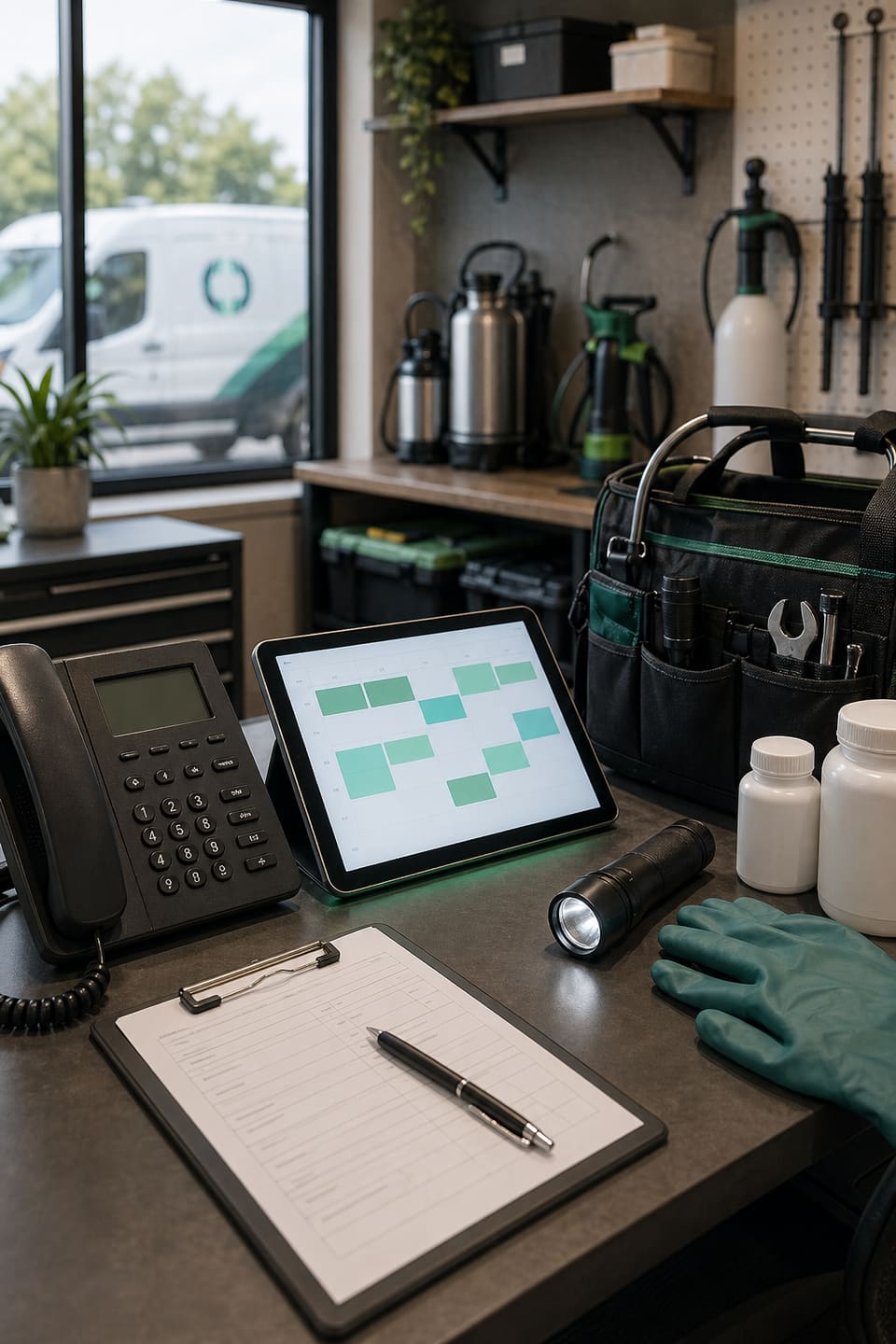
Pest control callers often want help the moment they see the problem. A missed call can be a lost inspection, lost treatment, or lost recurring-plan opportunity.
Read resource
Bed bug calls are high-anxiety, evidence-light, and easy to lose. The first answer should collect facts, avoid treatment advice, and create a credible inspection or callback path.
Read resource
Landscaping missed-call ROI is not just about phone volume. It is about recovered estimates, recurring maintenance accounts, seasonal cleanup demand, irrigation work, and better property details for callbacks.
Read resourceThese references support the phone demand, local search, and response speed claims above.
U.S. Bureau of Labor Statistics • 2025-08-28 • Accessed 2026-05-12
BLS Occupational Outlook Handbook profile for pest control workers covering 2024 employment, projected 2024-2034 growth, annual openings, licensing, safety requirements, and evening/weekend work.
Open sourceNational Pest Management Association / PR Newswire • 2026-03-02 • Accessed 2026-05-14
NPMA termite awareness release reporting an estimated $6.8 billion in annual U.S. property damage from termites and emphasizing early inspection and prevention.
Open sourceForbes Home • Accessed 2026-05-14
Forbes Home cost guide reporting typical exterminator visit cost ranges and noting that severe bed bug, fumigation, or larger infestation work can cost much more.
Open sourceU.S. Environmental Protection Agency • Accessed 2026-05-12
EPA list identifying public-health pests such as cockroaches, mosquitoes, ticks, bed bugs, rats, and mice, with brief explanations of health and contamination concerns.
Open sourceU.S. Environmental Protection Agency • Accessed 2026-05-12
EPA consumer guidance on safe pest control, prevention, EPA-registered products, and when residents should use care before applying pesticides.
Open sourceU.S. Environmental Protection Agency • Accessed 2026-05-12
EPA integrated pest management guidance for housing managers, emphasizing pest prevention, exclusion, food and water source control, and coordinated work with pest management professionals.
Open sourceU.S. Environmental Protection Agency • Accessed 2026-05-12
EPA bed bug guidance recommending careful product selection, EPA-registered products, and pest management professional involvement when inspection or treatment is needed.
Open sourceInvoca • 2025-08-18 • Accessed 2026-05-16
Invoca analysis showing live answer-rate benchmarks across industries and calling behavior for high-stakes purchases.
Open sourceBrightLocal • 2025 • Accessed 2026-05-16
Survey of 1,000 US consumers about general and local search behavior, maps usage, and business information expectations.
Open source