
Learn
Set the operating rules.
Services, coverage, hours, booking, routing, approved answers, and escalation paths are defined first.
I&O answers service calls, captures pool and access details, and protects recurring customer relationships.
See pool service ROIRespond quickly, preserve customer context, and keep every approved follow-up moving without sacrificing the human experience.
I&O answers pool owners, captures approved pool service companies context, and books or routes the next step.
I&O follows up approved pool owners, preserves source and contact rules, and books the next conversation.
Illustrative planning model. Replace the assumptions with your own call volume and booking value.
Model: monthly inbound calls × calls not answered live (%) × unanswered calls recovered (%) × first-job value. Replace every assumption with your phone logs and collected outcomes.
Meet Adam, your around-the-clock call handling employee that feels human.
I&O learns the operation once, then answers, books, follows up, and routes every approved conversation within your rules.
Services, coverage, hours, booking, routing, approved answers, and escalation paths are defined first.
Human-sounding AI answers pool owners without sending valuable demand to voicemail.
Each handled conversation becomes route-ready pool service jobs or a complete staff-ready handoff.
Answered demand, booked outcomes, routed conversations, and modeled value stay visible as performance improves.
Start with missed calls, service questions, or approved follow-up, then expand after retention impact is visible.
Use these checks to decide whether this call lane is worth modeling, what staff keeps, and where the next step should route.
It can capture the service request, address, pool type, condition, photos or notes, access instructions, timing, and contact details, then move qualified calls toward a visit or staff review.
It can identify whether the caller wants weekly, biweekly, seasonal, vacation-home, commercial, or one-time service and collect enough context for staff to price or schedule the next step.
It covers missed calls, overflow, after-hours demand, approved Q&A, intake, and summaries so staff can focus on scheduling, routing, pricing, and customer follow-up.
Demand slips away while the team is already serving customers, patients, or active jobs.
Opening season, heat waves, algae blooms, storm cleanup, and closing season can create call bursts exactly when route coordinators and owners are already stretched.
A caller asking about weekly service, a first cleaning, or a green-pool cleanup may become a monthly account if the company answers quickly and gives a clear next step.
Pool technicians are driving, testing water, cleaning, checking equipment, and talking with customers on site. Missed calls pile up while billable work is happening.
Every statistic links to a public source, keeping the revenue case grounded.
Pool service is a large, fragmented local-services category where fast call handling can shape which provider wins openings, cleanings, repairs, and recurring maintenance accounts.
High fragmentation means homeowners and property managers often have many local alternatives when a pool company misses the first call.
Even routine visits carry enough value that missed openings, green-pool calls, equipment checks, and weekly-service leads can add up quickly.
Recurring service calls can be worth more than one visit because the phone call may start a monthly maintenance relationship.
Chemical, exposure, and unsafe-water calls need careful routing and approved language, not casual troubleshooting by an untrained phone answer.
Commercial, HOA, apartment, hotel, and public-pool calls often carry compliance and safety urgency that should be routed clearly.
Water-efficiency questions can create service, cover, leak-check, and equipment-maintenance opportunities when the call path captures the pool owner's need.
Openings, closings, warm-weather maintenance, storm cleanup, and high-use pool issues compress calls into seasonal windows.
Pool callers may ask safety-sensitive questions about barriers, covers, alarms, unsafe water, or emergencies, so the call path should route those issues carefully.
Call handling should match how the business earns trust, books revenue, and hands off exceptions.
IBISWorld describes a fragmented pool-cleaning market with many local providers. If a homeowner or property manager gets voicemail, another company can frame the job first.
Calls about chemical exposure, unsafe water, electrical equipment, leaks, or child-safety concerns need approved language and staff routing instead of casual phone advice.
Pool type, size, surface, current condition, service history, equipment issue, photos, access, gate code, pets, and timing all help staff book or route the next step.
The best first layer is fast answer, clear qualification, then booking or escalation based on your operating rules.
I&O picks up immediately and confirms whether the caller needs weekly maintenance, an opening, a closing, a first cleaning, algae cleanup, equipment help, leak follow-up, or commercial service.
It collects address, pool type, approximate size, condition, photos or requested notes, equipment symptoms, access instructions, timing, service area fit, and whether the caller wants a recurring plan or one-time visit.
Bookable jobs move toward the calendar. Chemical, unsafe-water, electrical, leak, exact-price, commercial-compliance, and staff-only questions route with context attached.
These conversations are the highest-leverage starting point because they connect directly to revenue, schedule protection, or staff capacity.
Weekly service, biweekly service, first-time cleanup, green-pool recovery, vacation-home coverage, and route-fit questions.
Outcome: Capture the lead and move the caller toward a scheduled visit or plan conversation.
Seasonal openings, winterization, cover removal, equipment startup, chemical balancing, safety-cover questions, and closing-package requests.
Outcome: Protect seasonal demand before the caller books another local pool company.
Pump noise, filter problems, heater issues, automation trouble, cloudy water, algae, suspected leaks, and after-storm debris.
Outcome: Gather symptoms and route repair or staff-review needs without asking technicians to restart the call.
Apartment, hotel, HOA, school, gym, or public-pool questions involving inspection, closure, chemical exposure, unsafe water, access, or emergency response.
Outcome: Use approved guardrails and route compliance or safety-sensitive issues to trained staff.
Fast answering keeps weekly-service, biweekly-service, opening, closing, and first-cleaning prospects from shopping until another provider answers.
Approved Q&A and structured intake keep technicians focused while callers still get a useful first answer and next step.
Callbacks include pool type, condition, equipment issue, access notes, photos, timing, and urgency instead of only a phone number.
Opening calls hit voicemail during the spring rush.
AfterCallers get an immediate answer and a clear booking path.
Staff call back without knowing pool type, size, condition, or access notes.
AfterCallbacks start with the details needed to quote, book, or route.
Chemical, unsafe-water, and equipment concerns mix with routine cleaning calls.
AfterSafety-sensitive and staff-only issues route by approved rules.
Technicians lose focus answering repetitive service-area and timing questions.
AfterApproved basics are handled while the route keeps moving.
Correct. The AI should use approved language, gather facts, and route chemical exposure, unsafe-water, and treatment-specific questions to trained staff instead of improvising.
The first answer should explain approved pricing basics, collect pool details, and route quote decisions to staff when size, condition, equipment, access, or commercial requirements matter.
That relationship still matters. AI covers missed calls, after-hours demand, approved Q&A, and intake so staff can follow up with better context.
Start with the buyer's reason for calling. iando captures intent, books what is ready, and hands staff the context that closes.
Edit call volume, qualified intent, 25% lift, and first-job value.
Planning model only. Replace with real missed-call volume, recurring-plan conversion, opening and closing mix, repair mix, average first-job value, retention, and route capacity.
iando answers fast, captures why they raised their hand, books or routes the next step, and gives staff the context to close.
Each guide gives operators practical depth around staffing, call handling, conversion, and operational efficiency.
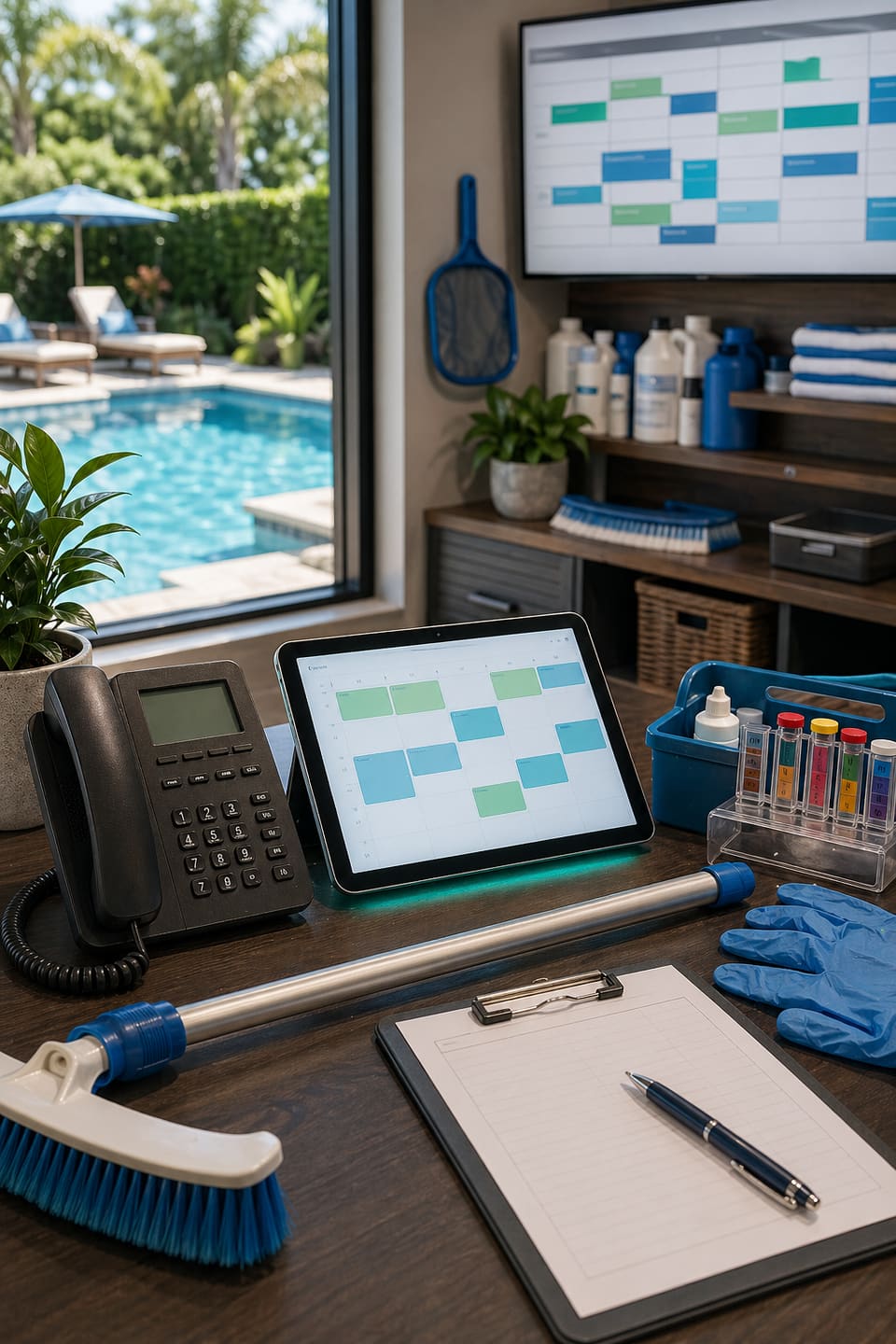
Pool-service calls are seasonal, local, and often urgent. The missed-call revenue case starts with fast answering, better pool details, careful safety handoffs, and more recurring-account capture.
Read resource
Fence company missed-call ROI starts with quote-ready callers who need a fast answer, a clean estimate path, and careful routing for materials, gates, utility marking, permits, and property-line questions.
Read resourceThese references support the phone demand, local search, and response speed claims above.
IBISWorld • 2025-11 • Accessed 2026-05-14
IBISWorld industry analysis reporting an estimated $8.8 billion U.S. swimming-pool-cleaning services market in 2025, 2.3% 2025 growth, 78,817 businesses in 2025, fragmented competition, and services that include cleaning, equipment maintenance, and chemical adjustments.
Open sourceAngi • 2026-03-17 • Accessed 2026-05-14
Angi pool-maintenance cost guide showing routine maintenance visit costs, cleaning, chemical balancing, opening and closing, equipment checks, deep cleaning, salt-cell replacement, and labor ranges.
Open sourceHomeGuide • 2025-09-22 • Accessed 2026-05-14
HomeGuide pool-maintenance cost guide reporting monthly service ranges, first cleaning, opening, closing, repairs, yearly upkeep, and total annual ownership cost ranges.
Open sourceCenters for Disease Control and Prevention • 2025-05-28 • Accessed 2026-04-26
CDC pool-chemical emergency guidance reporting about 4,500 emergency department visits each year from pool chemical injuries and recommending emergency response planning.
Open sourceCenters for Disease Control and Prevention • 2024-11-06 • Accessed 2026-04-26
CDC overview of the Model Aquatic Health Code, including public aquatic venue guidance, prevention of injuries and illnesses, outbreaks, chemical injuries, and inspection closures for pools and hot tubs.
Open sourceU.S. Environmental Protection Agency WaterSense • Accessed 2026-05-14
EPA WaterSense guidance on pool water efficiency, including maintenance practices, evaporation, leaks, cleaning, and the note that pool covers can prevent up to 95% of pool-water evaporation.
Open sourceU.S. Bureau of Labor Statistics • 2025-08-28 • Accessed 2026-05-14
BLS Occupational Outlook Handbook profile for grounds maintenance workers, noting swimming-pool maintenance duties, 1.3 million 2024 jobs, 4% projected growth, and seasonal spring, summer, and fall work patterns.
Open sourceCenters for Disease Control and Prevention • 2026-01-27 • Accessed 2026-04-26
CDC drowning facts page reporting that drowning is a leading cause of death for children and that children ages 1-4 are especially at risk, underscoring the need for careful safety-sensitive routing.
Open sourceInvoca • 2025-08-18 • Accessed 2026-05-16
Invoca analysis showing live answer-rate benchmarks across industries and calling behavior for high-stakes purchases.
Open sourceBrightLocal • 2025 • Accessed 2026-05-16
Survey of 1,000 US consumers about general and local search behavior, maps usage, and business information expectations.
Open source