I&O AI For SaaS Demo Follow-Up
iando.ai answers and follows up on demo requests, pricing calls, trial hand-raisers, webinar replies, product-qualified leads, no-show reschedules, procurement questions, and security-review callbacks so revenue teams get buyer context while interest is still active.
Built for B2B SaaS teams where response speed matters, but qualification, pricing, security, legal, procurement, product fit, discounting, and sales judgment still need approved staff.
Built around the jobs your phone has to do: answer, schedule, handle approved Q&A, create the next step, and recover missed-call revenue.
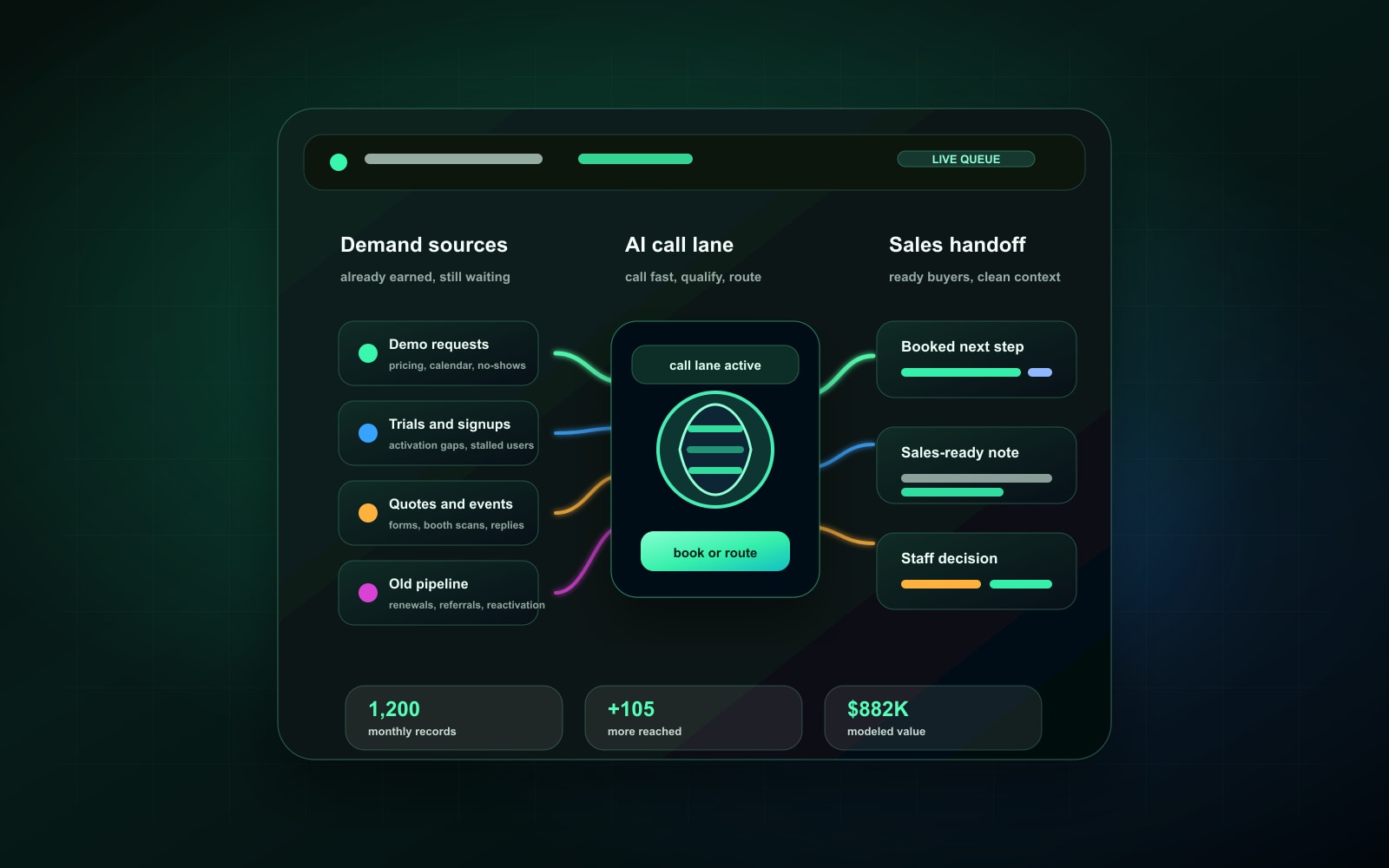
Edit call volume, qualified intent, 25% lift, and weighted pipeline value input.
Planning model only. Replace with source volume, connect rate, qualification rate, meeting-booked rate, show rate, SQL rate, opportunity rate, win rate, ACV, sales cycle, and approved call rules.
Show the caller a next step before they move on.
iando answers quickly, captures the details that matter, uses approved language, and gives staff a cleaner handoff.
The business case for b2b saas demo follow-up teams
Start with the calls the business already earned, then estimate which ones can become appointments, jobs, consults, or useful follow-ups.
For B2B SaaS teams, ROI is not raw call volume. It is kept buyer conversations: demo requests reached before a competitor answers, no-shows rebooked before the week is lost, trials helped before abandonment, and sellers handed useful notes instead of blank activity.
- Monthly demo requests, pricing calls, trial hand-raisers, webinar replies, no-show reschedules, and product-qualified callbacks
- Share that reaches a qualified account, active buyer, buying-committee member, partner, or expansion contact
- A conservative 25% lift from immediate answering and approved follow-up
- Weighted pipeline value input per booked demo, qualified discovery, rebooked meeting, trial assist, or expansion next step
- Capture demo requests, pricing calls, trial hand-raisers, webinar replies, no-show reschedules, procurement questions, and security-review callbacks while intent is active.
- Collect buying role, company size, use case, current tools, urgency, timeline, source, meeting preference, and buying-committee context.
- Separate booked demo, qualified discovery, trial assist, no-show rebook, procurement callback, security-review handoff, and staff-review paths.
- Send custom pricing, discounting, contract terms, data-processing, security exceptions, procurement commitments, and product-fit promises to approved staff.
What missed calls actually look like for b2b saas demo follow-up teams
These are the moments where demand slips away because the team is already busy serving customers, patients, or active jobs.
Demo interest decays while buyers compare
A buyer who asks for a demo, pricing, trial help, security review, or procurement next step is often talking to several vendors. Slow response gives another team the first useful conversation.
Sellers inherit blank form fills
A request rarely includes buying role, use case, company size, current tools, timeline, urgency, budget owner, meeting preference, no-show reason, or the exact question that needs staff.
Advice-sensitive questions need a clean handoff
SaaS follow-up can collect facts and book next steps, but custom pricing, discounting, security exceptions, legal terms, procurement commitments, and product-fit promises need approved staff.
What public data says about this buying behavior
Every stat references a public source below, so the revenue argument stays grounded instead of padded with invented benchmarks.
Buyers can get instant answers elsewhere, so the vendor response needs to be fast, specific, and useful enough to earn the next meeting.
Qualified SaaS demand should move into a clear calendar path before manual follow-up delay cools the account.
I&O AI should reduce repetitive chasing and prepare buyer conversations so sellers can spend more time on judgment, fit, and closing.
Improving conversion from already-earned demo demand can matter before a team increases paid acquisition or headcount.
Technical seller time is valuable, so the first response should collect context and send judgment-heavy questions to staff.
B2B SaaS Demo Follow-Up Teams need phone coverage built around their actual calls
The phone experience should match how the business earns trust, books revenue, and hands off exceptions.
Software buyers research before they talk
G2's 2026 research said more than half of B2B software buyers start research with AI chatbots more often than Google, and most use AI chatbots at some point in the buying process.
Qualified form fills still need a fast meeting path
Chili Piper's analysis of more than four million web form submissions found qualified form submissions booked meetings at 66.7%, far above the average form-to-meeting rate it reported.
Seller time should stay on judgment
Salesforce's 2026 State of Sales report said representatives spend 40% of time selling and 60% on other tasks. I&O AI should prepare conversations so sellers spend more time on fit, strategy, and closing.
How iando.ai handles these calls
The best first layer is fast answer, clear qualification, then booking or escalation based on your operating rules.
Answer or follow up while buyer interest is active
iando.ai identifies demo requests, pricing calls, trial questions, product-qualified hand-raisers, webinar replies, no-show reschedules, partner referrals, procurement questions, and security-review callbacks.
Capture seller-ready details
It records buying role, company size, use case, current tools, pain, timeline, urgency, source, budget context, buying committee, meeting preference, and the exact question that needs staff.
Book, rebook, summarize, or send to staff
The next step can be a booked demo, qualified discovery, no-show rebook, trial assist, procurement handoff, security-review callback, partner response, or expansion follow-up while staff keep sales judgment.
Calls iando.ai can answer, escalate, or recover
These conversations are the highest-leverage starting point because they connect directly to revenue, schedule protection, or staff capacity.
Demo request and pricing callbacks
Buyers who fill out a form, call after seeing pricing, ask for a live walkthrough, request a plan comparison, or need to understand whether the product fits their use case.
Outcome: Capture role, company size, use case, urgency, current tools, buyer source, meeting window, and staff-only pricing questions.
Trial and product-qualified hand-raisers
Users who ask about setup, invite limits, integrations, data import, plan limits, feature access, support, or whether a trial can become a team rollout.
Outcome: Collect trial state, workspace size, blocker, admin role, target outcome, and expansion context before customer-facing staff respond.
No-show and reschedule recovery
Prospects who miss a discovery call, need a new calendar slot, invite another stakeholder, change priority, or need a shorter buying-committee path.
Outcome: Rebook approved slots, capture reason, note urgency, and send high-value or at-risk accounts to staff with context.
Security, procurement, and legal-sensitive questions
Buyers asking about security review, data processing, legal terms, procurement requirements, custom paperwork, discounting, renewal timing, or contract exceptions.
Outcome: Capture the question and send it to the right staff path without inventing terms, commitments, or security claims.
What operators actually care about
Faster qualified demo booking
A buyer gets a useful next step before the next vendor, review site, AI answer, or comparison page captures the conversation.
Cleaner seller callbacks
Sales and success teams see source, role, use case, tools, urgency, buying committee, meeting preference, and guardrail exceptions before they respond.
More disciplined no-show recovery
Missed demos, reschedules, pricing questions, trial blockers, and security-review callbacks stop depending on spare seller time.
Where the payoff shows up operationally
- Capture demo requests, pricing calls, trial hand-raisers, webinar replies, no-show reschedules, procurement questions, and security-review callbacks while intent is active.
- Collect buying role, company size, use case, current tools, urgency, timeline, source, meeting preference, and buying-committee context.
- Separate booked demo, qualified discovery, trial assist, no-show rebook, procurement callback, security-review handoff, and staff-review paths.
- Send custom pricing, discounting, contract terms, data-processing, security exceptions, procurement commitments, and product-fit promises to approved staff.
- Turn missed calls and stale hand-raisers into seller-ready next steps without adding repetitive chasing labor.
How the operation changes when the phone stops leaking revenue
A demo form arrives after hours and waits until the next sales block.
AfterThe buyer gets a fast response, the meeting path is clear, and staff receive use-case context.
A pricing caller becomes a voicemail with no role, company size, or urgency.
AfterThe callback starts with buyer role, account context, use case, timeline, and staff-only pricing questions.
No-show recovery depends on when an account executive has time to chase.
AfterThe buyer gets approved reschedule help and the team sees which accounts still have active intent.
Security and procurement questions invite rushed off-script replies.
AfterSensitive topics are captured and sent to approved staff with the account context attached.
Questions before putting AI on the phone
Our account executives need to qualify the buyer
Correct. iando.ai should capture facts, book approved next steps, and send judgment-sensitive questions to sellers, solutions consultants, security, legal, or finance.
SaaS follow-up has consent and contact rules
Use the team's approved contact windows, consent rules, do-not-contact process, disclosure language, and source-specific follow-up rules before expanding call volume.
Demo requests vary by segment
That is why qualification matters. Segment, account size, use case, urgency, buying role, source, product area, and meeting preference help staff prioritize serious conversations.
Turn more calls into kept SaaS next steps for b2b saas demo follow-up teams.
iando.ai is built for businesses that depend on the phone and lose money when callers do not get a fast, useful answer. Book a demo and map the revenue path to your call volume, hours, booking logic, and staff-only handoffs.
Frequently asked questions
Can I&O AI follow up on SaaS demo requests?
Yes, when the team supplies approved contact windows, consent rules, qualification questions, calendar rules, handoff rules, and staff-only exception language.
Can it quote custom pricing or negotiate?
No. Custom pricing, discounts, legal terms, data-processing terms, security exceptions, procurement commitments, and product-fit promises should go to approved staff.
What should it capture before a seller calls back?
Name, company, role, source, use case, company size, current tools, urgency, timeline, buying committee, meeting preference, trial state, procurement needs, and the buyer's main question.
Does this help with no-shows?
It can follow approved reschedule language, capture why the meeting was missed, rebook allowed slots, note urgency, and send high-value exceptions to staff.
Deeper guides for b2b saas demo follow-up teams
Each guide gives operators practical depth around staffing, call handling, conversion, and operational efficiency.
Demo response is where software interest becomes a booked revenue conversation
Demo follow-up is not just more dialing. It is faster response with account context, clear staff boundaries, and a next step before software buyers compare elsewhere.
Read guideMore phone-revenue paths
Keep moving to the next useful call plan.
These pages connect the guide, adjacent call coverage, pricing, and setup paths buyers usually need next.
Research behind this page
These references support the phone-demand, local-search, and response-speed claims above.
G2 • 2026-04-21 • Accessed 2026-05-05
G2 research report stating that 51% of B2B software buyers start research with AI chatbots more often than Google and 71% rely on AI chatbots at some point in the buying process.
Open sourceChili Piper • 2025-11-11 • Accessed 2026-05-05
Chili Piper benchmark based on more than four million web form submissions, reporting a 30% average form-to-meeting rate and 66.7% meeting booking for qualified submissions.
Open sourceSalesforce • 2026 • Accessed 2026-05-05
Salesforce State of Sales report stating that sales representatives spend 40% of their time selling and 60% on non-selling tasks, with agentic AI adoption shaping sales work.
Open sourceLighter Capital • 2025-09-09 • Accessed 2026-05-05
Lighter Capital benchmark based on data from 155 SaaS startups, reporting 28% median annual growth and a 3.19x median sales and marketing multiple in 2025.
Open sourceU.S. Bureau of Labor Statistics • Accessed 2026-05-05
BLS Occupational Outlook Handbook profile describing sales engineers as sellers of complex scientific and technological products or services, including software-related products and support.
Open sourceG2 • 2025 • Accessed 2026-05-05
G2 buyer-behavior report based on a global survey of B2B software decision makers, covering AI's role in software selection, buyer confidence, and software purchase expectations.
Open sourceHarvard Business Review • 2011-03-01 • Accessed 2026-05-05
Harvard Business Review article describing research on 2,241 U.S. companies and online sales lead response, including slow average response times and nonresponse rates.
Open sourceInsideSales • 2021 • Accessed 2026-05-05
InsideSales page summarizing its 2021 lead-response research across more than 55 million sales activities on 5.7 million inbound leads and 400+ companies, including an 8x first-five-minutes conversion finding.
Open sourceInvoca • 2025-08-18 • Accessed 2026-05-13
Invoca analysis showing live answer-rate benchmarks across industries and calling behavior for high-stakes purchases.
Open sourceBrightLocal • 2025 • Accessed 2026-05-13
Survey of 1,000 US consumers about general and local search behavior, maps usage, and business information expectations.
Open source