Start with verified local intent, not a generic call list
The strongest franchise and multi-location follow-up calls start from a known source: a local search click, quote form, booking request, call after hours, event scan, review callback, no-show, inactive-customer list, or wrong-location inquiry.
That context matters because a distributed brand has two jobs at once. The brand has to keep language consistent, while the local operator needs enough detail to decide whether the next step is a quote, booking, callback, manager review, or staff-only exception. When those verified sources pile up faster than locations can respond, treat the problem as signup backlog follow up instead of broad prospect dialing.
- Brand and local quote forms
- Missed calls, after-hours calls, and local campaign replies
- Grand-opening, community, webinar, and field-event lists
- No-shows, review callbacks, inactive customers, and old estimates
Use a kept-local-next-step model
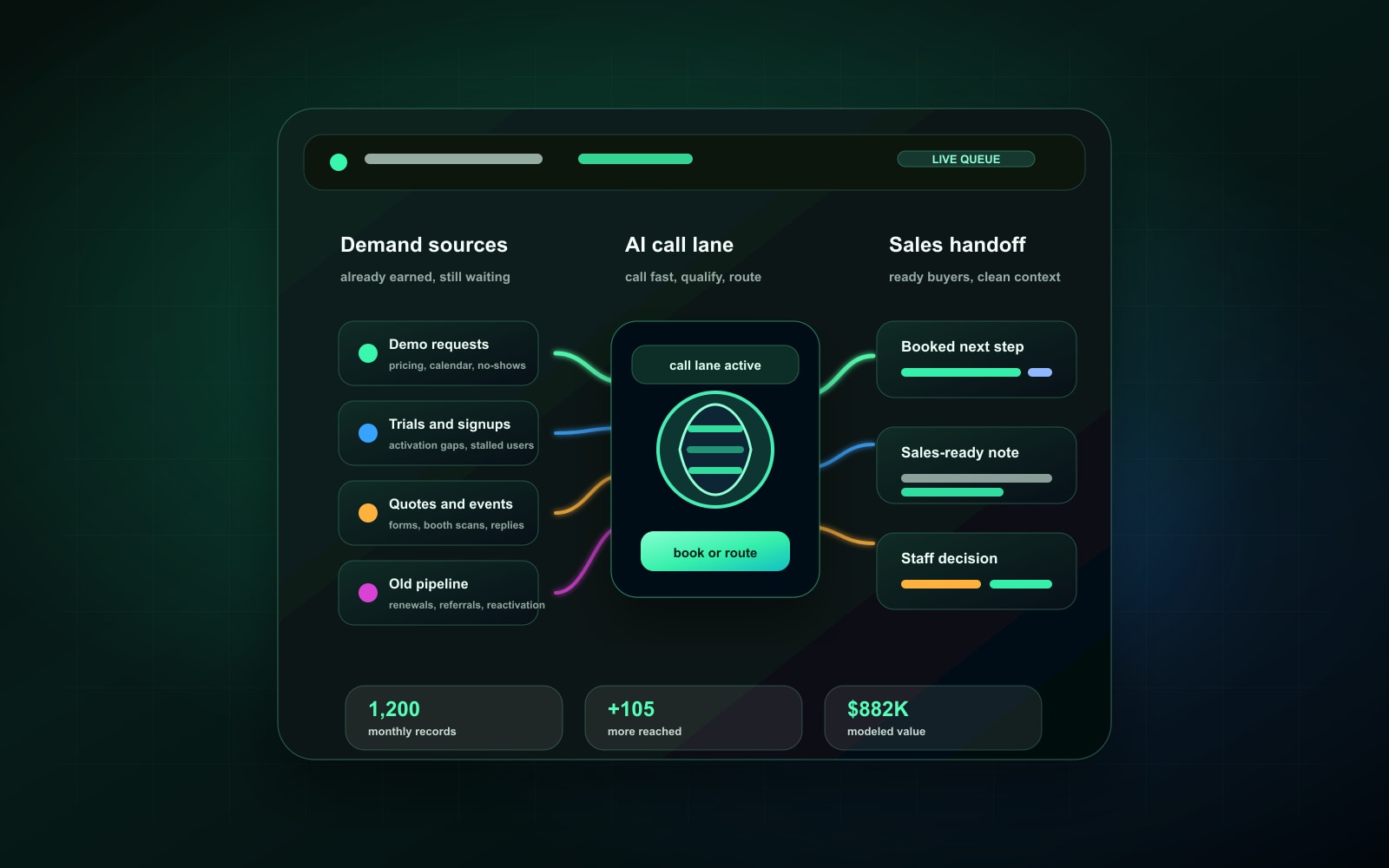
Raw call attempts are not the business case. The practical model starts with monthly follow-up volume, filters for location-ready intent, estimates the lift from faster approved follow up, and assigns a conservative weighted value to the next step.
For planning, 640 monthly verified local lead, quote, booking, event, review, no-show, and inactive-customer follow-up calls x 41 percent location-ready intent x 23 percent lift x $725 weighted value input equals about 60 kept location-ready next steps and $43,755 in monthly modeled value before suppression, opt outs, show rate, close rate, repeat value, location capacity, and franchise mix are added.
- 640 monthly local lead, quote, booking, event, review, no-show, and inactive-customer follow-up calls
- 41% location-ready intent after filtering duplicates, wrong territory, low-fit requests, and staff-only questions
- 23% lift from fast approved follow up and cleaner handoff to the right location
- $725 weighted value input per kept local next step before close rate, show rate, repeat value, and franchise mix
Franchise scale makes handoff accuracy valuable
The International Franchise Association's 2025 outlook projected more than 851,000 U.S. franchise units, more than 9 million jobs, and more than $936 billion in total output. FRANdata's outlook points to the same scale and continued unit growth.
At that scale, small handoff defects repeat. A lead sent to the wrong territory, a local quote that waits overnight, or a no-show that is never rebooked can become a system-wide revenue leak when every location handles it differently.
Local search creates response expectations
Rio SEO's 2025 local search study reported daily local-business search behavior and fast response expectations. BrightLocal's consumer search research also shows that local buyers inspect practical trust signals such as contact information and hours.
For multi-location brands, the phone path is part of that trust signal. A customer who cannot confirm the right location, availability, service area, or next step may move to another provider before the local team sees the request.
Keep local operators on judgment
Salesforce's 2026 State of Sales report said representatives spend 40 percent of time selling and 60 percent on other tasks. In franchise systems, local operators and managers often carry the same burden: callbacks, no-show recovery, review response, local event lists, and brand-form follow-up.
Use iando to prepare the conversation. People should still own price exceptions, staffing decisions, territory calls, warranties, refunds, legal terms, compliance, service guarantees, and local relationship work.
Use approved follow-up boundaries
The approved call path should define the source record, location handoff rule, source system, contact window, opt-out language, permanent suppression check, caller ID rules, staff handoff, and the topics the AI employee must not promise.
Do not position franchise follow up as blanket dialing. Use it for approved lists where the brand has a concrete reason to call and a clear path to stop calling when someone opts out.
- No promised bookings, connect rates, local revenue, or repeat purchases
- No exact local pricing, availability exceptions, territory rights, refunds, warranties, legal terms, compliance, or custom-policy promises
- No ignoring TCPA, DNC, state calling rules, consent posture, opt outs, or customer-approved language
- No treating low-fit, duplicate, wrong-location, or staff-review-sensitive records as if they were ready buyers
What the call should capture
A useful local handoff should let staff decide the next action quickly. It should show whether the person is quote-ready, booking-ready, event-interested, no-show-recoverable, review-sensitive, inactive-customer-ready, wrong-location, or staff-review-sensitive.
Use this checklist before adding more local ad spend, events, franchisee campaigns, review programs, or brand forms.
- Location, market, address, service area, or territory signal
- Source, campaign, event, referral, review, or prior contact
- Service need, product interest, timing, urgency, and preferred callback window
- Suppression result, opt-out status, contact window, local owner, staff-only question, and any local exception requested