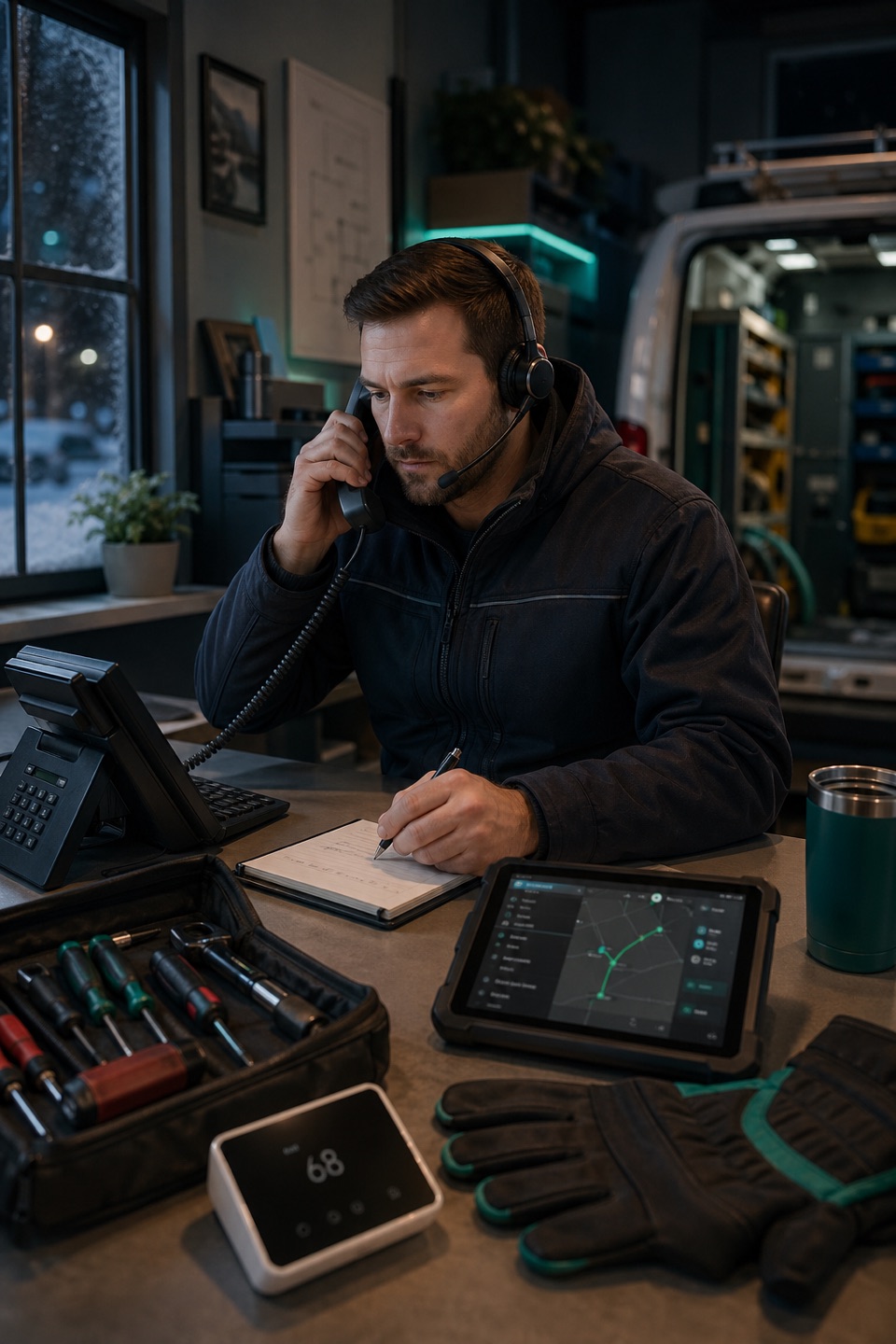
AI For Furnace No-Heat Calls
iando.ai answers furnace, heat pump, boiler, thermostat, after-hours, tenant, and property-manager heating calls 24/7 so winter urgency gets classified, documented, and moved into a clear next step before callers keep shopping.
Built for HVAC contractors where the first answer needs to lower stress, capture heat-loss and access context, avoid unsafe troubleshooting, and create a believable dispatch or callback path.
Built around the jobs your phone has to do: answer, schedule, handle approved Q&A, create the next step, and recover missed-call revenue.
Edit call volume, buyer intent, 25% lift, and average urgent heating job value.
Planning model only. Replace with winter call logs, after-hours mix, dispatchable share, diagnostic fee, repair close rate, replacement attach rate, property-management share, and actual average invoice value.
The business case for emergency hvac no-heat call teams
Start with the calls the business already earned, then estimate which ones can become appointments, jobs, consults, or useful follow-ups.
For emergency heating work, ROI is recovered repair visits, diagnostic fees, replacement opportunities, maintenance saves, and property-management relationships protected by a prepared first answer.
- Monthly no-heat, weak-heat, thermostat, furnace, boiler, and after-hours calls
- Dispatchable, diagnostic, replacement, or callback-ready share of those calls
- Average emergency heating repair, diagnostic, or replacement opportunity value
- A conservative 25% lift from immediate answering and cleaner handoff
- No-heat, weak-heat, furnace, boiler, heat pump, and thermostat calls answered immediately
- After-hours urgency and cold-night pressure captured
- Repair, maintenance, replacement, and callback paths separated
- Tenant impact, access, photos, and owner-update details organized
What missed calls actually look like for emergency hvac no-heat call teams
These are the moments where demand slips away because the team is already busy serving customers, patients, or active jobs.
No heat becomes urgent fast
A cold bedroom, weak heat, failed furnace, thermostat issue, older occupant, infant, frozen-pipe worry, or tenant complaint can turn a routine heating issue into a same-night trust test.
Winter callers keep dialing
When the house is cold, callers rarely wait patiently. If the first contractor cannot answer or sound prepared, the next search result gets the opportunity.
Property managers need update-ready details
Resident impact, owner-thread pressure, access windows, photos, repeat complaints, and open-by-morning expectations all matter when heating calls stack up after hours.
What public data says about this buying behavior
Every stat references a public source below, so the revenue argument stays grounded instead of padded with invented benchmarks.
No-heat calls can carry meaningful same-day value before emergency fees, replacement estimates, maintenance-plan saves, or high-cost component work are considered.
A no-heat call can become a replacement conversation when an older system has repeated failures or repair costs no longer make sense.
Seasonal no-cool demand lands in a labor market where technician capacity and dispatch clarity matter.
Emergency HVAC No-Heat Call Teams need phone coverage built around their actual calls
The phone experience should match how the business earns trust, books revenue, and hands off exceptions.
Warmth is the buying moment
No-heat demand is seasonal and emotional. The caller wants comfort, safety, and a clear next step before they care about a long explanation of the system.
Guardrails matter on heating calls
The AI should not diagnose gas, combustion, carbon monoxide, breaker, venting, warranty, code, or health risk issues. It should collect facts and send the call through company-approved rules.
Cold snaps expose weak coverage
When technicians and dispatchers are already overloaded, fast intake keeps urgent heating calls from becoming blank voicemails and lost replacement opportunities.
How iando.ai handles these calls
The best first layer is fast answer, clear qualification, then booking or escalation based on your operating rules.
Answer and classify the heating concern
iando.ai identifies no heat, weak heat, furnace not starting, boiler concern, heat pump concern, thermostat trouble, unusual smell, tenant complaint, or replacement estimate intent.
Capture what dispatch needs
It gathers address, caller role, property type, indoor comfort impact, cold-weather deadline pressure, access notes, equipment type if known, and vulnerable-occupant context only if the caller volunteers it.
Route the next step
Emergency, after-hours, diagnostic, replacement, maintenance-plan, property-manager, and callback-only calls move through the contractor's approved rules with a useful summary attached.
Calls iando.ai can answer, escalate, or recover
These conversations are the highest-leverage starting point because they connect directly to revenue, schedule protection, or staff capacity.
No-heat and weak-heat calls
Homeowners, tenants, or managers reporting no heat, cool air, uneven heat, short cycling, or equipment that will not start.
Outcome: Capture urgency and move the caller into the approved heating dispatch path.
Cold-night and vulnerable-occupant calls
Callers worried about a cold bedroom, children, older adults, health-sensitive occupants, pets, or a home that will not stay warm overnight.
Outcome: Document concern level without medical advice or unsafe troubleshooting.
Property-manager tenant escalation
Maintenance teams balancing resident updates, owner questions, vendor-shopping risk, access, photos, and repeat complaints.
Outcome: Create a prepared callback summary instead of a vague missed number.
Repair versus replacement signals
Callers describing older furnaces, repeat failures, high-cost components, maintenance-plan status, or interest in a replacement quote.
Outcome: Separate diagnostic work from estimate-ready opportunities.
What operators actually care about
More dispatch-ready callbacks
Staff see the property type, comfort impact, affected areas, access notes, after-hours pressure, and likely repair-versus-replacement context before responding.
Less no-heat uncertainty after hours
Callers hear a specific intake path and approved next-step language instead of voicemail or risky troubleshooting.
Cleaner property-manager communication
Tenant impact, owner pressure, repeat complaint status, photos, and access details are captured before the vendor-shopping loop widens.
Where the payoff shows up operationally
- No-heat, weak-heat, furnace, boiler, heat pump, and thermostat calls answered immediately
- After-hours urgency and cold-night pressure captured
- Repair, maintenance, replacement, and callback paths separated
- Tenant impact, access, photos, and owner-update details organized
How the operation changes when the phone stops leaking revenue
A no-heat call hits voicemail while the caller keeps searching for furnace repair.
AfterThe call is answered, classified, and moved into a dispatch, diagnostic, estimate, or callback path.
Dispatch calls back without room impact, access, or cold-night context.
AfterThe summary includes the facts needed for a credible next response.
Property managers repeat resident and owner context across scattered threads.
AfterResident impact, owner pressure, repeat complaint, and photo status are captured in the first answer.
After-hours coverage sounds generic.
AfterThe caller hears a heating-specific path built around warmth, access, and next-step clarity.
Questions before putting AI on the phone
Heating calls can involve safety concerns
Correct. The AI should not give medical advice, diagnose equipment, or tell callers what is safe. It should document the concern and follow approved emergency and callback rules.
Our dispatcher decides what is urgent
Keep that rule. iando.ai handles first answer and intake so the dispatcher starts from a clearer summary.
Some callers need exact ETAs
The call path should avoid fake certainty. It should capture deadline pressure and give only the expectation-setting language the company has approved.
Turn more calls into booked revenue for emergency hvac no-heat call teams.
iando.ai is built for businesses that depend on the phone and lose money when callers do not get a fast, useful answer. Book a demo and map the revenue path to your call volume, hours, and booking logic.
Frequently asked questions
Can AI answer emergency no-heat HVAC calls safely?
Yes, when it stays inside approved language. It should collect facts, avoid equipment diagnosis or medical advice, and send urgent or safety-sensitive calls into the contractor's approved next step.
Can this help after-hours furnace repair calls?
Yes. It captures the heating problem, household impact, access, property type, equipment context if known, and deadline pressure before staff decide the next step.
Does it decide whether to dispatch an HVAC tech?
It follows your rules. Some calls can be escalated immediately. Others create a clean callback summary for the owner, dispatcher, or on-call technician.
Why build a no-heat page separate from a general HVAC page?
Because winter no-heat buyers search and decide differently. They care about cold rooms, safety concerns, frozen-pipe worry, tenant impact, after-hours response, and whether the contractor sounds prepared.
Deeper guides for emergency hvac no-heat call teams
Each guide gives operators practical depth around staffing, call handling, conversion, and operational efficiency.
No-heat calls are won by the first prepared answer
No-heat callers need more than a callback promise. They need a fast answer that captures comfort impact, access, urgency, repair-versus-replacement signals, and a credible next step.
Read ROI guideMore phone-revenue paths
Research behind this page
These references support the phone-demand, local-search, and response-speed claims above.
Forbes Home • Accessed 2026-04-29
Forbes Home pricing guide reporting common furnace repair cost ranges, emergency furnace repair considerations, and repair-versus-replacement factors.
Open sourceForbes Home • Accessed 2026-04-29
Forbes Home pricing guide reporting average new furnace installation cost and typical range by system size, type, efficiency, and installation factors.
Open sourceU.S. Bureau of Labor Statistics • 2025-08-28 • Accessed 2026-04-28
BLS Occupational Outlook Handbook profile for HVACR mechanics and installers covering system repair duties, varied schedules, extreme-temperature work environments, 2024 median pay, projected 2024-2034 growth, and annual openings.
Open sourceU.S. Department of Energy • Accessed 2026-04-29
DOE Energy Saver guidance describing furnace and boiler systems, AFUE efficiency, maintenance steps, professional inspection, and carbon monoxide safety context.
Open sourceENERGY STAR • Accessed 2026-04-29
ENERGY STAR guidance noting that dirt and neglect are leading causes of heating and cooling system failure and recommending pre-season professional maintenance and monthly filter checks.
Open sourceU.S. Energy Information Administration (EIA) • 2026-04-07 • Accessed 2026-04-29
EIA Winter Fuels Outlook comparing U.S. residential energy consumption, prices, and expenditures across natural gas, electricity, propane, and heating oil for the 2025-2026 heating season.
Open sourceCenters for Disease Control and Prevention • 2024-02-07 • Accessed 2026-04-29
CDC winter-weather guidance describing hypothermia as a dangerous cold-exposure condition and identifying higher-risk groups including older adults, babies, and people without adequate heating.
Open sourceInvoca • 2025-08-18 • Accessed 2026-04-29
Invoca analysis showing live answer-rate benchmarks across industries and calling behavior for high-stakes purchases.
Open sourceBrightLocal • 2025 • Accessed 2026-04-29
Survey of 1,000 US consumers about general and local search behavior, maps usage, and business information expectations.
Open source