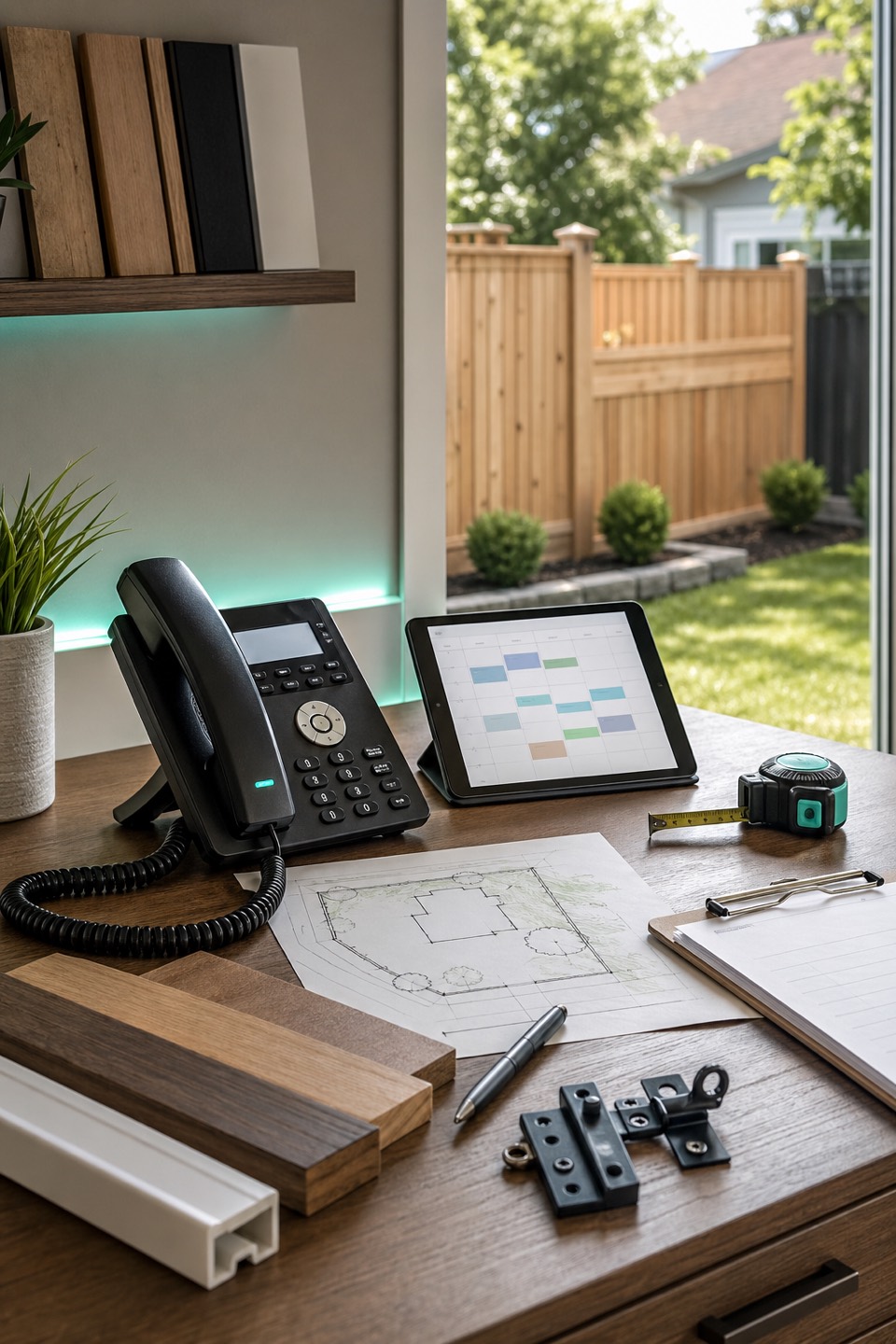
AI Answering Service For Fence Companies
iando.ai answers fence company calls 24/7, captures project type, linear footage, material, gates, property details, timing, permit questions, and utility-marking needs, then moves qualified callers toward an estimate or clean callback path.
Built for contractors where homeowners, HOAs, property managers, builders, farms, and commercial buyers ask about privacy fences, vinyl, wood, chain link, aluminum, gates, repairs, pool barriers, and replacement work while crews are on job sites.
Built around the jobs your phone has to do: answer, schedule, route, handle approved Q&A, and recover missed-call revenue.
Edit call volume, buyer intent, 25% lift, and average fence installation value.
Planning model only. Replace with real missed-call volume, quote-to-estimate rate, average linear footage, project mix, material margin, gate add-ons, repair share, close rate, crew capacity, and actual average job value.
The business case for fence companies
Start with the calls the business already earned, then estimate which ones can become appointments, jobs, consults, or useful follow-ups.
For fence companies, ROI comes from recovering privacy, vinyl, wood, chain-link, aluminum, gate, repair, pool, farm, and commercial estimate calls before the buyer books a competing contractor.
- Missed, after-hours, abandoned, and overflow calls by source and hour
- Quote, estimate, repair, replacement, gate, and commercial intent share
- Average fence project value, add-ons, close rate, and crew capacity
- Recovered estimate rate after immediate AI answering
- Capture quote, estimate, repair, gate, replacement, pool, farm, commercial, and property-manager calls when staff cannot answer.
- Collect linear footage, material, height, gates, removal, slope, access, photos, timing, and property details up front.
- Answer approved service-area, estimate-process, timing, material, gate, and scheduling questions without inventing exact prices.
- Route permit, HOA, pool, property-line, easement, utility-marking, exact-price, and commercial-scope questions with context.
What missed calls actually look like for fence companies
These are the moments where demand slips away because the team is already busy serving customers, patients, or active jobs.
Fence shoppers compare fast
A homeowner asking about a six-foot privacy fence, a vinyl replacement, a gate, or a pool barrier usually wants a price range and estimate window now. If the phone goes to voicemail, the next contractor can win the appointment.
Crews cannot stop mid-install
Installers may be setting posts, working around utilities, hauling panels, pouring concrete, or finishing gates. Answering every quote and repair call breaks production.
Good estimates need site details
Linear footage, material, height, gates, removal, slope, trees, access, pets, HOA rules, pool requirements, property-line confidence, and utility marking all change the estimate path.
What public data says about this buying behavior
Every stat references a public source below, so the revenue argument stays grounded instead of padded with invented benchmarks.
A large residential, agricultural, and industrial fencing market means quote-ready callers often have several local contractors to compare.
Growing demand for privacy, security, property improvement, and durable materials keeps fence contractors competing for high-intent quote calls.
Average project value makes each qualified fence quote call meaningful before upsells such as gates, removal, grading, staining, and premium materials.
Fence call handling should capture scope before quoting because size, height, material, gates, terrain, old-fence removal, and permits change project value.
Linear footage is one of the first details an answering path should collect for a useful callback or estimate appointment.
Fence call plans should set the right expectation around utility marking, timing, and safe excavation instead of treating every quote as immediately installable.
Installer labor is a real capacity constraint, so better intake should protect estimator and crew time rather than creating low-quality callbacks.
AI answering should use company-approved language and route permit, setback, pool, HOA, and property-line questions when local rules matter.
When money or urgency is involved, buyers still reach for the phone.
Phone-driven SMB pages still need strong local-search and trust signals.
Fence Companies need phone coverage built around their actual calls
The phone experience should match how the business earns trust, books revenue, and routes exceptions.
The category is large and locally competitive
Grand View Research reports a $10.32 billion U.S. fencing market size value in 2026 and a 5.4% forecast CAGR through 2033. Local contractors are competing for homeowners who may call several installers.
Project value is high enough to protect
Angi and HomeAdvisor both place average professional fence installation around $3,270, with common homeowner ranges around $1,860 to $4,838. One missed qualified estimate can matter.
Some questions need guardrails
811 guidance says fence installation requires utility marking before digging. Local permit, height, setback, pool, property-line, and HOA questions also need approved language or staff review.
How iando.ai handles these calls
The best first layer is fast answer, clear qualification, then booking or escalation based on your operating rules.
Answer fast and identify the project
iando.ai picks up immediately and separates new installation, replacement, repair, gate, privacy, chain-link, vinyl, wood, aluminum, pool, farm, commercial, and property-manager calls.
Collect estimate-ready details
It captures name, phone, address, project type, approximate linear footage, material, height, gates, removal, slope, access, pets, photos, timing, HOA or permit concerns, and 811 expectations.
Book, answer, route, or summarize
Qualified projects move toward an estimate. Exact pricing, survey, permit, easement, pool, HOA, commercial scope, utility, and staff-only questions route with a useful summary.
Calls iando.ai can answer, route, or recover
These conversations are the highest-leverage starting point because they connect directly to revenue, schedule protection, or staff capacity.
Residential estimate calls
Privacy, wood, vinyl, chain-link, aluminum, decorative, replacement, yard enclosure, pet containment, and backyard upgrade questions.
Outcome: Capture enough scope to book an estimate or give staff a strong callback note.
Gate, repair, and replacement calls
Leaning posts, broken panels, storm damage, sagging gates, latch problems, old-fence removal, partial replacement, and urgent access issues.
Outcome: Identify whether the job is repairable, estimate-worthy, photo-based, or needs crew review.
Permit, property-line, HOA, and pool calls
Height limits, setbacks, corner lots, pool barriers, HOA rules, neighbor questions, survey uncertainty, and local inspection concerns.
Outcome: Use approved language and route jurisdiction-specific or legal questions to staff.
Commercial, farm, and property-manager calls
Security fencing, chain link, gates, access control, livestock, rental turnovers, multifamily repairs, and invoice or site-access needs.
Outcome: Capture scope, timeline, access, and decision-maker details before committing estimator time.
What operators actually care about
Recover more qualified estimate calls
SEO, local ads, referrals, yard signs, review sites, and neighborhood visibility already created the demand. Immediate answering keeps more callers from booking the next installer.
Give estimators better notes
Callbacks include material, footage, height, gates, photos, removal, slope, access, timing, and permit or property-line concerns instead of only a phone number.
Protect crews and owners from repetitive interruptions
Approved Q&A and structured intake let people stay on-site while callers still get a professional answer and a clear next step.
Where the payoff shows up operationally
- Capture quote, estimate, repair, gate, replacement, pool, farm, commercial, and property-manager calls when staff cannot answer.
- Collect linear footage, material, height, gates, removal, slope, access, photos, timing, and property details up front.
- Answer approved service-area, estimate-process, timing, material, gate, and scheduling questions without inventing exact prices.
- Route permit, HOA, pool, property-line, easement, utility-marking, exact-price, and commercial-scope questions with context.
- Turn after-hours and peak-install demand into an estimate path instead of a blank voicemail.
How the operation changes when the phone stops leaking revenue
Estimate calls hit voicemail while crews are setting posts.
AfterCallers get an immediate answer and a clear estimate or callback path.
Staff call back without footage, material, gates, access, or photos.
AfterFollow-up starts with the details needed to qualify and schedule the estimate.
Routine quote calls and property-line concerns mix together.
AfterPermit, HOA, pool, survey, and 811-sensitive questions are identified early.
After-hours homeowners keep searching until another contractor responds.
AfterFence demand gets covered 24/7 without manually staffing every call.
Questions before putting AI on the phone
Every fence quote depends on the yard
Correct. The AI should not make up exact prices. It should capture the variables that affect the estimate and use your approved ranges, minimums, or callback rules.
Property-line and permit questions can get risky
The call plan should stay inside approved language, identify survey, HOA, pool, easement, setback, and permit concerns early, and route anything jurisdiction-specific to staff.
We already answer during business hours
This covers lunch, after-hours demand, owner-operator busy windows, peak install season, estimator travel time, and repetitive quote calls that interrupt field work.
Turn more calls into booked revenue for fence companies.
iando.ai is built for businesses that depend on the phone and lose money when callers do not get a fast, useful answer. Book a demo and map the call plan to your call volume, hours, and booking logic.
Frequently asked questions
Can AI answer fence price questions?
Yes, inside your approved rules. It can explain estimate process, minimums, common range factors, material differences, and what details affect price, then route exact quotes to staff.
Can it schedule fence estimates?
It can move qualified callers toward an estimate when your calendar rules allow it, or capture enough project detail for staff to confirm quickly.
Can it handle 811, permit, HOA, or property-line questions?
It can capture the concern and use approved general language, but local rules, legal boundaries, pool requirements, easements, and survey questions should route to staff.
What details should a fence call plan collect?
At minimum: project type, material, approximate footage, height, gates, removal, slope, photos, address, timeline, access, pets, HOA or permit concerns, and whether utility marking is needed.
Does this replace estimators or installers?
No. It covers missed calls, after-hours intake, approved Q&A, and clean summaries so people can focus on estimating, installing, and closing qualified projects.
Deeper articles for fence companies
Each guide supports the ICP landing page with practical, search-focused depth around staffing, routing, conversion, and operational efficiency.
Recover fence estimate calls before the homeowner books another contractor
Fence company missed-call ROI starts with quote-ready callers who need a fast answer, a clean estimate path, and careful routing for materials, gates, utility marking, permits, and property-line questions.
Read articleA painting contractor missed-call model for quote-ready homeowners and property managers
Painting contractors lose revenue when quote-ready callers reach voicemail during estimates, job walks, crew work, supply runs, and after hours. The fix is a call path that captures project scope before the estimator follows up.
Read articleMore phone-revenue pages
Research behind this page
These references support the phone-demand, local-search, and response-speed claims above.
Grand View Research • 2026 • Accessed 2026-04-27
Grand View Research U.S. fencing market report showing a $10.32 billion 2026 market-size value, $14.90 billion 2033 revenue forecast, 5.4% CAGR from 2026 to 2033, and residential, agricultural, and industrial application segments.
Open sourceAngi • 2026-03-05 • Accessed 2026-04-27
Angi cost guide reporting an average fence installation cost of $3,271, a common homeowner range of $1,860 to $4,837, average cost of $23 per linear foot, and material, height, gate, removal, terrain, utility, and labor cost drivers.
Open sourceHomeAdvisor • 2025 • Accessed 2026-04-27
HomeAdvisor fence cost guide reporting most homeowners spend $1,860 to $4,838, with a $3,272 national average, and that length, height, posts, gates, labor, permits, grading, and old-fence removal affect final price.
Open source811 Before You Dig • Accessed 2026-04-27
811 safe-digging guidance explaining that anyone planning to dig should contact 811 or a state 811 center before digging, including for fence or mailbox installation, so buried utilities can be marked.
Open sourceU.S. Bureau of Labor Statistics • 2024-04-03 • Accessed 2026-04-27
BLS Occupational Employment and Wage Statistics profile defining fence erectors as workers who erect and repair fences and gates with hand and power tools, with 21,470 employment estimate and wage benchmarks in May 2023.
Open sourceCity of Portland • Accessed 2026-04-27
City fence-permit guide explaining that fence rules depend on height, material, setbacks, public right of way, pool enclosures, and local planning and zoning requirements.
Open sourceSacramento County • Accessed 2026-04-27
County code-enforcement guidance noting that fences do not establish legal property lines and recommending surveyor involvement to determine legal boundaries when needed.
Open sourceInvoca • 2025-08-18 • Accessed 2026-03-31
Invoca analysis showing live answer-rate benchmarks across industries and calling behavior for high-stakes purchases.
Open sourceBrightLocal • 2025 • Accessed 2026-03-31
Survey of 1,000 US consumers about general and local search behavior, maps usage, and business information expectations.
Open source