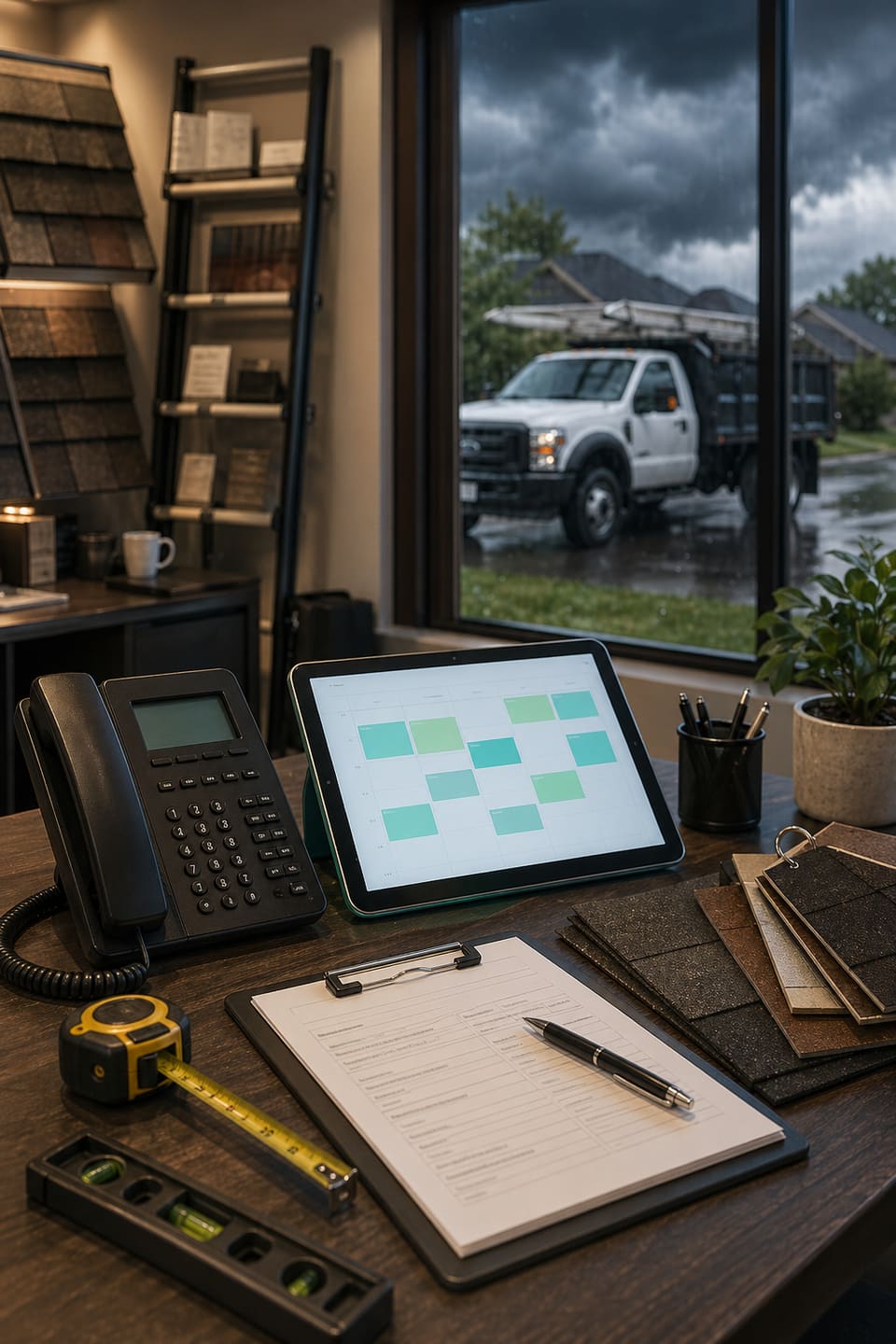
iando.ai answers emergency roof tarp, storm leak, active drip, wind, hail, tree-limb, missing-shingle, and after-hours roofing calls 24/7 so urgent buyers get a safe next step before they keep shopping.

Built for roofing teams where the first sixty seconds matter: capture water-entry, roof-access, photo, claim, pet, gate, timing, and hazard context without giving roof, ladder, or repair advice.

Built around the jobs your phone has to do: answer, schedule, handle approved Q&A, create the next step, and recover missed-call revenue.

  • 24/7 first answer for tarp-now, storm-leak, wind, hail, and tree-impact calls
  • Water-entry, room, ceiling, roof-access, photo, insurance, and timing context captured
  • Roof, ladder, electrical, structural, and exact-price questions sent to staff
  • Temporary protection, repair, inspection, water-entry, and claim paths separated
Revenue Lift 24/7
Monthly modeled value

Edit call volume, qualified intent, 25% lift, and average roof repair value.

Monthly lift
$27,378/mo
Recovered calls that turn into booked, escalated, or staff ready next steps.
Annualized return Live estimate
$328,536/yr
The number operators use to decide whether better call coverage is worth it.
+23 recovered roof-tarp next steps/mo
90-day proof review: compare answered calls, captured next steps, and staff handoffs.
Run your numbers Adjust the four inputs. The return updates instantly.
180 calls/mo, 52% intent, 25% lift 24/7 coverage captures the calls that happen after hours, during peaks, and while staff are busy.
$1,170 average roof repair value Average value per converted booking, job, consult, appointment, or documented next step.
90-day review Compare answered calls, captured next steps, booked outcomes, and staff handoffs against the model.

Planning model only. Replace with roof-tarp call logs, missed-call rate, dispatchable share, after-hours mix, tarp capacity, repair average, storm seasonality, service-area fit, insurance handoff rules, and actual close rates.

Calls Coming In
Tarp-now and active-drip calls Water dripping, ceiling stain spreading, attic moisture, missing shingles, exposed decking, or a homeowner asking...
Storm-leak and water-entry handoffs Homeowners who need the roof stopped, the ceiling protected, wet rooms documented, or water-damage help queued...
Wind, hail, and storm-damage calls Lifted shingles, hail hits, tree limbs, flashing damage, skylight leaks, gutter impact, and neighborhood storm...
After-hours and weekend calls Calls that arrive when staff are closed, crews are in the field, or storm volume has overwhelmed the office.
Revenue Path

Show the caller a next step before they move on.

iando answers quickly, captures the details that matter, uses approved language, and gives staff a cleaner handoff.

What Staff Gets
Tarp-now and active-drip calls Capture urgency and dispatch context without telling the caller to climb or patch the roof.
Storm-leak and water-entry handoffs Separate roofing, temporary-protection, water-entry, and documentation paths before staff call back.
Wind, hail, and storm-damage calls Document damage context, photos, property details, insurance status, and inspection timing.
After-hours and weekend calls Give the caller a credible next step while staff receive a structured summary.
Industry ROI

The business case for emergency roof tarp calls

Start with the calls the business already earned, then estimate which ones can become appointments, jobs, consults, or useful follow-ups.

Roof tarp call recovery
The business case starts with homeowners asking who can protect the house today.

For emergency roof tarp calls, ROI is recovered temporary-protection visits, leak inspections, repair jobs, storm-damage follow-up, and fewer urgent buyers lost to the first roofer who answers.

Call volume x qualified intent x average value x recovery lift
  • Monthly tarp-now, storm-leak, wind, hail, tree-impact, and after-hours calls
  • Dispatchable, inspection-ready, or repair-ready share of those calls
  • After-hours and storm-spike mix when office staff are least available
  • A conservative 25% lift from immediate answering and cleaner dispatch paths
What to recover first
Prioritize the calls with direct revenue or schedule impact.
  • Tarp-now, storm-leak, active drip, wind, hail, tree-impact, skylight, flashing, and after-hours calls answered immediately.
  • Water entry, room affected, ceiling status, roof access, photo, insurance, pet, gate, parking, and timing context captured.
  • Roof, ladder, electrical, structural, exact-price, deductible, and coverage questions sent to approved staff.
  • Temporary protection, repair, inspection, water-entry, replacement, and documentation paths separated.
Where Revenue Leaks

What missed calls actually look like for emergency roof tarp calls

These are the moments where demand slips away because the team is already busy serving customers, patients, or active jobs.

Temporary protection is urgent buying intent

A homeowner asking for a tarp after wind, hail, a tree limb, missing shingles, or water entering a room is usually trying to protect the house now. Voicemail gives the next roofer a chance to win the job.

Storms create call spikes and field pressure

The same weather that creates tarp-now demand also puts estimators, crews, and owners on roofs, in trucks, or on existing emergency jobs.

Bad first answers create safety and trust risk

Wet roofs, ladders, sagging ceilings, active dripping near electrical fixtures, and claim questions should be handled with approved language, not rushed advice.

Proof And Context

What public data says about this buying behavior

Every stat references a public source below, so the revenue argument stays grounded instead of padded with invented benchmarks.

$1,170
average roof repair cost in Angi's 2026 guide 1

Average repair value gives roof-tarp call handling a practical baseline before storm mix, temporary-protection work, replacement attach rate, and local pricing are applied.

$360-$1.55K
roof-leak repair range in Angi's 2026 guide 1

Leak-specific value supports fast answering because a small number of recovered tarp-now calls can matter before larger repair, insurance, or replacement opportunities are considered.

50%
roof-structure threshold referenced by USACE temporary roofing criteria 2

USACE temporary roofing criteria show why tarp conversations should avoid overpromising and should collect structural, access, roof-type, debris, and habitability context for staff.

24-48 hrs
EPA drying window for wet materials where possible 3

Moisture timing explains why active leaks and tarp-now calls deserve immediate capture, while cleanup, health, and remediation guidance stays with qualified professionals.

Why This Industry Is Different

Emergency Roof Tarp Calls need phone coverage built around their actual calls

The phone experience should match how the business earns trust, books revenue, and hands off exceptions.

Tarp-now callers are perishable demand

When water is entering, the buyer often calls until someone answers with a credible plan. Slow response turns an earned lead into a competitor's inspection.

Storm leaks can become water-damage calls

The same roof event can create a roofing inspection, temporary-protection visit, ceiling-leak cleanup, basement water question, or documentation request. The first answer should separate those paths before the callback queue blurs.

Temporary covering is still a professional decision

USACE describes temporary roofing as plastic sheeting used after disasters while permanent repairs are arranged, with eligibility and structural limits. Local roofers need the same discipline around safety, access, and scope.

Storm buyers are already cautious

BBB and FTC guidance warn homeowners about pressure tactics and storm-repair scams. A calm, branded first answer helps legitimate roofers sound prepared instead of opportunistic.

How It Works

How iando.ai handles these calls

The best first layer is fast answer, clear qualification, then booking or escalation based on your operating rules.

1

Answer and identify the storm-leak request

iando.ai separates active leak, tarp-now, storm leak, wind, hail, tree-impact, skylight, flashing, missing-shingle, repair, inspection, warranty, and claim-context calls.

2

Capture dispatch-ready facts

It gathers address, service area, water-entry timing, room affected, roof access, height if known, photos, insurance status, pets, gates, parking, and preferred callback or visit window.

3

Create the right next step

Bookable emergency visits, leak inspections, repair callbacks, water-damage referrals, and estimate requests move into the right path. Unsafe, exact-price, structural, and claim-specific questions go to staff.

Calls It Handles

Calls iando.ai can answer, escalate, or recover

These conversations are the highest-leverage starting point because they connect directly to revenue, schedule protection, or staff capacity.

Tarp-now and active-drip calls

Water dripping, ceiling stain spreading, attic moisture, missing shingles, exposed decking, or a homeowner asking whether someone can tarp the roof today.

Outcome: Capture urgency and dispatch context without telling the caller to climb or patch the roof.

Storm-leak and water-entry handoffs

Homeowners who need the roof stopped, the ceiling protected, wet rooms documented, or water-damage help queued after the roofing decision.

Outcome: Separate roofing, temporary-protection, water-entry, and documentation paths before staff call back.

Wind, hail, and storm-damage calls

Lifted shingles, hail hits, tree limbs, flashing damage, skylight leaks, gutter impact, and neighborhood storm activity that may need inspection or temporary protection.

Outcome: Document damage context, photos, property details, insurance status, and inspection timing.

After-hours and weekend calls

Calls that arrive when staff are closed, crews are in the field, or storm volume has overwhelmed the office.

Outcome: Give the caller a credible next step while staff receive a structured summary.

Insurance and documentation questions

Questions about photos, adjuster appointments, written estimates, invoices, warranties, deductibles, and what the roofing company can document.

Outcome: Capture claim context and send coverage, deductible, legal, or policy-specific questions to approved staff.

Outcomes

What operators actually care about

More tarp calls become dispatch-ready

Staff receive leak location, room affected, storm timing, access notes, photos, insurance context, and urgency before they call back.

Fewer storm buyers keep shopping

The caller hears an emergency roof-tarp path instead of voicemail while your team is dealing with the storm surge.

Cleaner repair and mitigation handoffs

Temporary protection, leak inspection, repair, replacement, ceiling-leak cleanup, basement-water, and documentation needs get separated before the lead goes cold.

Recovered Value

Where the payoff shows up operationally

  • Tarp-now, storm-leak, active drip, wind, hail, tree-impact, skylight, flashing, and after-hours calls answered immediately.
  • Water entry, room affected, ceiling status, roof access, photo, insurance, pet, gate, parking, and timing context captured.
  • Roof, ladder, electrical, structural, exact-price, deductible, and coverage questions sent to approved staff.
  • Temporary protection, repair, inspection, water-entry, replacement, and documentation paths separated.
  • Storm spikes turned into cleaner callback queues instead of blank missed calls.
Before And After

How the operation changes when the phone stops leaking revenue

Before

A homeowner asking for a roof tarp hits voicemail during a storm.

After

The call is answered, classified, and turned into a dispatch-ready storm-leak summary.

Before

Staff call back without leak location, storm timing, photos, or access notes.

After

The callback starts from the facts that affect whether a tarp visit is realistic.

Before

Tarp requests invite unsafe ladder or roof-walking advice.

After

The AI stays inside approved language and sends sensitive questions to staff.

Before

Repair, water-damage, replacement, and insurance questions blur together.

After

Each next step is separated before the buyer goes cold.

Operator Questions

Questions before putting AI on the phone

Roof tarping depends on weather and roof condition

Correct. The AI should not promise a tarp visit blindly. It should capture what the homeowner sees and hand the safety, access, weather, capacity, and scope decision to the roofing team.

We do not want callers getting roof advice

Keep that guardrail. iando.ai should avoid roof-walking, ladder, tarp-installation, electrical, and structural instructions while collecting details for staff.

Insurance questions can create trouble

The call path should collect claim context and send coverage, deductible, adjuster, legal, and policy-specific questions to approved staff.

Recover Missed Revenue

Turn more calls into recovered roof-tarp next steps for emergency roof tarp calls.

iando.ai is built for businesses that depend on the phone and lose money when callers do not get a fast, useful answer. Book a demo and map the revenue path to your call volume, hours, booking logic, and staff-only handoffs.

FAQ

Frequently asked questions

Can AI answer emergency roof tarp calls safely?

Yes, when it stays inside approved language. It should collect facts, avoid roof, ladder, electrical, and structural advice, and send urgent exceptions to the company's emergency process.

Can it book a roof tarp visit?

It can create a dispatch or callback path when your rules allow it. Weather, roof condition, crew capacity, safety, and exact scope should remain staff decisions.

Does it give claim or deductible advice?

No. It can capture claim status, adjuster timing, photo needs, and documentation requests, then send coverage, deductible, and policy questions to approved staff.

Why make a dedicated roof-tarp page?

Because tarp-now callers have specific urgency, safety constraints, access needs, and storm-trust concerns that broad roofing copy usually misses.

Supporting Guides

Deeper guides for emergency roof tarp calls

Each guide gives operators practical depth around staffing, call handling, conversion, and operational efficiency.

The roof-tarp call is won before the first callback

Roof tarp and storm-leak calls are urgent, local, and safety-sensitive. The first answer should capture dispatch facts, avoid unsafe advice, and give homeowners a credible next step.

Read guide

The storm damage call is won before the first callback

Storm roof damage calls are urgent, local, and trust-sensitive. The first answer should capture damage context, avoid unsafe advice, and give homeowners a credible next step before they keep dialing.

Read guide

When water is overhead, the first prepared answer keeps the job moving

Ceiling leak callers need a prepared first answer that captures active water, source clues, photos, ceiling condition, access, and a credible next step before another restorer, roofer, plumber, or property vendor wins the call.

Read guide
Sources

Research behind this page

These references support the phone-demand, local-search, and response-speed claims above.

1. How Much Does Roof Repair Cost? [2026 Data]

Angi • 2026-03-17 • Accessed 2026-05-06

Angi 2026 cost guide reporting an average roof repair cost of $1,170, a normal range of $394 to $1,961, a roof-leak repair range of $360 to $1,550, and emergency repair or tarping cost considerations.

Open source
2. Temporary Roofing

U.S. Army Corps of Engineers • 2024-10-10 • Accessed 2026-05-12

USACE fact sheet explaining Operation Blue Roof temporary roofing, including reinforced plastic sheeting, FEMA mission support, eligibility limits, and the temporary nature of covering damaged roofs before permanent repairs.

Open source
3. A Brief Guide to Mold, Moisture and Your Home

U.S. Environmental Protection Agency • 2026-02-18 • Accessed 2026-05-06

EPA homeowner guidance explaining moisture control, roof-leak context, professional cleanup considerations, and drying wet materials or areas within 24 to 48 hours where possible to help prevent mold growth.

Open source
4. Fall Protection in Residential Construction - OSHA Guidance Document

Occupational Safety and Health Administration • Accessed 2026-05-06

OSHA guidance focused on preventing fall-related injuries and fatalities during residential construction activities, including roofing.

Open source
5. BBB Tip: Protect yourself from storm chasers after a natural disaster

Better Business Bureau • Accessed 2026-05-06

BBB consumer guidance warning homeowners about storm chasers, out-of-town contractors, high-pressure sales, upfront-payment red flags, and roof or attic work homeowners cannot easily inspect.

Open source
6. How To Avoid a Home Improvement Scam

Federal Trade Commission • Accessed 2026-05-06

FTC consumer guidance on avoiding home-improvement scams, including pressure tactics, upfront payments, vague contractor promises, and post-disaster repair caution.

Open source
7. Severe Weather 101: Hail Basics

NOAA National Severe Storms Laboratory • Accessed 2026-05-06

NOAA NSSL educational resource explaining hail formation and severe hail, useful context for roofing teams handling storm, hail, roof-damage, and temporary-protection calls.

Open source
8. Facts + Statistics: Homeowners and renters insurance

Insurance Information Institute • Accessed 2026-05-06

Insurance Information Institute statistics on homeowners and renters insurance claims and losses, useful context for storm, wind, hail, water damage, and claim-related roofing calls.

Open source
9. Consumer Services Call Conversion Benchmarks Report 2025

Invoca • 2025 • Accessed 2026-05-06

Invoca benchmark report based on AI analysis of more than 60 million consumer-services phone calls, used as a response-speed and phone-demand benchmark.

Open source
10. Local Consumer Review Survey 2026

BrightLocal • 2026 • Accessed 2026-05-06

BrightLocal local consumer research showing the ongoing importance of trust signals and online reputation when consumers choose local businesses.

Open source