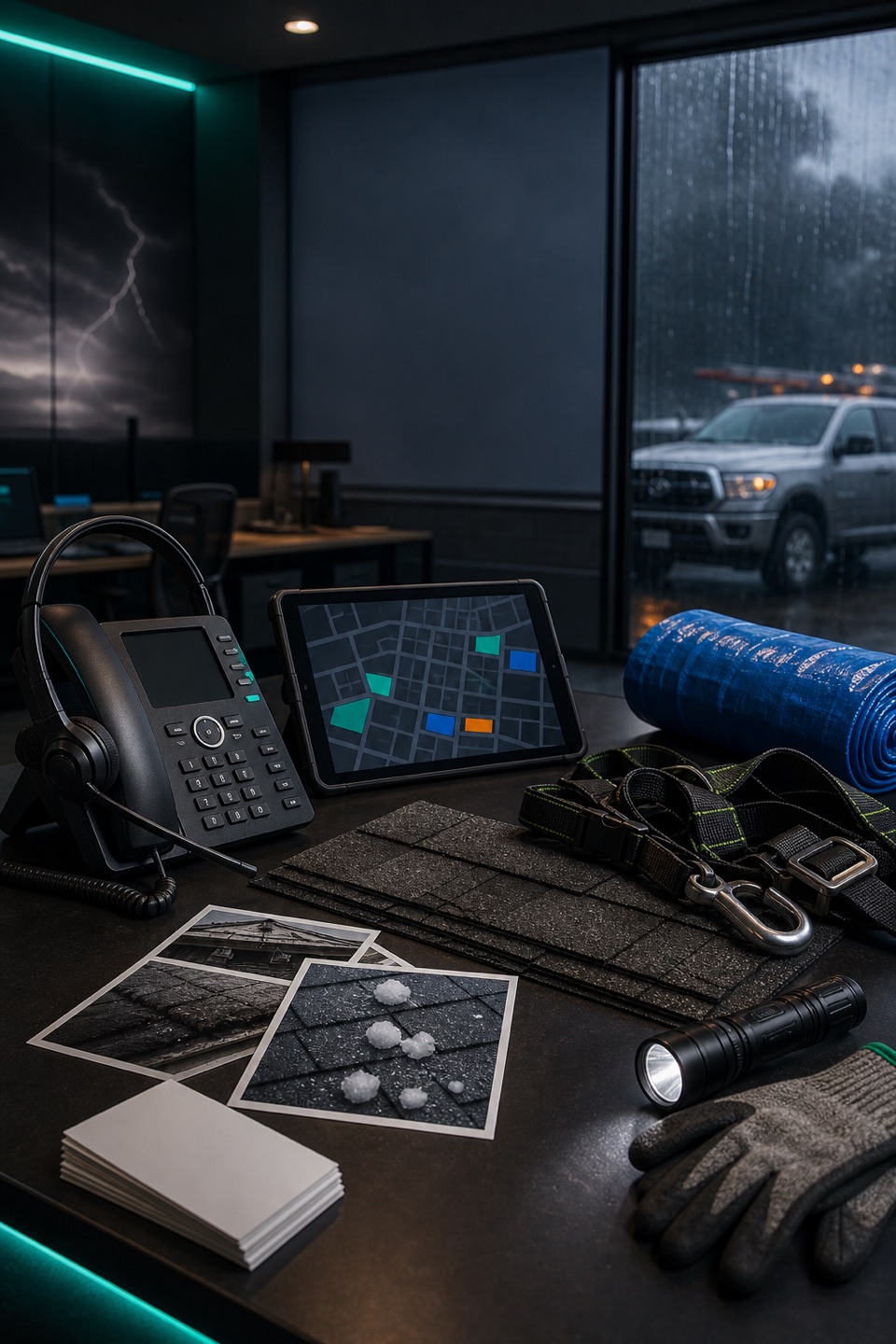
Active leak callers are already in decision mode
A homeowner with water coming through a ceiling, a leaking skylight, a missing-shingle patch after wind, or a tarp now request is not making a casual inquiry. The buyer wants to know whether the home can be protected and whether the company sounds prepared.
That urgency makes the first answer commercially important. If the roofing company sounds unavailable or generic, the caller keeps shopping until another local provider gives a credible next step.
- Is water actively entering the home or is it a stain from a prior storm?
- Which room, ceiling, skylight, vent, chimney, or roof area is involved?
- Is the caller asking for emergency tarping, a leak inspection, repair, or replacement advice?
- Is this after hours, during heavy rain, after hail, or tied to a claim or bedtime concern?
Use an emergency-call ROI model, not generic call volume
Total call volume hides the value of urgent leak calls. A better model starts with active water entry, tarp now requests, storm damage, skylight leaks, flashing failures, ceiling stains, and after-hours calls because those are the moments where slow answering creates immediate conversion risk.
For planning, use monthly urgent calls, dispatchable or inspection-ready intent, a conservative lift from immediate answering, and average job value. The example here uses 220 monthly emergency roofing calls, 48 percent buyer intent, a 25 percent lift, and Angi's $1,170 average roof repair value.
- Calls per month: active leak, tarp now, storm, skylight, flashing, ceiling stain, and after-hours
- Intent rate: callers likely to book repair, request temporary protection, or schedule an inspection
- Lift: recovered next steps from immediate answer and better intake
- Average value: repair, temporary protection, inspection, and replacement-related first opportunity
The first answer should separate four paths
Active leak calls sound similar at first, but the next step changes quickly. One caller needs a leak inspection, another is asking for temporary protection, another is calling after hail, and another has wet drywall or a ceiling fixture concern that may need staff review or a water-damage partner.
The strongest call path separates active leak, tarp now, storm and claim, and interior water-entry needs before staff calls back. That keeps a high-intent homeowner from being treated like a generic estimate request.
- Active leak path: room, ceiling, attic, skylight, flashing, chimney, vent, water timing, and storm context
- Tarp now path: access, photos, height or pitch if known, weather pressure, pets, gates, parking, and response window
- Storm and claim path: wind, hail, tree impact, adjuster timing, photo request, warranty, and documentation need
- Interior water path: wet materials, light-fixture concern, drywall damage, mitigation need, and staff-only hazard review
Repair value is large enough to protect
Angi's 2026 roof repair guide reports an average roof repair cost of $1,170, a common range of $394 to $1,961, and a roof leak repair range of $360 to $1,550. The same guide notes that homeowners should account for inspection fees, emergency repair surcharges, gutter repairs, and permit costs.
That means the ROI case does not require every caller to become a full replacement. Recovering a modest number of leak repairs, temporary-protection visits, flashing repairs, storm inspections, and replacement follow-ups can justify stronger answering coverage when the company has available capacity.
Temporary protection needs careful language
FEMA's blue-roof materials describe temporary roof coverings as a way to reduce further damage after eligible disasters. USACE temporary roofing guidance also frames blue-roof work around eligibility, roof condition, and temporary protection before permanent repairs. That does not mean every local tarp now call can be promised over the phone, especially when weather, pitch, height, access, decking condition, and crew availability matter.
The first active roof leak call handling roi answer captures source, context, urgency, and the approved next step. Staff retain sensitive decisions.
- Active dripping, stained ceiling, attic water, skylight leak, or flashing issue
- Missing shingles, visible hole, tree limb, hail, wind, or storm timing
- Roof height, pitch, access, pets, gate codes, parking, and safe approach notes
- Photo availability, insurance claim status, adjuster timing, and preferred callback window
Storm volume arrives when staff are least available
NOAA's 2024 U.S. billion-dollar disaster summary reported 27 billion-dollar weather and climate events, including 11 severe weather or hail events. Triple-I homeowners insurance statistics also show wind and hail as recurring property-damage claim drivers.
For roofing companies, that means inbound demand can arrive in bursts exactly when crews, owners, estimators, and dispatchers are already busy. The point of I&O AI is not to replace the roofer's judgment. It is to answer first and capture the facts while the buyer still believes the company can help.
Safety guardrails protect the caller and the brand
OSHA's residential fall-protection guidance is built around preventing fall-related injuries in roofing and other residential construction work. EPA mold guidance also emphasizes drying wet materials quickly and addressing moisture because mold can grow on wet materials when conditions remain wet.
A roofing AI call path should respect those boundaries. It should not coach roof access, ladder setup, tarp installation, electrical evaluation, ceiling puncturing, or structural assessment. It should capture what the homeowner sees and send the sensitive parts to trained staff.
Trust matters after storms
BBB warns homeowners about storm chasers after natural disasters, and FTC home-improvement guidance cautions consumers about pressure tactics, upfront-payment issues, and vague contractor promises. Those warnings affect how urgent roofing buyers interpret a first response.
A legitimate roofer benefits from a calm, branded answer that confirms the service area, collects facts, explains the approved next step, and avoids pressure. The caller should feel the company is organized before a dispatcher, estimator, or owner calls back.
Phone response and local trust decide who gets the inspection
Invoca's 2025 call-answer-rate analysis reported that 61 percent of callers reach a human across industries, with home services at 55 percent. It also reported that high-stakes buyers still use the phone when they need help.
BrightLocal consumer search research reinforces why that first response has to feel local and credible: consumers use local search to choose businesses, verify basic information, and judge whether a company looks trustworthy enough to contact.
Dispatch needs more than a name and number
A useful active leak summary should tell dispatch what kind of urgency exists. Water location, timing, room affected, roof access, photo status, insurance context, prior repairs, pets, gate codes, and whether the caller needs temporary protection all affect the next step.
That context reduces callback friction. Staff can start with the actual roof leak situation instead of restarting the intake from zero while the homeowner is still anxious and comparing competitors.
- Leak location, room affected, active water entry, and storm timing
- Photo status, attic access, ceiling condition, and visible roof damage
- Address, service area, parking, gate codes, pets, roof access, and preferred timing
- Insurance claim status, adjuster appointment, warranty question, and documentation need
Measure the proof loop in the first 30 days
The first proof loop should be operational, not theoretical. Track active leak calls answered, missed calls recovered, dispatchable summaries created, tarp now or leak-inspection next steps protected, and staff-only exceptions handled with enough context for a faster callback.
A roofing owner should be able to compare the first month against call logs: how many water entry callers reached a clear next step, how many calls arrived after hours or during storm pressure, and which call paths still need approved language or staffing rules.
- Active leak, tarp now, ceiling stain, skylight, flashing, and storm calls answered
- Dispatch-ready summaries with room, source, photo, access, and timing context
- Staff-only roof, ladder, electrical, structural, exact-price, and claim questions handled by staff
- Booked inspections, protected callbacks, water-damage handoffs, and lost-call reduction
Where this fits in the roofing revenue path
Use the active roof leak path beside emergency roof-tarp coverage, the broader roofing contractor page, ceiling-leak water entry, water damage restoration, missed-call recovery, pricing, and Get Started. The cluster should make one point clear for search and answer engines: emergency roofing demand is urgent phone demand, not a slow form-fill process.
For Adam outreach, lead with the storm moment the owner already recognizes: active water during rain, a skylight leak after hours, a tree-impact caller, or a tarp now request while crews are already in the field. Offer a missed-call revenue audit and a live call demo using the roofer's service area, after-hours rules, photo process, water-damage handoff, claim language, and staff-only safety guardrails.