Inbound & Outbound AI For SaaS Trials
iando answers inbound trial help calls and runs approved outbound follow up for stalled trials, product-qualified hand-raisers, pricing clicks, onboarding blockers, demo no-shows, security-review questions, and expansion signals so revenue teams get seller-ready context while product interest is still active.
Built for SaaS teams where trial conversion depends on speed and context, but pricing, security, legal, procurement, product fit, roadmap, discounting, consent rules, opt-out handling, and sales judgment still stay with approved staff.
Built around the jobs your phone has to do: answer, schedule, handle approved Q&A, create the next step, and recover missed call revenue.
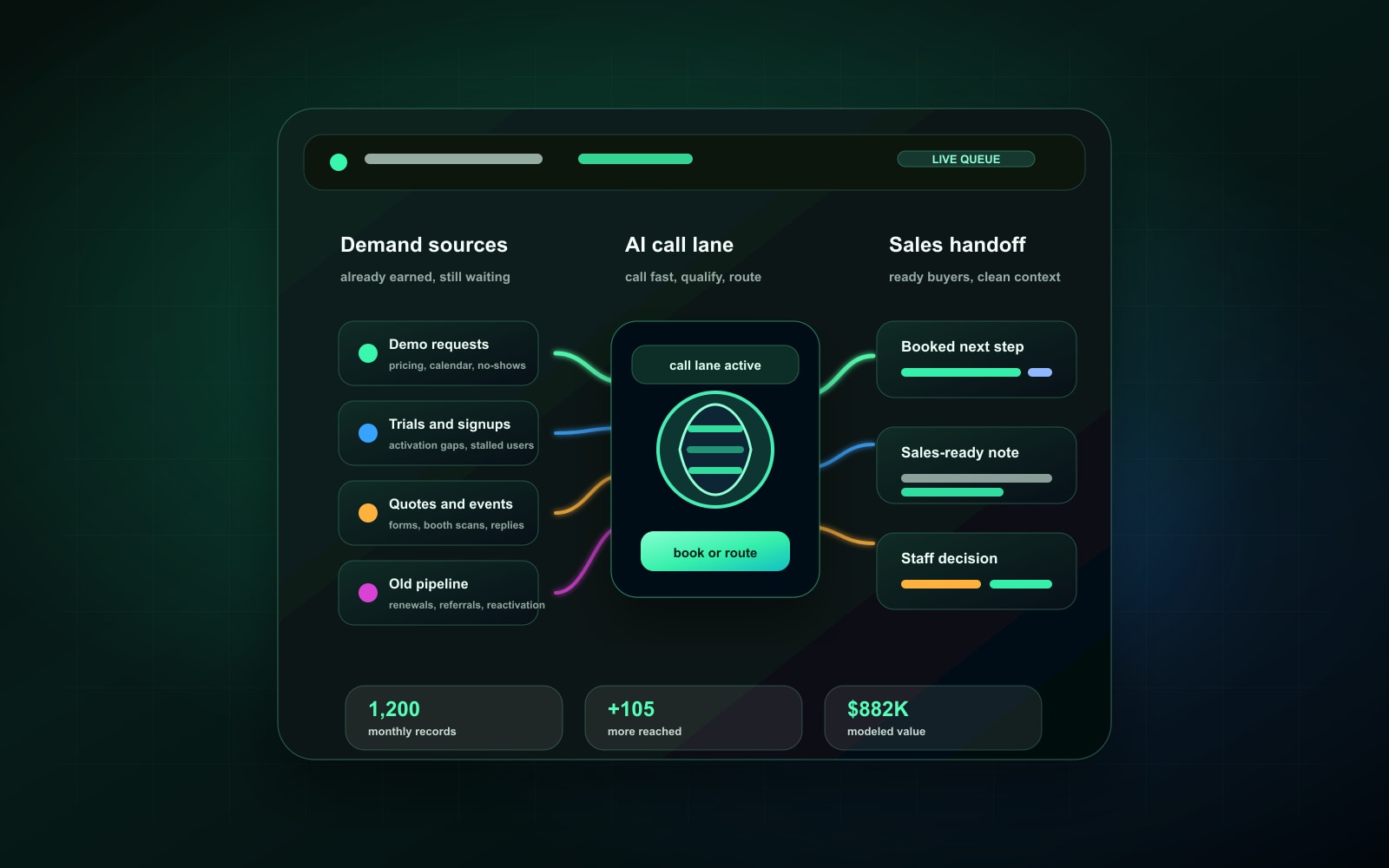
Edit call volume, qualified intent, 25% lift, and weighted pipeline value input.
Planning model only. Replace with trial source volume, activation events, product-qualified definition, connect rate, trial-assist rate, booked-meeting rate, show rate, SQL rate, opportunity rate, win rate, ACV, sales cycle, opt-out rules, and approved call rules.
Show the caller a next step before they move on.
iando answers quickly, captures the details that matter, uses approved language, and gives staff a cleaner handoff.
Turn product-qualified trial intent into a staff-ready next step before the account disappears.
The strongest SaaS trial call plan starts from known product context, responds quickly, captures the blocker, and keeps pricing, legal, security, procurement, roadmap, and product-fit judgment with approved staff.
The business case for saas trial reactivation teams
Start with the calls the business already earned, then estimate which ones can become appointments, jobs, consults, or useful follow ups.
For SaaS teams, ROI is not more activity against every signup. It is recovered product-qualified demand: trial users helped before abandonment, pricing hand-raisers reached while intent is visible, no-shows rebooked, and sellers handed useful account context instead of blank tasks.
- Monthly trial users, product-qualified hand-raisers, pricing clicks, onboarding blockers, no-show reschedules, and security-review requests
- Share with recoverable product, buyer, partner, expansion, or procurement intent
- A conservative 25% lift from faster approved follow up and cleaner handoff notes
- Weighted pipeline value input per reactivated trial, booked demo, trial assist, security callback, or expansion next step
- Call or answer stalled trial users, product-qualified hand-raisers, pricing clicks, onboarding blockers, no-show reschedules, and security-review questions while intent is fresh.
- Collect trial state, product area, activation gap, blocker, no-show reason, pricing signal, role, company size, use case, current tools, urgency, timeline, and meeting preference.
- Separate trial assist, booked demo, no-show rebook, success callback, procurement callback, security-review handoff, staff review, and low-fit closeout paths.
- Send custom pricing, discounts, contract terms, security exceptions, procurement commitments, roadmap promises, migration details, and product-fit claims to approved staff.
What missed calls actually look like for saas trial reactivation teams
These are the moments where demand slips away because the team is already busy serving customers, patients, or active jobs.
Trial users stall with real buying context
A user may invite a teammate, view pricing, hit a setup blocker, ask about security, miss a demo, or stop before activation. That is not the same as a cold signup.
Sellers inherit stale product signals
Without fast context capture, a seller sees an old task but not the product area, activation gap, company role, blocker, timeline, or question that caused the trial to stop.
Trial help can cross sensitive boundaries
The call path can collect facts and offer approved next steps, but pricing exceptions, security claims, procurement commitments, roadmap promises, and product-fit judgment need staff.
What public data says about this buying behavior
Every stat references a public source below, so the revenue argument stays grounded instead of padded with invented benchmarks.
Product signal helps teams decide which trial users deserve faster human or AI follow-up before the account goes quiet.
Qualified SaaS demand should move into a clear calendar path before manual follow-up delay cools the account.
Buyers can get instant answers elsewhere, so the vendor response needs to be fast, specific, and useful enough to earn the next meeting.
Inbound & Outbound AI should reduce repetitive chasing and prepare buyer conversations so sellers can spend more time on judgment, fit, and closing.
SaaS Trial Reactivation Teams need phone coverage built around their actual calls
The phone experience should match how the business earns trust, books revenue, and hands off exceptions.
Product signal makes follow up more selective
ProductLed's benchmark research says product-qualified lead usage is associated with materially higher free-account conversion, while many companies still undertrack activation.
Qualified demand should move cleanly to a meeting path
Chili Piper's form-conversion benchmark found qualified submissions booked meetings at a much higher rate than average submissions, reinforcing the value of a clear next step once fit is visible.
Buyers keep researching while trials stall
G2's Answer Economy research says many B2B software buyers start with AI chatbots and use them during the buying process, so slow vendor response gives buyers another place to compare.
Seller time should stay on judgment
Salesforce's 2026 State of Sales report says representatives spend more time on non-selling work than selling, which makes repetitive trial chasing a poor use of senior revenue time.
How iando handles these calls
The best first layer is fast answer, clear qualification, then booking or escalation based on your operating rules.
Start from a real product or buyer signal
iando identifies stalled activation, pricing clicks, product-qualified actions, onboarding blockers, help requests, no-show reschedules, security-review questions, partner notes, and expansion signals.
Capture the blocker and seller-ready context
It records trial state, product area, activation gap, no-show reason, pricing signal, role, company size, use case, current tools, urgency, timeline, buying committee, meeting preference, and the exact staff-only question.
Book, assist, rebook, summarize, or send to staff
The next step can be a trial assist, booked demo, no-show rebook, success callback, security-review handoff, procurement callback, expansion follow up, or low-fit closeout.
Calls iando.ai can answer, escalate, or recover
These conversations are the highest-leverage starting point because they connect directly to revenue, schedule protection, or staff capacity.
Stalled activation and onboarding blockers
Users who start setup, invite teammates, hit an integration question, stop before the first useful outcome, or ask for help before going quiet.
Outcome: Capture product area, activation step, blocker, current tools, admin role, and whether the next step is trial assist, success callback, or seller handoff.
Pricing clicks and product-qualified hand-raisers
Trial users who view pricing, ask about plans, reach usage limits, invite admins, compare seats, or show team rollout intent.
Outcome: Collect plan interest, company size, seat count, buying role, urgency, budget context, and staff-only pricing questions.
Demo no-shows and reschedule recovery
Trial users or buyers who missed a meeting, need another stakeholder, changed priority, or need a shorter buying path before the trial expires.
Outcome: Rebook approved slots, capture reason, note urgency, and send high-value or at-risk accounts to revenue staff with context.
Security, procurement, and product-fit questions
Buyers asking about security review, data processing, legal terms, procurement steps, migration, implementation, roadmap, or product fit.
Outcome: Capture the question and send it to approved staff without inventing promises, commitments, or technical claims.
What operators actually care about
More trial users get a useful next step
The buyer gets help, a meeting path, or a clean staff handoff before the trial becomes another stale product signal.
Cleaner seller and success callbacks
Revenue teams see product area, blocker, account context, urgency, meeting preference, and the staff-only question before they respond.
Lower low-fit chasing
Approved criteria separate product-qualified users from low-fit or opted-out contacts so the team does not treat every signup as equal demand.
Where the payoff shows up operationally
- Call or answer stalled trial users, product-qualified hand-raisers, pricing clicks, onboarding blockers, no-show reschedules, and security-review questions while intent is fresh.
- Collect trial state, product area, activation gap, blocker, no-show reason, pricing signal, role, company size, use case, current tools, urgency, timeline, and meeting preference.
- Separate trial assist, booked demo, no-show rebook, success callback, procurement callback, security-review handoff, staff review, and low-fit closeout paths.
- Send custom pricing, discounts, contract terms, security exceptions, procurement commitments, roadmap promises, migration details, and product-fit claims to approved staff.
- Turn already-earned product interest into seller-ready next steps without adding repetitive manual chasing.
How the operation changes when the phone stops leaking revenue
A trial user hits a setup blocker and goes quiet.
AfterThe user gets an approved follow-up path and staff see the exact activation gap.
A pricing click becomes another stale task in the CRM.
AfterThe callback starts with role, company size, plan interest, urgency, and staff-only pricing questions.
No-show recovery depends on when a seller has time to chase.
AfterThe buyer gets approved reschedule help and the team sees whether trial intent still exists.
Security or procurement questions invite rushed promises.
AfterSensitive questions are captured and sent to approved staff with account context attached.
Questions before putting AI on the phone
Not every trial user deserves a phone call
Correct. Start from approved product signals, fit criteria, source rules, contact windows, consent posture, do-not-contact records, and opt-out handling.
Trial users ask technical and pricing questions
iando should capture the question, offer approved process basics, and send pricing, security, procurement, implementation, roadmap, and product-fit judgment to staff.
Sales and customer success need different notes
The summary should show whether the right next step is seller follow up, trial assist, success callback, security review, procurement response, or low-fit closeout.
Turn more calls into reactivated SaaS next steps for saas trial reactivation teams.
iando is built for businesses that depend on the phone and lose money when callers do not get a fast, useful answer. Book a demo and map the revenue path to your call volume, hours, booking logic, and staff only handoffs.
Frequently asked questions
What is a SaaS trial reactivation call?
It is an approved follow-up call or answered callback for a trial user, product-qualified account, pricing hand-raiser, onboarding blocker, no-show, security-review request, or procurement question where product interest already exists.
Should every SaaS trial user get outbound follow up?
No. Use product signal, fit criteria, source-specific contact rules, opt-out handling, do-not-contact checks, and approved staff review before deciding who should receive a call.
Can iando answer product and pricing questions?
iando can answer approved process basics, capture the exact blocker, offer approved next steps, and summarize the call. Custom pricing, discounts, legal terms, security exceptions, procurement commitments, roadmap promises, and product-fit claims should stay with staff.
How should SaaS teams measure trial reactivation ROI?
Measure trial source volume, product signal, response time, connects, qualified conversations, trial assists, demos booked, show rate, SQL rate, opportunity rate, win rate, ACV, sales-cycle movement, opt-outs, and handoff quality.
Deeper guides for saas trial reactivation teams
Each guide gives operators practical depth around staffing, call handling, conversion, and operational efficiency.
Demo no-show recovery calls should rebook active buyers before seller time disappears
Demo no-shows are not always lost demand. Many are still active buyers who need a faster approved reschedule path, clearer context capture, and a staff-ready next step before the account cools off.
Read guideTrial reactivation calls should start from product signal, not generic chasing
Trial reactivation works best when the call starts from real product context: a stalled setup, missed activation point, pricing question, security review, or user who asked for help before going quiet.
Read guideB2B SaaS demo follow-up calls turn fresh interest into seller-ready next steps
Demo follow-up is not just more dialing. It is faster approved response with account context, clean opt-out handling, staff boundaries, and a next step before software buyers compare elsewhere.
Read guideMore phone revenue paths
Keep moving to the next useful call plan.
These pages connect the guide, adjacent call coverage, pricing, and setup paths buyers usually need next.
Research behind this page
These references support the phone demand, local search, and response speed claims above.
ProductLed • 2025-02-05 • Accessed 2026-05-16
ProductLed benchmark research based on 600+ SaaS businesses, reporting product-led-growth adoption, free-to-paid conversion patterns, PQL usage, and activation tracking gaps.
Open sourceChili Piper • 2025-11-11 • Accessed 2026-05-16
Chili Piper benchmark based on more than four million web form submissions, reporting a 30% average form-to-meeting rate and 66.7% meeting booking for qualified submissions.
Open sourceG2 • 2026-04-21 • Accessed 2026-05-16
G2 research report stating that 51% of B2B software buyers start research with AI chatbots more often than Google and 71% rely on AI chatbots at some point in the buying process.
Open sourceSalesforce • 2026 • Accessed 2026-05-16
Salesforce State of Sales report stating that sales representatives spend 40% of their time selling and 60% on non-selling tasks, with agentic AI adoption shaping sales work.
Open sourceInsideSales • 2021 • Accessed 2026-05-16
InsideSales page summarizing its 2021 lead-response research across more than 55 million sales activities on 5.7 million inbound leads and 400+ companies, including an 8x first-five-minutes conversion finding.
Open source