
After-hours dental answering service for pain, swelling, and weekend calls
260
calls per month modeled
+31
more next steps per month
$187,200
annual modeled value
I&O handles emergency dental after hours scheduling calls, captures useful context, and moves the approved next step forward while staff keep sensitive decisions.
Built for dental offices that need an emergency dental answering service with a calm first answer, clear practice-approved boundaries, and a credible booking or callback path without clinical advice.
Start with the buyer's reason for calling. iando captures intent, books what is ready, and hands staff the context that closes.
Edit call volume, qualified intent, 25% lift, and average urgent first-visit value.
Planning model only. Replace with practice call logs, after-hours mix, same-day capacity, emergency exam fee, new-patient share, callback speed, procedure-start mix, payer mix, and actual collected first-visit value.
iando answers fast, captures why they raised their hand, books or routes the next step, and gives staff the context to close.
The first answer should feel specific to dental pain, capture the details staff need, and keep clinical, payment, benefits, and emergency-level decisions inside the practice's approved process.
Start with the demand the business already earned, then replace each assumption with phone logs and completed outcomes. The model follows one direct path: total demand, calls not answered live, and recaptured next steps.
Gross modeled value from after-hours dental next steps. The model excludes uncollected revenue and outcomes the team cannot fulfill.
Model: monthly inbound calls × calls not answered live (%) × unanswered calls recovered (%) × average urgent first-visit value.
Pricing is scoped after lane review using coverage, expected volume, workflow depth, integrations, and staff handoff. The value model excludes setup, labor, cancellations, refunds, and uncollected revenue.
Demand slips away while the team is already serving customers, patients, or active jobs.
A person with severe tooth pain, swelling, a broken tooth, a lost crown, or a worried child is not waiting for a generic voicemail. They keep searching until an after-hours dental answering service gives a credible next step.
Evening, weekend, early-morning, lunch, and procedure-block calls can include the highest anxiety and strongest booking intent. Without a first answer, the practice loses both context and choice position.
A missed number does not tell staff whether the caller is new, existing, post-op, pediatric, swollen, dealing with trauma, flexible for a same-day slot, or asking a staff-only question.
After-hours dental calls can involve infection concern, bleeding, injury, medication questions, pregnancy, medical history, or emergency-room language. The answer should capture and hand off, not diagnose.
A caller who could fill an urgent opening may choose another office before staff arrive, especially if the practice cannot capture availability, patient status, concern words, and callback timing right away.
Every statistic links to a public source, keeping the revenue case grounded.
Model night, weekend, lunch, procedure-block, severe-pain, swelling, broken-tooth, lost-crown, post-op, and same-day calls before expanding into routine dental traffic.
Use call logs to replace this planning input across same-day booking, urgent callback, existing-patient emergency, post-op, and approved instruction paths.
Peerlogic's dental call study shows why urgent after-hours and same-day demand should be measured as a conversion path, not only as phone coverage.
Dental pain, swelling, fever concern, trauma, medication, treatment, care-level, and post-op questions should move to approved clinical judgment instead of AI advice.
Use local collections data to replace this conservative model value across emergency exams, imaging, fillings, extractions, crown repair, root-canal starts, broken-tooth visits, and first appointments.
Call handling should match how the business earns trust, books revenue, and hands off exceptions.
MouthHealthy, the ADA's patient-facing site, tells patients with dental emergencies to get to a dentist's office or emergency room as soon as possible and notes that many dentists reserve daily time for emergencies.
ADA practice guidance says offices should have clear emergency instructions, make after-hours arrangements, and train staff in basic triage. The AI call plan should mirror those approved rules instead of improvising urgent dental advice.
ADA patient-intake guidance treats prospective-patient calls as a front-door moment and recommends scripts for common topics. After-hours urgent calls deserve the same structure.
BLS describes dental assistants as handling patient care, records, and appointment scheduling. Calls that arrive during clinical flow or after hours should arrive back to staff with useful context.
Peerlogic's 26-practice dental call study found unanswered-call and new-patient conversion gaps, which makes urgent after-hours demand worth measuring separately from routine traffic.
Invoca and BrightLocal research both reinforce that phone response and local business information influence high-intent local decisions. For emergency dental callers, the first answer is part of the trust signal.
The best first layer is fast answer, clear qualification, then booking or escalation based on your operating rules.
iando.ai identifies tooth pain, swelling, broken tooth, knocked-out tooth, lost crown, lost filling, trauma, post-op concern, same-day request, new-patient call, or existing-patient callback.
It gathers caller role, patient status, concern words, timing, location, photos if requested, insurance basics if approved, same-day flexibility, callback window, and any staff-only question.
Bookable, callback, after-hours, existing-patient, new-patient, and emergency-instruction paths use practice-approved language while clinical, cost, benefits, medication, and care-level decisions stay with staff.
Urgent repair, new-patient appointment, cancellation-fill, insurance, hygiene, and routine recall calls can be separated so the after-hours emergency path does not become a catchall queue.
These conversations are the highest-leverage starting point because they connect directly to revenue, schedule protection, or staff capacity.
Adults, parents, or caregivers calling after the office closes with severe pain, pressure, sensitivity, inability to sleep, or a fast-worsening concern.
Outcome: Capture the caller's words, patient status, timing, and callback needs before they book with another office.
Callers describing facial swelling, gum swelling, fever concern, drainage, bad taste, or symptoms that sound worse in their own words.
Outcome: Move the call through approved urgency language without diagnosis, medication advice, or false reassurance.
New or existing patients who need a same-day path after a cracked tooth, lost crown, broken filling, sports injury, or cosmetic emergency.
Outcome: Collect timing, photos if requested, pain language, event deadline, and staff-only questions for a cleaner booking or callback path.
Callers asking whether the practice has any openings today, tomorrow morning, before work, after school, or after a cancellation.
Outcome: Capture flexibility and fit context without promising clinical suitability or real-time availability unless the practice has approved it.
Existing patients calling after an extraction, crown, implant, root-canal, surgery, or other treatment with pain, bleeding, swelling, or medication questions.
Outcome: Identify the procedure context and send staff-only decisions through the approved callback path.
Search-driven callers who have not visited the practice but need to know whether there is a credible urgent appointment or callback path.
Outcome: Capture lead and concern context, set approved expectations, and keep the caller from disappearing into voicemail.
Urgent callers hear a dental-specific first answer, get practice-approved next-step language, and leave staff with context instead of a bare missed number.
The call plan captures availability, patient status, concern words, photos, and staff-only questions so the team can decide fit faster.
Swelling, trauma, bleeding, post-op, medication, pregnancy, medical-history, and emergency-level questions move into approved staff paths.
A severe-pain or swelling call hits voicemail after hours while the caller keeps searching.
AfterThe call is answered, documented, and moved into a same-day, callback, or approved emergency-instruction path.
Staff call back without knowing patient status, concern words, timing, photos, or availability.
AfterThe summary gives staff the context needed to respond without restarting the entire conversation.
Post-op and new-patient emergency calls land in the same generic queue.
AfterExisting-patient, post-op, new-patient, same-day, and routine dental calls are separated before staff review.
The first answer drifts into improvised advice.
AfterThe call path stays inside approved words and sends diagnosis, medication, treatment, price, and care-level questions to staff.
Correct. The AI should not diagnose, recommend medication, decide treatment, interpret swelling, or tell a caller where to receive care. It should capture what the caller reports and follow the practice's approved next-step rules.
The call plan can separate new-patient demand, existing-patient emergencies, post-op concerns, swelling language, routine questions, and callback windows so staff-only issues rise first.
The caller does not need a fake promise. They need a credible intake and callback or booking path that captures timing and preserves clinical fit for staff.
The AI can capture plan names, payment questions, and exact-cost concerns while benefits, eligibility, treatment-specific estimates, financing exceptions, and collected charges stay with staff.
Book a demo, talk to Adam, or start with one lane: the demo request, quote form, missed call, renewal, no-show, or follow-up list your team already earned but cannot reach fast enough.
Use these checks to decide whether this call lane is worth modeling, what staff keeps, and where the next step should route.
It should not diagnose, recommend medication, interpret symptoms, or tell a caller what treatment they need.
It can capture same-day intent, timing, flexibility, and staff-only fit questions without deciding treatment or appointment suitability.
It can identify the patient, procedure context, caller concern, timing, callback window, and staff-only question, then send the call through the practice-approved callback path.
They need a first answer that names the problem, captures context, and sets an approved next step before they call another practice.
Each guide gives operators practical depth around staffing, call handling, conversion, and operational efficiency.
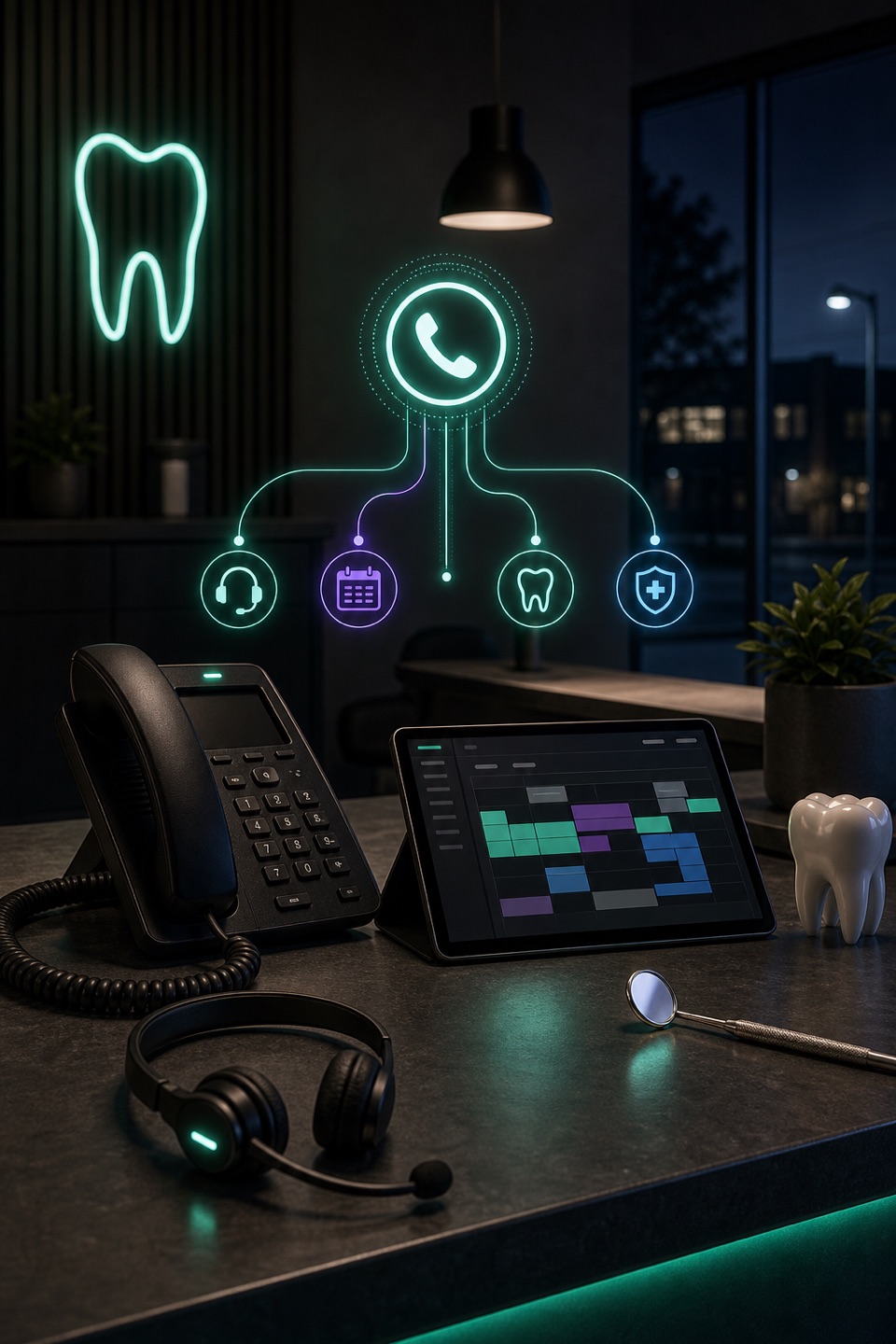
After-hours dental callers need a calm first answer and a credible next step. The right dental answering service captures urgent intent, avoids clinical advice, and gives staff a cleaner path before the caller keeps searching.
Read resource
Emergency dental callers need a calm first answer, not a generic voicemail. The right call path captures same-day intent, avoids clinical advice, and gives staff a cleaner next step before the patient keeps searching.
Read resource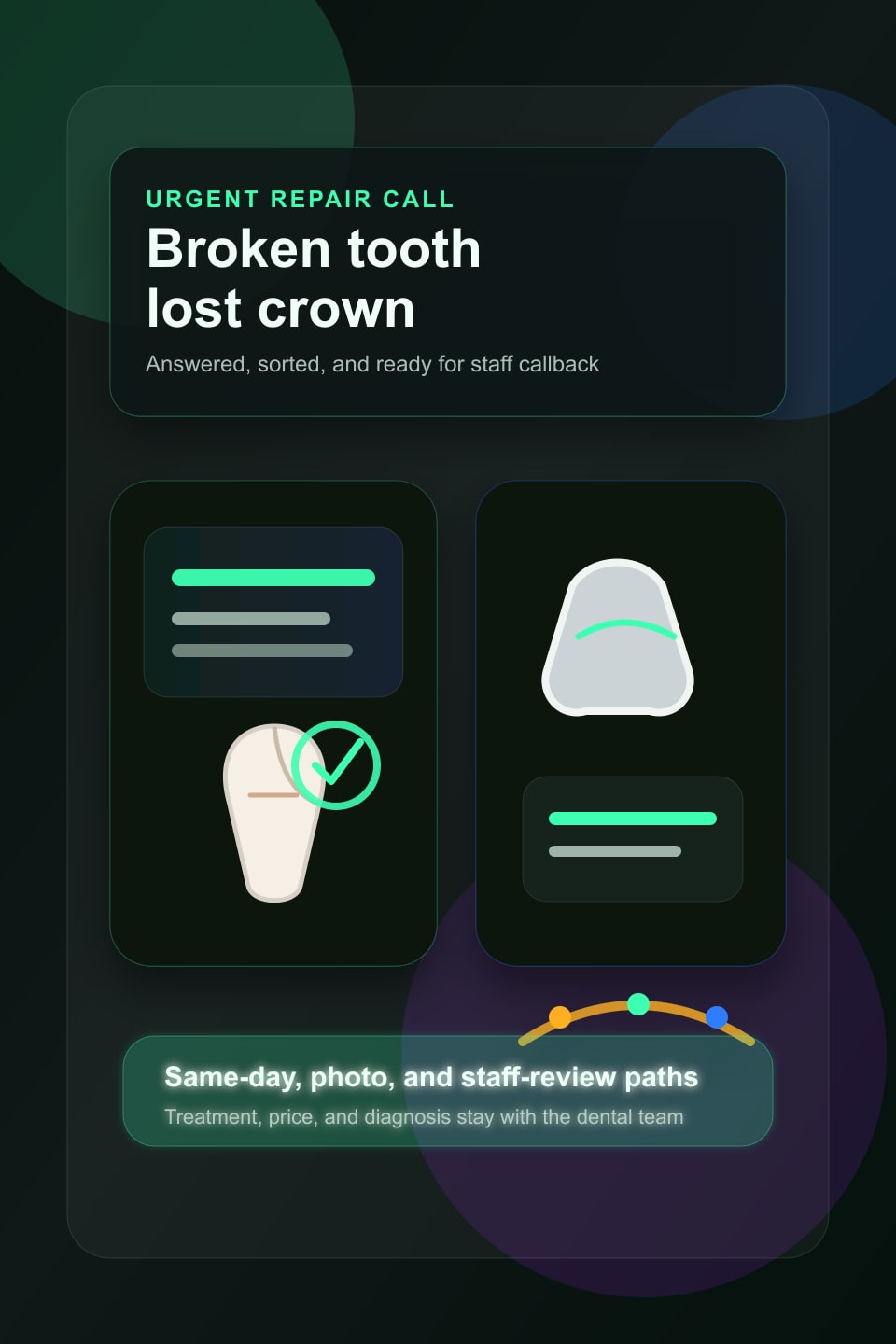
Broken-tooth and lost-crown callers are deciding fast. A broken tooth answering service captures what happened, pain or photo context, same-day timing, and staff-only questions before the caller keeps searching.
Read resourceThese references support the phone demand, local search, and response speed claims above.
MouthHealthy / American Dental Association • Accessed 2026-05-14
ADA patient guidance explaining what to do for dental emergencies, including toothaches, cracked teeth, knocked-out teeth, swelling, and the importance of contacting a dentist or emergency room promptly.
Open sourceAmerican Dental Association • Accessed 2026-05-14
ADA practice-management guidance stating that dentists must be available for patients of record when emergencies occur and that staff should be trained in basic triage and after-hours emergency handling.
Open sourceAmerican Dental Association • 2026 • Accessed 2026-05-13
ADA patient-intake guidance for dental practices covering answer speed, phone scripts, emergency handling, and first-appointment call flows.
Open sourcePeerlogic • 2026-03-30 • Accessed 2026-05-13
Case study covering 4,280 calls across a 26-practice dental group in February 2026 with answer-rate, conversion, and recovered-revenue benchmarks.
Open sourceAmerican Dental Association • Accessed 2026-05-14
ADA evidence-based guideline page for urgent management of pulpal- and periapical-related dental pain and intraoral swelling, emphasizing professional evaluation and guideline-based treatment decisions.
Open sourceNCBI Bookshelf / StatPearls • 2022-12-07 • Accessed 2026-05-13
Clinical reference describing dental emergencies as traumatic, infectious, or post-procedural, with pain as a common presenting complaint and serious untreated infections as a risk.
Open sourceCareCredit • Accessed 2026-05-14
CareCredit dental procedure cost guide covering common exam, filling, extraction, crown, root canal, and other dental procedure cost ranges that can inform conservative first-visit value modeling.
Open sourceAmerican Dental Association • Accessed 2026-05-12
ADA practice-management script resource covering prospective-patient phone calls, including urgent needs, emergency treatment language, scheduling context, and caller handoff structure.
Open sourceAmerican Dental Association • 2026-03 • Accessed 2026-05-14
ADA practice guidance explaining that complete, accurate medical and dental health history is essential before diagnosis or treatment, and that dentists are responsible for obtaining, maintaining, and reviewing current histories.
Open sourceAmerican Dental Association • Accessed 2026-05-14
ADA patient-intake guidance explaining that a new patient's first visit sets the tone for the future relationship and that warm, organized first impressions build comfort and confidence.
Open sourceU.S. Bureau of Labor Statistics • 2025-08-28 • Accessed 2026-05-14
BLS Occupational Outlook Handbook profile explaining that dental assistants provide patient care, take x-rays, keep records, and schedule appointments, with duties varying by state and dental office.
Open sourceInvoca • 2025 • Accessed 2026-05-14
Invoca benchmark report based on AI analysis of more than 60 million phone calls in consumer services.
Open sourceInvoca • 2025-08-18 • Accessed 2026-05-16
Invoca analysis showing live answer-rate benchmarks across industries and calling behavior for high-stakes purchases.
Open sourceBrightLocal • 2025 • Accessed 2026-05-16
Survey of 1,000 US consumers about general and local search behavior, maps usage, and business information expectations.
Open source