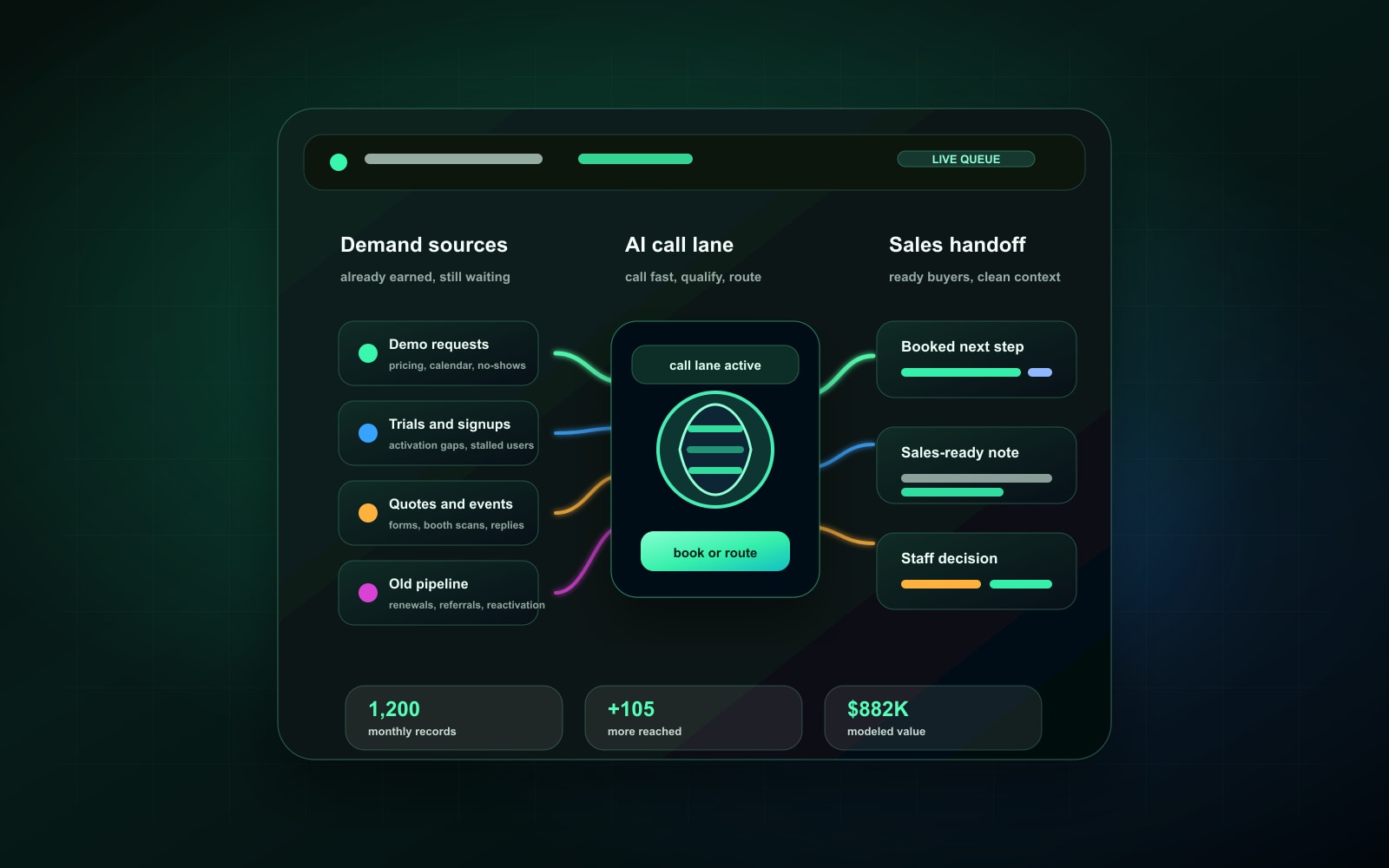
Start with the buyer signal and the source proof
The list is not the strategy. The buyer signal is. A demo request, quote form, webinar registration, missed call, renewal signal, no-show, referral, trial, or stale opportunity already says something about timing and intent.
The first approval question is whether the team can point to the source: CRM field, form timestamp, event scan, prior reply, quote file, property ticket, staffing record, or another record that explains why the buyer still expects follow up.
A good AI sales call turns that signal into a useful next step: book the demo, recover the quote review, confirm the event callback, route the franchise lead, rebook the no-show, or send a staff-ready summary.
- What did they do? Demo, quote, trial, event, estimate, referral, renewal, no-show, or old opportunity.
- What proves it? Source record, date, owner, source system, and buyer action.
- Why call now? Intent is fresh, the next step is obvious, or staff capacity is the bottleneck.
More details
- What is useful? Book, rebook, qualify, answer basics, collect missing context, or summarize for staff.
- Where should AI stop? Opt out, wrong person, suppression match, low fit, staff-only concern, or unclear source.
- What proves it worked? Reached buyers, booked next steps, useful handoffs, show rate, and closed value.
Make the call feel earned
Speed only helps when the opener earns the conversation. The call should clearly connect to a real buyer signal: a form, event, quote, missed call, renewal, trial, no-show, referral, or prior conversation.
The plan should define the source proof, source reference, caller identity, next-step offer, allowed answers, prohibited promises, opt-out handling, sender limit, and staff handoff. That gives the AI enough context to be useful without improvising.
- Who is calling and on whose behalf
- What the buyer already did
- Why the timing matters now
More details
- What the AI employee may ask, answer, book, or summarize
- What must go to staff without an answer
- How opt outs and do-not-contact requests are recorded
Write the stop path before the opener
Start with one approved approved outbound call plan checklist source and staff owner. Confirm contact, suppression, routing, and staff-review rules before expanding.
Permanent suppression is first in the operating order. Exact suppressed contacts are removed before enrichment, scoring, or dialing, even when another data source later says the contact looks reachable.
The FTC describes the National Do Not Call Registry as a way for consumers to tell companies they do not want most telemarketing sales calls and robocalls. The same operating mindset should govern entity-specific stop requests, internal suppression lists, source-specific rules, and staff review.
- Check whether the source, relationship, and contact rule support the call
- Filter permanent bounce suppression, do-not-contact, internal suppression, duplicate, stale, and source-unclear records before enrichment or dialing
- Give a clear stop path when someone does not want further calls
- Record opt outs where staff can enforce them before the next campaign block
Treat AI voice trust as part of the product
AI voice changes the trust bar. The FCC announced in 2024 that AI-generated voices are artificial under the TCPA for robocall enforcement. That does not mean every useful follow-up path is prohibited; it means the business must design the call path around current rules, consent posture, and legal review.
A practical launch keeps the call source, disclosure, opt-out path, caller ID, staff owner, and prohibited topics visible before call volume expands.
- Review TCPA, DNC, TSR, state calling rules, source-specific consent posture, and customer language before launch
- Avoid spam framing, deceptive identity, vague lead sources, guaranteed-meeting claims, and pressure language
- Use defined stop lines for legal, medical, insurance, mortgage, hiring, pricing, coverage, billing, or safety questions
- Keep outreach logs, opt outs, staff handoffs, and source notes connected to the list
Give staff the ending, not another loose thread
Outbound AI should not just place calls. It should return a note that a human can use without restarting the conversation.
The handoff should show the buyer story: source, reason to call, response, qualification context, requested next step, opt-out status, and staff-only question. For regulated or judgment-heavy categories, that handoff is the product.
- SaaS: demo source, use case, team size, timeline, security or procurement question, and preferred meeting window
- Insurance: line of business, current carrier, renewal date, bundle interest, documents, and licensed-staff question
- Staffing candidate: role interest, shift, location, pay range, availability, skills, and recruiter-only issue
More details
- Staffing client: job order, headcount, shift, start date, interview feedback, assignment blocker, and account-manager-only issue
- Home services: project type, photos, address, timing, estimate need, safety concern, and staff-only pricing or scope question
Model the story before you model revenue
A useful first model does not need every downstream metric. Start with monthly known-source records, qualified response rate, lift from faster follow up, and weighted value per protected next step.
For planning, 1,000 known-source records x 32 percent qualified response x 20 percent lift x $250 weighted next-step value equals about 64 protected next steps and $16,000 in monthly modeled value. Replace every input with real source, connect, show, close, and opt-out data as soon as the path is live.
- Known-source records by source and date
- Attempts, connects, qualified conversations, opt outs, and staff-review handoffs
- Booked demos, quote reviews, estimate appointments, interviews, consultations, or callbacks
- Show rate, close rate, revenue, retention, or pipeline value after staff completes the human-owned step
Map each story to the right sales lane
The same checklist should lead to different call plans by vertical and by buyer story. Signup backlog follow up, lead response capacity, SaaS demo follow up, insurance quote follow up, staffing candidate follow up, staffing client job-order follow up, event follow up, franchise local follow up, agency prospect follow up, home-services estimate follow up, mortgage lead response, real estate lead response, open-house and seller valuation follow up, and property management follow up all need different stop lines and handoffs.
For quote-heavy lanes, the source split matters before the opener. Insurance quote shoppers need producer-ready context, contractors need estimate-ready notes, franchises need the right location owner, agencies need proposal context, and event teams need group or sponsor detail before staff handles price, coverage, terms, or scope.
Use this guide as the shared operating model, then pick the vertical page that matches the actual source proof and reason to call.
- Signup backlog from demo requests, trials, quote forms, events, estimates, consultations, renewals, no-shows, and reactivation lists
- SaaS demos, trials, webinar leads, and demo no-shows
- Insurance quote shoppers, renewal-risk accounts, bundle reviews, and quote no-shows
More details
- Franchise local leads, quote forms, wrong-location requests, no-shows, and inactive customers
- Candidate callbacks, interview confirmations, document reminders, redeployment lists, and client job-order follow up
- Event registrants, booth scans, sponsor inquiries, and no-show follow up
- Real estate portal leads, open-house visitors, seller valuation forms, sign calls, referrals, and stale CRM records
- Property management resident updates, vendor access, owner callbacks, no-access visits, photo proof, and maintenance status
- Home-services estimates, project photos, stale quotes, and appointment reschedules
Keep the approval receipt small enough to audit
The approval receipt should be short, concrete, and reviewable before the first block of calls runs. It is not a campaign brief. It is the minimum proof that the call has a known source, a clean gate, a measurable next step, and a staff owner.
Use the receipt to keep launch conversations disciplined. If the team cannot fill in the source record, suppression result, opt-out state, allowed opener, stop lines, handoff owner, and success metric, the lane is not ready for more volume.
This receipt also helps buyers compare lanes without turning the page into a dense link list. The demo, quote, event, staffing, property, franchise, real estate, and home-services paths can all point back to the same four checks while keeping their own staff-owned boundaries.
- Source: record type, date, source system, source owner, and buyer action.
- Gate: permanent suppression, bounced-email suppression, opt-out, do-not-contact, contact window, sender limit, and source-age result.
- Value: the one booked, rebooked, routed, recovered, or staff-ready next step being measured.
- Owner: the human team member who keeps pricing, approvals, regulated advice, negotiation, scope, exceptions, and closing.
Use the page in outreach
Lead with the operator pain: the business already has high-intent records, but follow up is late, inconsistent, or missing the context staff need.
The offer is a short call-plan review and a live demo built around one buyer source, one reason to call, one stop path, and one staff handoff. Do not sell blanket dialing, guaranteed meetings, guaranteed revenue, or compliance without review.